

The Quadient iX-6 is a larger connected franking system offered in HF and AF configurations. Its attraction is not simply a higher printing speed: feeding, weighing, sealing and reporting choices can change how much handling remains in a busy office or mailroom.
The right comparison starts with the exact configuration and a timed batch of your own mail. This review separates the UK specification from optional features, explains the difference between HF and AF, and uses clearly labelled cost models where the manufacturer requires a quotation.
Quadient iX-6 HF vs AF
| Feature | iX-6 HF | iX-6 AF |
|---|---|---|
| Feeding description | Semi-automatic / power-assisted hand feeding | Automatic feeding |
| Main operational distinction | Operator continues presenting items | Feeder handles a prepared stack within its supported limits |
| Family advertised maximum | Up to 110 letters per minute; confirm exact configuration | Up to 110 letters per minute; confirm exact configuration |
| Dimensions in UK brochure | 905 × 416 × 306mm | 1,121 × 416 × 306mm |
| Weight in UK brochure | 13.1kg | 21kg |
| Best demonstration | Individual handling and mixed-item work | Stack feeding, replenishment, exceptions and output handling |
The official UK iX-6 brochure and UK product page distinguish the two feed types. The family’s maximum speed should not be treated as a guarantee that every HF or AF package achieves an identical real-world rate with every mail mix.
HF can suit an office where individually presented work remains manageable. AF can reduce repeated presentation of envelopes, particularly on substantial batches. Neither description establishes that every optional scale, sealing function, software feature or accessory is included in a particular quote.
- Takes 2 minutes
- Receive quotes to compare
- Easy and no commitment
Other UK specifications to check
| Capability | UK brochure information |
|---|---|
| Touchscreen | 7.5-inch vertical display |
| Physical envelope thickness | Up to 12mm |
| Label handling | Integrated label dispenser |
| Weighing | Piece-by-piece weighing; stack-weighing options available |
| External scale capacities listed | 3kg, 5kg, 8kg, 10kg and 35kg |
| Accounts | Up to 300; confirm licensed package |
| Favourites | Nine |
| Advertising messages | Ten |
| Reporting | S.M.A.R.T. Online bundled; S.M.A.R.T. Essential optional |
| Connectivity | LAN standard; Wi-Fi optional |
| Sealing | Confirm the optional sealing configuration |
The specification table is more useful than assuming a photograph shows everything supplied. Ask the supplier to annotate the quote with “included”, “optional” or “not supported” against each required function. If sealing or stack weighing is essential, have it demonstrated on the proposed configuration.
The 12mm physical envelope allowance does not redefine Royal Mail’s postal formats. An envelope can pass through the machine while requiring large-letter rather than letter postage. Thickness, length, width, weight and the selected postal product all need checking.
How much does the Quadient iX-6 cost?
The current official UK information reviewed uses a quotation process rather than publishing a fixed purchase or rental price. There is therefore no verified new-machine manufacturer tariff to insert here. HF and AF quotations also need comparable scales, software, service and contract terms before their prices can be assessed fairly.
Ask for purchase, rental or finance routes where available. Each offer should identify the equipment condition, feeder, weighing arrangement, sealer, tray or stacker, connectivity, installation, training and software. Request the total payable and actual payment schedule rather than relying on a weekly headline.
- Give your requirements
- Receive quotes to compare
- Choose a provider or walk away - your choice!
An apparently small monthly difference grows over a long contract. The following illustrative AF premiums are assumptions, not Quadient quotes. They compare the extra cost only, and exclude any initial charges or contractual price increases.
| Assumed monthly AF premium | Annual difference | Five-year arithmetic difference | Time needed monthly at assumed £18/hour |
|---|---|---|---|
| £30 | £360 | £1,800 | 1 hour 40 minutes |
| £60 | £720 | £3,600 | 3 hours 20 minutes |
| £90 | £1,080 | £5,400 | 5 hours |
Replace the premium and hourly assumption with actual figures. Released staff time is not automatically money removed from payroll. It becomes a direct cash saving where it avoids overtime, agency support, outsourced work or another identifiable expenditure.
A practical HF-versus-AF time model
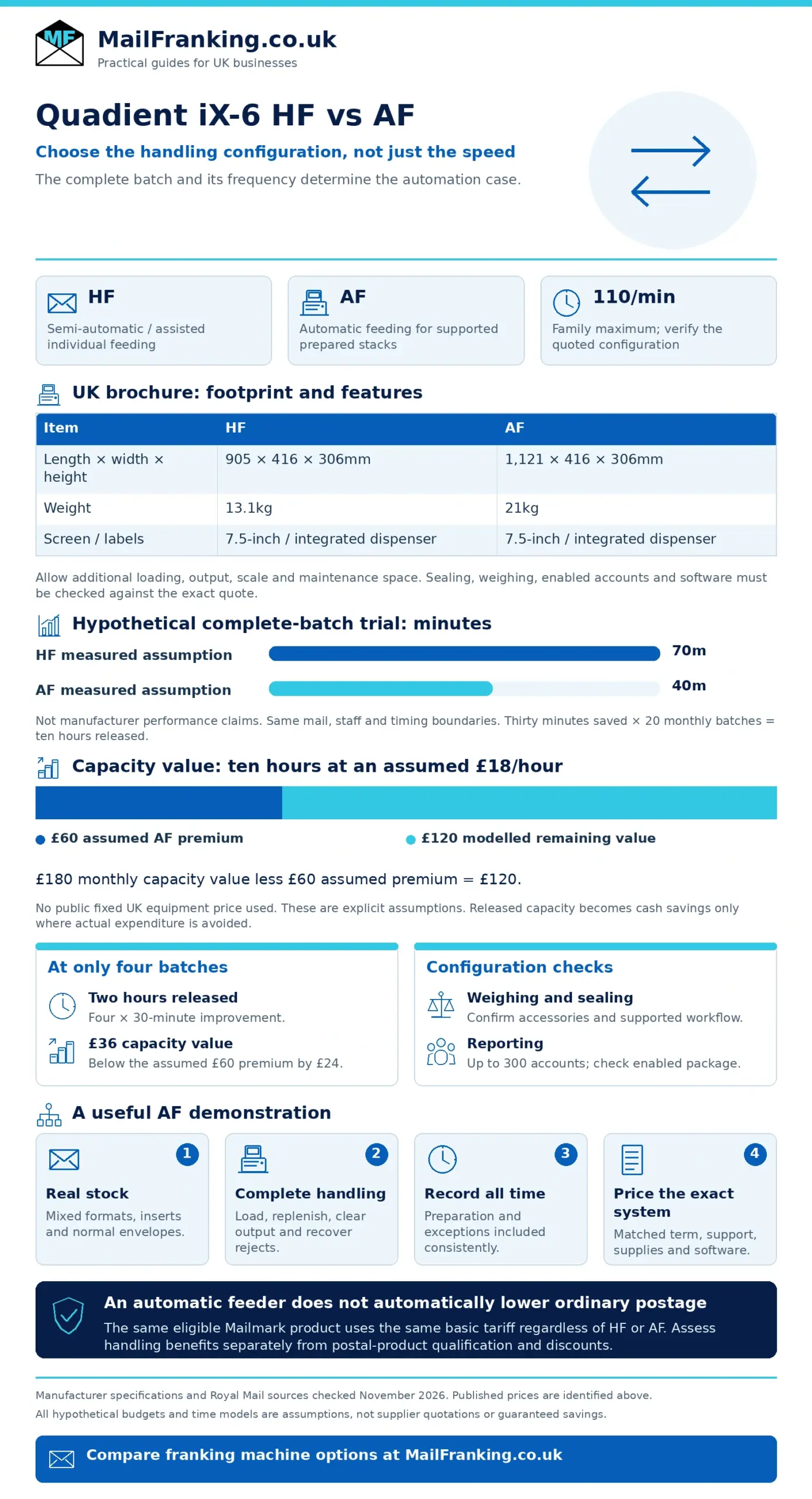
Suppose a real-mail demonstration measures a complete recurring batch at 70 minutes on HF and 40 minutes on AF. Those are hypothetical measured outcomes for this example, not manufacturer performance claims. The difference is 30 minutes per batch, including the same preparation boundaries in both trials.
At 20 such batches per month, AF releases ten hours. At an assumed £18 per hour, that represents £180 of capacity value. Deducting an assumed £60 monthly premium leaves £120 of modelled benefit before any other differences. Whether that becomes cash depends on how the time is actually used.
| Worked demonstration model | HF assumption | AF assumption |
|---|---|---|
| Complete time per comparable batch | 70 minutes | 40 minutes |
| Batches per month | 20 | 20 |
| Monthly time | 23 hours 20 minutes | 13 hours 20 minutes |
| Difference | 10 hours released | £180 capacity value at £18/hour |
If there are only four batches monthly, the same 30-minute improvement releases two hours, worth £36 under the assumption. A £60 premium would then exceed the modelled capacity value by £24. Frequency matters as much as the time saved per batch.
At the family maximum of 110 per minute, 2,500 envelopes represent roughly 22 minutes 44 seconds of continuous processing. That is an ideal printing-stage calculation, not a promise for a mixed mailroom job. Preparation, weighing, replenishment and exceptions can dominate the actual result.
Test the complete feeding process
Prepare a representative sample using the envelopes, inserts and postal classes your team normally handles. Include the awkward items that cause interruptions. A demonstration built entirely from uniform thin envelopes can overstate the benefit for a business sending mixed document packs.
Record who loads, replenishes and clears the feeder, how staff handle different formats and how rejected or interrupted items are recovered. Ask what happens after a double feed, a depleted balance or a service change. Measure the restart process as well as the uninterrupted run.
If sealing is included, test your actual envelope stock and flap styles. Confirm consumables, cleaning and any seal-only mode required. A feeder that works well with one envelope may behave differently with another, so written compatibility information and a practical trial are valuable.
Automatic feeding does not necessarily remove document printing, folding and inserting. If those stages consume most of the labour, consider the broader mailroom process. Our high-volume franking guide explains why franking capacity and document-production capacity need to be balanced.
Weighing, labels and parcel work
Stack or differential weighing can reduce repeated manual actions in a mixed batch, but confirm the exact option, scale and supported process. Ask the operator to demonstrate removing an item, selecting its service and returning to the next one without losing the correct account or product.
For heavy or bulky items, an external platform may be more practical than an integrated weighing position. Select a capacity appropriate for the finished package and ensure it rests freely. The fact that a 35kg option is listed does not mean every quoted system includes it or every postal service accepts that weight.
The integrated label dispenser is useful for items that cannot be printed directly. Establish which labels are compatible and what they cost per usable item. An envelope postage label is not automatically the same as a tracked parcel shipping label with an electronic shipment record.
If parcels are a major part of your work, ask for an explicit product and software list. Test order entry, tracking references, reprints and international customs processes where relevant. Compare the exact workflow with online shipping rather than assuming that a larger franking machine necessarily gives cheaper parcel postage.
Reporting, permissions and network requirements
The UK brochure lists up to 300 accounts. Confirm the number enabled, any upgrade or subscription cost and how access is controlled. A large potential account count is only useful if the reports and operator process match your organisation’s cost-allocation requirements.
Request a sample report for several departments, including adjustments and exceptions. Check export formats, retention and reconciliation with the postage account. Staff selecting the wrong cost centre can undermine otherwise capable reporting, so include training and a regular checking process.
S.M.A.R.T. Online and optional S.M.A.R.T. Essential should be compared feature by feature in the quote. Ask which dashboard functions are included, what happens if a subscription ends and who can access the data. Avoid treating every screen shown during a demonstration as a standard entitlement.
LAN is standard and Wi-Fi optional in the cited UK brochure. Have your IT team check the actual network requirements before installation. Agree responsibility for connectivity faults, security changes and moving the device, plus a practical alternative for urgent post if the system is unavailable.
Space and installation
The AF footprint is longer and the system heavier than HF: the brochure lists 1,121mm versus 905mm length and 21kg versus 13.1kg. Both need additional operational clearance for loading, output, scales and access. Measure the working area with the full proposed configuration, not just the base unit.
Consider the route into the room, the support surface and where incoming and completed mail will sit. An inefficient desk arrangement can consume part of the handling benefit. Check access to power, the network and consumables without blocking normal movement around the workstation.
Installation should include configuration of accounts, rates and software, a working postage download and a trial batch. Train a backup operator and retain clear support details. Agree who signs off acceptance and what happens if the installed system does not perform the demonstrated workflow.
Postage and running-cost checks
For the same eligible Mailmark product, buying AF rather than HF does not by itself reduce the ordinary postal tariff. Current ordinary letters up to 100g are £1.77 for 1st Class and 88p for 2nd Class under the October 2026 Mailmark tariff, each 3p below the corresponding stamps.
Some large-letter comparisons offer larger savings, while separately qualifying bulk-mail products have their own conditions and VAT treatment. If your volumes are substantial, assess Business Mail Advanced eligibility carefully. A monthly total does not automatically make every posting a qualifying batch.
Obtain ink, labels, sealing supplies, funding charges and service costs for each proposal. Request the same annual volume assumptions from every supplier, including how many items print directly onto envelopes and how many use separate labels, to avoid comparing incompatible consumables estimates. Check yield assumptions and avoid double-counting items included in a bundle. Use the same VAT basis for alternatives, reflecting the business’s actual ability to recover relevant input VAT.
Service cover should define response, repair, replacement, parts, labour and exclusions. At larger volumes, downtime planning matters: a loan machine or alternative posting route may be worth more than a vague fast-response promise. Record escalation contacts and responsibilities before an outage occurs.
Our assessment
HF deserves consideration where a capable larger system is needed but individual presentation remains manageable. AF is more compelling where tested stack handling removes substantial repetitive work. The useful question is how many minutes the complete process saves at your actual batch frequency.
This review uses published UK documentation and explicit budget assumptions, rather than hands-on testing or an undisclosed price quote. Compare the iX-4 if manual feeding remains acceptable, and require a clear whole-contract justification before paying for excess capacity. Written specifications and a representative demonstration should settle the decision.
Frequently asked questions
The UK brochure describes HF as semi-automatic and AF as automatic feeding. The practical difference is continued individual presentation versus supported stack handling. Confirm the exact feeder, sealing, weighing and output configuration, then time a representative batch. A shared family speed headline does not establish identical results for both packages.
The official UK information reviewed requires a quotation rather than publishing a fixed purchase or rental tariff. Request an itemised HF and AF comparison on matching specifications and terms. The premiums in this guide are explicitly hypothetical calculations, not advertised prices or evidence of what a supplier will charge.
The family is advertised at up to 110 letters per minute. Ask which quoted configuration and operating conditions support that figure. Complete jobs take longer because of preparation, weighing, loading, service changes and exceptions. Test the entire process and avoid treating an ideal continuous printing calculation as guaranteed throughput.
Do not assume so. The UK brochure lists sealing as a configuration to confirm, and a feeder and sealer perform different tasks. Ask what is included, which envelopes are supported and what consumables are required. Demonstrate your actual envelope stock before relying on a fully hands-off description.
The cited brochure lists HF at 905 × 416 × 306mm and AF at 1,121 × 416 × 306mm, with weights of 13.1kg and 21kg respectively. Allow additional room for scales, loading, completed mail and maintenance access. Measure the full quoted setup on suitable furniture before installation.
It can if measured time savings avoid real expenditure, such as overtime or temporary support. Otherwise the main benefit may be released staff capacity. Compare the complete premium with batch frequency, actual handling time and other running-cost differences. Do not convert every saved minute into an assumed payroll reduction.