
Business Mail Advanced is a Royal Mail option for qualifying business correspondence, including a route accessed through supported Mailmark franking machines. It offers volume-related prices, but a batch must meet the preparation rules and the VAT treatment can change whether it is worthwhile.
Do not judge the service by a headline discount alone. Compare the final qualifying charge, any VAT you cannot recover, the work needed to prepare the letters and the ordinary Mailmark postage you would otherwise pay. The value can differ sharply between 1st Class and 2nd Class.
This guide explains current published prices checked in November 2026, the meter-account adjustment process and practical eligibility checks. The examples assume clearly stated volumes and full qualification; they are not promises that every letter in a real batch will receive the quoted price.
What is Business Mail Advanced?
Business Mail Advanced, often shortened to BMA, is intended for suitable business correspondence processed to Royal Mail’s machine-readable standards. In the franking route, the meter and supplier’s account arrangements support the initial payment and later reconciliation of the final charge.
- Takes 2 minutes
- Receive quotes to compare
- Easy and no commitment
Do not confuse the Mailmark barcode printed by a franking meter with every Royal Mail product bearing “Mailmark” in its name. The Retail Letters price guide lists separate Advanced and Mailmark product codes. Use the row relevant to your actual service rather than choosing the lowest number from a neighbouring row.
Similarly, this is not a parcel discount. Royal Mail’s Business Mail guidance distinguishes transactional correspondence from goods. If your workload is online orders, compare parcel franking and shipping options instead of applying a business-letter rate to fulfilment items.
Who can use the franking route?
Start with a supported UK Mailmark meter and a supplier able to enable and administer the service. A machine’s ability to print ordinary Mailmark postage does not by itself establish that its particular configuration supports BMA. Obtain written confirmation and a demonstration from the supplier.
Pitney Bowes’ BMA guidance describes a minimum qualifying mailing of 250 standard letters of the same class to UK addresses, with suitable addressing and presentation in mail trays. Royal Mail’s technical guide provides the detailed construction and addressing requirements. Agree the correct process for your meter before preparing a large batch.
- Give your requirements
- Receive quotes to compare
- Choose a provider or walk away - your choice!
A monthly total is not the same thing as a qualifying posting. Sending 20 letters a day for several weeks does not automatically produce a 500-letter qualifying batch. Keep class, posting date, site and preparation requirements visible in the plan rather than adding unrelated work together to reach a target number.
Current published Advanced letter prices
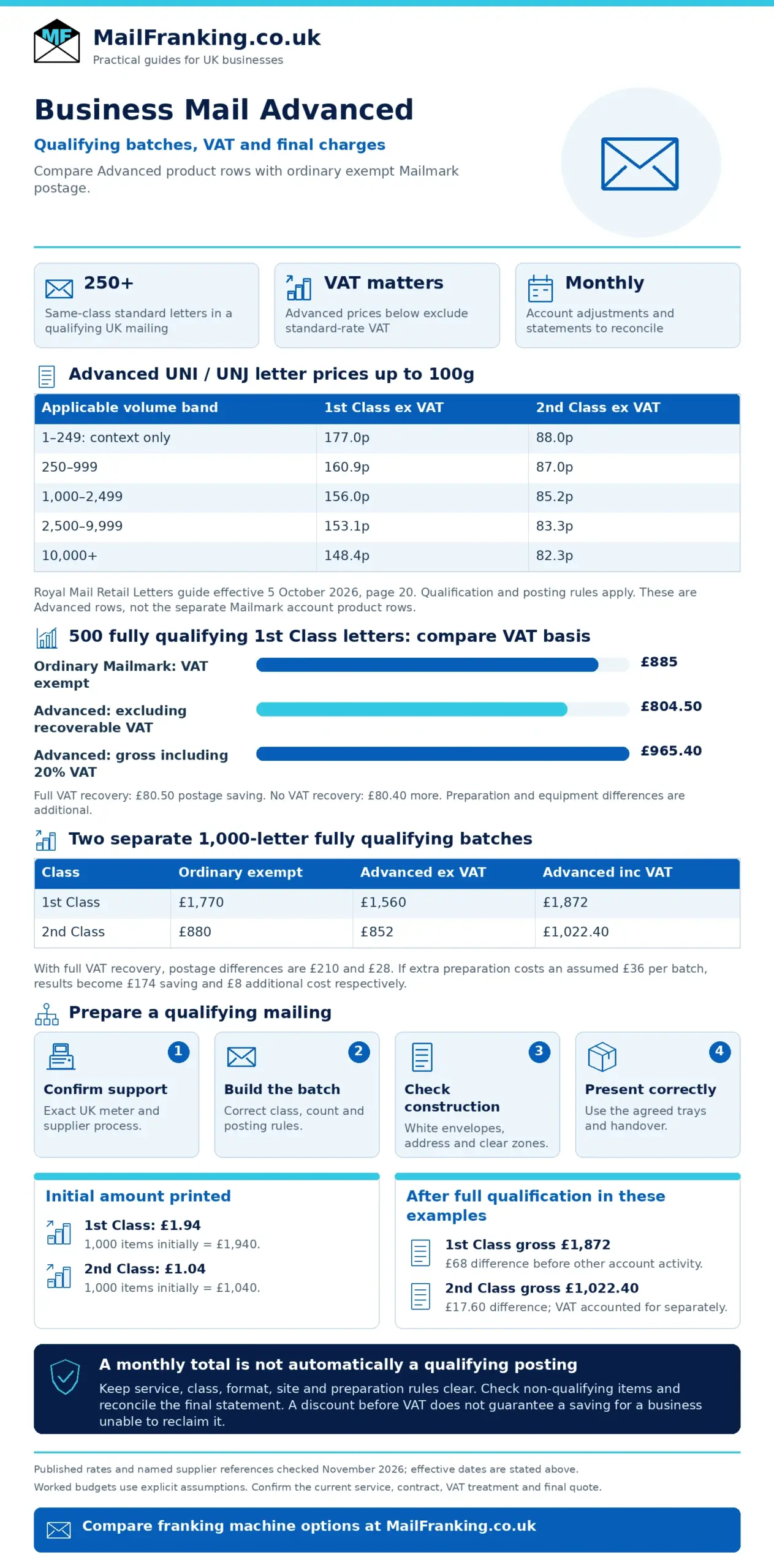
The following Advanced UNI and UNJ figures are from page 20 of Royal Mail’s Retail Letters price guide, effective from 5 October 2026. They apply to letters up to 100g in the stated volume bands and exclude VAT, charged at the standard rate.
| Items in the applicable volume band | 1st Class Advanced UNI, excluding VAT | 2nd Class Advanced UNJ, excluding VAT |
|---|---|---|
| 1–249 | 177.0p | 88.0p |
| 250–999 | 160.9p | 87.0p |
| 1,000–2,499 | 156.0p | 85.2p |
| 2,500–9,999 | 153.1p | 83.3p |
| 10,000+ | 148.4p | 82.3p |
The 1–249 row is shown for context, not as a claim that a small batch earns a volume discount. Royal Mail’s guide states that items qualifying for a volume price must meet the service, class, format and order requirements. Ask your supplier how the applicable franking posting is counted and reconciled.
Ordinary standard Mailmark franking is £1.77 for a 1st Class letter and 88p for a 2nd Class letter up to 100g, exempt from VAT under the Mailmark wallchart. Those figures provide a useful comparison baseline, but they do not have the same tax treatment as the Advanced prices above.
Why VAT changes the answer
Take a qualifying batch of 500 1st Class letters at 160.9p excluding VAT. Adding 20% produces 193.08p per letter. A business that can recover all that VAT compares the 160.9p net charge with ordinary exempt postage of 177p; a business unable to recover it compares 193.08p with 177p.
| 500 qualifying 1st Class letters | Calculation | Cost |
|---|---|---|
| Ordinary Mailmark postage | 500 × £1.77 | £885.00 |
| Advanced charge excluding VAT | 500 × £1.609 | £804.50 |
| VAT at 20% | £804.50 × 20% | £160.90 |
| Advanced charge including VAT | £804.50 + £160.90 | £965.40 |
On these assumptions, a business recovering all relevant VAT saves £80.50 on postage before preparation and equipment differences. A business unable to recover VAT pays £80.40 more. Partial recovery produces an outcome between those positions; ask the accounts team to calculate the amount your business can actually reclaim.
This is why the label “discounted” is not enough. Use the right tax basis and the same alternative service. Do not deduct VAT from exempt ordinary postage, and do not compare a gross Advanced debit with a net supplier quotation without explaining the difference.
Worked example: 1,000 letters of each class
Assume two separate fully qualifying 1,000-letter batches, one 1st Class and one 2nd Class. Use the 1,000–2,499 band for each, rather than combining the classes to choose a different tier. The illustration isolates postage and leaves equipment and preparation costs for a separate check.
| Batch | Ordinary exempt Mailmark | Advanced excluding VAT | Advanced including VAT |
|---|---|---|---|
| 1,000 1st Class letters | £1,770.00 | £1,560.00 | £1,872.00 |
| 1,000 2nd Class letters | £880.00 | £852.00 | £1,022.40 |
With full VAT recovery, the illustrative postage savings are £210 on the 1st Class batch and £28 on the 2nd Class batch. Without VAT recovery, the Advanced gross costs are £102 and £142.40 higher respectively than the ordinary alternatives shown. This calculation uses the current published figures, not a general claim about every future tariff.
Now allow an illustrative £36 of additional preparation effort for each batch. The fully VAT-recovering 1st Class saving falls to £174; the 2nd Class comparison becomes £8 more expensive. Replace £36 with measured work and avoid charging time twice if it is already included in your normal letter preparation.
The initial franked amount is not the final price
The current Retail Letters guide lists an initial BMA franked price of £1.94 for 1st Class and £1.04 for 2nd Class letters up to 100g, including VAT. It describes the subsequent account credit or debit based on qualifying and non-qualifying items, with monthly VAT and franking-account statements.
For a fully qualifying 1,000-letter 1st Class example, the initial amount is £1,940. The calculated final gross charge at 156p excluding VAT is £1,872, leaving a £68 difference before other account activity. The VAT-recoverable amount is then considered separately; the £68 adjustment is not the whole economic saving against ordinary postage.
For the equivalent 2nd Class example, £1,040 initially franked compares with £1,022.40 gross after qualification, a £17.60 difference. These examples explain the arithmetic, not the exact posting or invoice rounding of every supplier system. Reconcile the actual statement rather than assuming every expected credit has arrived.
What if some letters fail to qualify?
Addressing, print quality, construction and presentation can affect the result. A letter that fails the relevant checks may receive a different final charge. Ask the supplier how non-qualifying items are identified, how they affect the applicable volume assessment and where the adjustment appears.
Royal Mail’s guide separately lists non-qualifying BMA figures and their tax basis. Do not assume the difference between the amount printed and an ordinary exempt tariff is automatically your refund. Use the supplier’s statement and the current product rules to establish what was charged and why.
Keep a sample of the approved envelope design and compare it with actual production. If a new printer moves the address, or an extra insert changes thickness, the fact that the previous batch qualified is not proof that the new version will qualify. Recheck material changes before a large posting.
Prepare the envelopes and addresses correctly
Royal Mail’s Advanced technical guide covers indicia, addressing, fonts, print quality, clear zones, construction and physical properties. It states that franking customers using BMA must use white envelopes. Use the full current specification for production design rather than relying on a short checklist alone.
The supplier’s summary gives standard-letter dimensions from 145 × 110mm to 240 × 165mm, with thickness from 0.25mm to 5mm. This is more specific than simply fitting an ordinary letter’s maximum size. Check the entire finished item, including the effect of folded inserts and window placement.
Addresses should be machine printed, correctly positioned and suitable for matching to Royal Mail’s address data. Keep required clear areas free of logos, slogans and other printing. A design can look attractive to a person while still obstructing the automated reading process that underpins the service.
Plan the batch and handover
Separate eligible letters by class and prepare them using the agreed trays and posting process. Confirm what information must be supplied, how the meter communicates its records and who is responsible for resolving a mismatch. Retain the date, class, item count and job reference for each batch.
If work comes from several offices, establish the rules for each posting site rather than assuming that volumes can be pooled without qualification. Likewise, ask about multiple runs or collections on one day. The operational treatment matters more than the total displayed on a monthly spreadsheet.
For busy operations, select equipment based on the whole task: envelope preparation, feeding, weighing, printing and tray handling. Our high-volume machine guide explains why a headline letters-per-minute figure is not the same as completed-batch throughput. Use the feeding and batch-time guide to measure preparation capacity. The iX-6 configuration review illustrates why HF and AF handling must be distinguished, but confirm Advanced-product support separately with the provider.
Reconcile discounts and account adjustments
Create an expected batch record before comparing it with the supplier statement. Show the initial debit, qualifying count, applied band, final net charge, VAT, adjustment and any exceptions. Match these entries using the supplier’s reference rather than relying only on the month-end account total.
Keep the statement needed to support any VAT recovery and ask the accounts team to review partial-recovery situations. A credit in the postage account may remain available for future mailing rather than arriving in your bank. Our postage credit guide explains the different balances.
If an expected adjustment is missing, query the identified batch with the supplier. Provide the meter details, date, class and count through its support process. Do not attempt to recreate a discount by manually entering a lower postage amount on the next mailing.
When is Business Mail Advanced worth considering?
It deserves a comparison when you send qualifying transactional letters in suitable batches, can produce compliant mail reliably and understand the VAT position. A fully VAT-recovering business sending repeated 1st Class batches may have a stronger postage case than a low-volume sender whose mail is mostly 2nd Class.
Also compare whether a less urgent service is appropriate before optimising the payment method. Changing a genuine deadline requirement is different from obtaining a franking discount. If outsourcing the physical production is an option, compare hybrid mail with franking using the complete cost of the same documents.
Ask shortlisted franking suppliers to price and demonstrate your actual batch. Request written confirmation of meter support, preparation rules, funding, adjustment reporting and complete equipment charges. Choose on verified net benefit and a manageable process, not on a headline bulk-mail percentage.
Frequently asked questions
The supplier guidance for the franking route describes at least 250 standard letters of the same class in a qualifying UK mailing. Other preparation and addressing conditions apply. A monthly total spread across unrelated small postings does not automatically create one qualifying batch or a higher discount band.
Do not assume so. Confirm the exact UK meter, configuration and supplier account arrangements before buying or enabling the service. Ask for a demonstration of the correct product selection and adjustment reporting. Ordinary Mailmark postage capability alone does not establish that the proposed BMA workflow is available.
The cited Advanced rates exclude VAT, which the price guide states is charged at the standard rate. Ordinary standard Mailmark postage is exempt. Compare recoverable net amounts if your business can reclaim VAT, or gross costs if it cannot. Partial recovery needs a business-specific calculation.
Royal Mail’s guide specifies initial BMA franked amounts and later account adjustments based on qualification. Monthly statements show the resulting charges and VAT. Reconcile the initial debit, final charge and credit or debit separately; the adjustment alone is not the full saving against ordinary postage.
No. The franking example in this guide concerns qualifying standard business letters. Goods and fulfilment parcels need appropriate parcel services and their own prices, labels and data. Do not apply a business-correspondence discount simply because a parcel can also be paid for using a franking machine.
No. VAT recovery, class, volume, preparation effort and qualification affect the result. On the current examples, a gross Advanced charge can exceed ordinary exempt postage for businesses unable to reclaim VAT. Compare the final complete cost for a representative batch before changing your mailing process.