
International franking lets a UK business pay for supported overseas postal services through its mailing equipment. It can suit regular correspondence and some parcels, but the machine does not replace customs declarations, electronic shipment data or checks on the destination and contents.
Choose the international service first, then confirm that your exact meter and supplier’s software can complete the required process. A low postage figure is useful only when the shipment also meets the service’s size, documentation, tracking and import requirements.
This guide uses Royal Mail prices and operational information checked in November 2026. It separates published postage from illustrative handling costs and explains the questions to ask before using a machine for international business mail.
What can you send using international franking?
Royal Mail’s franking guidance lists international services including Standard, Economy and tracked options. Availability depends on the destination and selected product, while the capabilities of an individual meter also need to be confirmed with its supplier.
- Takes 2 minutes
- Receive quotes to compare
- Easy and no commitment
Distinguish personal correspondence, business documents and goods. A paper invoice accompanying a commercial product does not turn the package into a document-only mailing. Likewise, a free sample can still be goods for customs purposes. Describe the contents accurately instead of choosing a category because it appears simpler.
A supplier demonstration should show the complete route: service selection, destination, weighing, paid impression, electronic customs submission, physical documentation and handover. If an additional online application is required, include its account setup, staff time and charges in the buying decision.
Published international franking prices
The examples below come from the Mailmark franking wallchart, effective from 5 October 2026. These are International Standard prices, not tracked-service quotations. Zones must be checked against the actual destination, and some routes or products may be unavailable.
| International Standard item | Destination group | Mailmark postage |
|---|---|---|
| Letter up to 100g | Europe or listed rest-of-world zones | £3.60 |
| Large letter up to 100g | Europe zones 1–3 | £3.80 |
| Large letter up to 250g | Europe zones 1–3 | £6.15 |
| Small parcel up to 250g | Europe zone 1 or 2 | £9.80 |
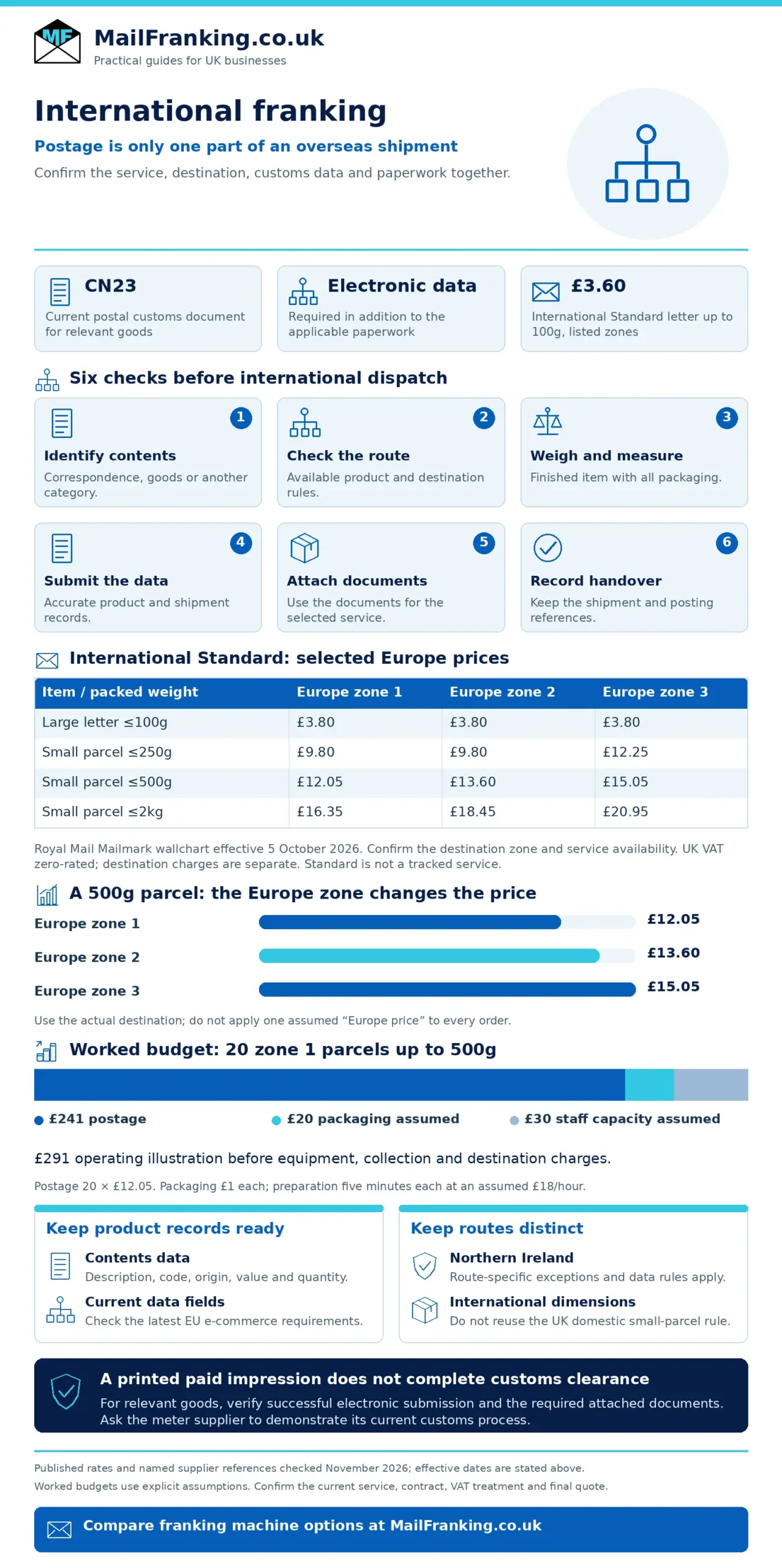
| Small parcel up to 500g | Europe zone 1 | £12.05 |
| Small parcel up to 500g | Europe zone 2 | £13.60 |
| Small parcel up to 500g | Europe zone 3 | £15.05 |
| Small parcel up to 2kg | Europe zone 1 | £16.35 |
| Small parcel up to 2kg | Europe zone 2 | £18.45 |
| Small parcel up to 2kg | Europe zone 3 | £20.95 |
The wallchart states zero-rate UK VAT for these EU and rest-of-world services and lists compensation up to £20, subject to conditions. Zero-rated UK postage does not mean the overseas recipient cannot face import VAT, duty or handling charges. Those are different parts of the transaction.
- Give your requirements
- Receive quotes to compare
- Choose a provider or walk away - your choice!
The same chart marks World Zone 3 International Standard small-parcel prices as unavailable. Do not substitute another world zone or assume a displayed international service is valid for every country. Obtain an available service for the actual route and check the current destination guidance before accepting an order.
Size and packed weight change the price
International small parcels have a different shape limit from standard domestic small parcels: the combined length, width and depth must not exceed 900mm, with no side longer than 600mm, within the stated product weight limit. Do not apply a UK domestic box rule automatically to overseas post.
Weigh the completed item with its packaging and documents. If the product is 480g before a box and protective material are added, it may not fit a 500g postage band. Record packed weights for repeat products, then sample-check them rather than relying on the original product listing.
Packaging changes can create savings, but the contents still need adequate protection. Compare a correctly protected large letter with a parcel only where the finished item genuinely fits the format. A damaged export can cost far more than the original postage difference through replacement, handling and customer support.
CN23 paperwork and electronic customs data
Royal Mail’s current postal customs guidance requires electronic customs data and the appropriate physical documentation for relevant international goods. Its October 2026 franking wallchart specifies a CN23 declaration and submission of electronic data through the franking supplier’s API. Ask the supplier how your staff access that process.
Treat these as two checks. A completed paper form does not demonstrate that electronic data has been submitted; an electronic submission does not demonstrate that the required paperwork is attached. Store the shipment reference and verify that the documents match the item and paid service.
Royal Mail’s Click & Drop customs instructions state that CN22 has been retired in that workflow. They also identify commercial service codes that use commercial invoices instead. Use the documents generated for the actual current product rather than copying an old online instruction that divides every shipment between CN22 and CN23 by value alone.
Northern Ireland needs particular care. Royal Mail identifies an exception for goods moving from Northern Ireland to the EU. Great Britain-to-Northern Ireland movements also have their own requirements. Establish the origin and destination explicitly rather than treating every UK dispatch address as the same customs route.
Prepare a reusable product data record
Create a checked record for each product you sell overseas. Useful fields include a precise description, commodity code, country of origin, unit value, quantity and packed weight. Keep the business’s sender details and any relevant tax or registration identifiers separately so they are not mistyped on every order.
“Accessory” is less useful than a description identifying the material and purpose. Similarly, the country where you bought an item is not necessarily where it was manufactured. Ask the person responsible for your product records to resolve uncertainty before the dispatch team is facing a collection deadline.
For affected EU e-commerce shipments, Royal Mail’s current Click & Drop guidance describes product SKU and non-standardised manufacturer ID requirements introduced in November 2026, with enforcement in the application from 26 October. Check that your order import contains the required information; marketplace imports do not necessarily populate every customs field.
An operational checklist should cover:
- Sender and recipient details, including the contact information required by the route.
- Accurate contents, quantity, value, origin and commodity classification.
- The correct commercial, e-commerce, returned-goods or other category.
- Tax, duty and fee payment arrangements for the chosen service.
- Successful electronic submission and the required attached documents.
- Current destination restrictions and any additional licences or certificates.
Who pays import taxes and fees?
Establish the payment arrangement before quoting a customer a delivered price. A service where the recipient pays import charges has a different customer experience from one where the sender pays them. The postage debit on your machine is not necessarily the whole landed cost.
For example, a seller advertising “delivery included” should decide whether that means carriage alone or also destination charges. If this is unclear, the buyer may be surprised by a payment request before delivery. Ask the shipping provider to explain the precise service and billing mechanism rather than relying on a general “international” label.
Avoid using an old universal low-value threshold as the basis for every shipment. Destination rules and Royal Mail’s available payment arrangements change. The most reliable operating process checks the live requirements for the country, goods category and value when selecting the service.
Worked cost example: 40 overseas letters
Assume an office sends 40 document-only letters up to 100g on a supported International Standard route at £3.60 each. Published postage totals £144. Add an illustrative 20p per item for envelopes and printing, and allow 45 minutes of total preparation time at an assumed £18 an hour.
| Cost component | Calculation | Example cost |
|---|---|---|
| Postage | 40 × £3.60 | £144.00 |
| Print and envelopes | 40 × £0.20 | £8.00 |
| Staff capacity | 0.75 hours × £18 | £13.50 |
| Combined operating illustration | Sum of the above | £165.50 |
The resulting £4.1375 per item is a modelled operating cost, not a Royal Mail price. It excludes equipment allocation and any separate collection cost. If the machine is bought solely for this work, add its full new cost; if already needed for domestic mail, identify the genuinely additional costs.
Worked cost example: 20 European parcels
Now assume 20 small parcels, each within 500g after packing, all going to a confirmed Europe zone 1 destination using International Standard. The published postage is 20 × £12.05, or £241. Allow £1 per parcel for packaging and five minutes of staff time per parcel at an illustrative £18 an hour.
Packaging adds £20 and preparation represents £30, producing a £291 operating illustration before equipment, collection, destination charges or exceptions. The five-minute allowance is an assumption to replace with a timed batch. Goods requiring extra checks may take longer.
If five of the parcels instead belong in Europe zone 3 at £15.05, the postage rises by £15. A single “Europe parcel price” would therefore understate the batch. Keep the destination zone and weight band visible in your spreadsheet so changes can be checked rather than hidden in an average.
When should you choose tracking?
Compare the risk of the contents and the evidence your business needs. For a low-value routine document, a standard service may be sufficient. For an order whose replacement would be expensive, check tracked and compensation options, exclusions and the evidence required if something goes wrong.
Do not describe International Standard as a fully tracked service. A paid impression and a dispatch record show that you prepared postage; they are not equivalent to end-to-end tracking or a delivery guarantee. Likewise, compensation limits are not the same as automatic reimbursement of every commercial loss.
Ask the supplier to demonstrate how the recipient receives the tracking number and how your team searches it later. If staff must manually copy identifiers into an order system, include that work in the comparison with online shipping tools. Our parcel franking guide covers the wider dispatch workflow.
Comparing a meter with online international postage
Use an identical sample basket for both routes: the same countries, packed weights, formats, service features and tax-payment arrangements. Add the machine’s service, supplies and funding costs to the franking side, and the actual printer and label costs to the online side.
Then run an exception test. Can you correct an address before printing? Cancel an unused label? Produce another copy of the customs document? Export a dispatch report for the accounts team? A route that works only for perfect orders can create expensive manual work once real customers start making changes.
Our franking vs Click & Drop comparison and savings calculator help with the domestic cost framework. International rates and customs handling should be entered as a separate calculation instead of borrowing a domestic saving percentage. The C vs Plus comparison shows the package checks to make where a meter is paired with shipping software. Ask for a current international-goods demonstration rather than assuming the postage impression completes the required data process.
Questions to ask an international franking supplier
Request written confirmation of supported countries and products, the electronic customs application, user access, charges and available label formats. Ask who provides support when the meter prints correctly but a customs submission fails. The equipment provider and postal operator may handle different parts of the problem.
Check rate-update arrangements and how staff are told about a service suspension or documentation change. Maintain an alternative posting route for urgent work and appoint an owner for the product data. These practical controls matter more than an unsupported promise of a fixed percentage saving on every overseas item.
Use our supplier guide to build a shortlist, then compare complete quotations using your real international mail profile. The right system is one your team can operate accurately, with a clear cost for the required service and a workable process when an order needs attention.
Frequently asked questions
Yes, where the exact meter and supplier’s system support the required international service. You must also complete the correct customs process, including electronic data and physical documents for relevant goods. Confirm destination availability and demonstrate a complete shipment before buying equipment for overseas dispatch.
For relevant goods, yes. Printing postage does not replace customs requirements. Royal Mail’s current franking wallchart specifies CN23 paperwork and electronic submission through the supplier’s API. Use the current instructions for your product and route, including any exceptions and commercial invoice requirements.
No. International Standard and tracked international products are separate services. Select tracking when your business needs it and check the destination coverage, compensation conditions and delivery aim. A franking impression or internal dispatch report is not the same as a tracked delivery event.
Royal Mail’s October 2026 wallchart states zero-rate UK VAT for the International Standard services shown for EU and rest-of-world destinations. Overseas import taxes, duties and handling fees are separate. Confirm the treatment of your actual postal product and any equipment or software charges.
Not automatically. International small-parcel dimensions differ from Royal Mail’s domestic small-parcel format. Check the selected international product, destination and packed weight. The published international small-parcel limit combines length, width and depth, so a box suitable for one route may not qualify for another.
No. Compare the same destination, weight, format and service with an available online or account alternative. Include customs preparation, equipment, printing, funding and collection costs. Test real shipments and exception handling rather than assuming that a domestic stamp saving applies equally to overseas post.