

A franking machine is worth paying for when its postage and practical benefits exceed its complete running costs. The number of letters needed to achieve that result depends heavily on what you send: ordinary letters, large letters and parcels do not produce the same saving.
Use the calculator below to compare your monthly mail mix against stamps or standard online postage. It separates gross postage savings, machine costs and optional staff-time benefits, so you can judge the equipment on realistic figures rather than a blanket percentage claim.
Calculate your monthly franking savings
Choose the alternative you would otherwise use, enter monthly quantities and replace the example operating costs with your written quotation. All large-letter inputs have their own weight bands. The preset is 500 ordinary Second Class letters and 500 First Class large letters up to 100g, with £40 monthly running costs.
Your monthly franking comparison
Your result
- Monthly items
- 1,000
- Baseline postage
- £2,105.00
- Mailmark postage
- £1,870.00
- Gross postage saving
- £235.00
- Entered monthly machine costs
- £40.00
- Optional monthly time value
- £0.00
The calculator uses published standard domestic rates effective from 5 October 2026. It is a comparison tool, not a postage-purchasing system or live supplier quotation. It does not calculate tracked, signature, guaranteed, international or negotiated account services. A service change needs its own comparison.
- Takes 2 minutes
- Receive quotes to compare
- Easy and no commitment
For a positive net postage result, the machine-related cost must be below the gross saving on the selected mail mix. Optional staff-time benefits are displayed separately because time released does not necessarily become a cash saving. Purchase budgets are spread over the period you enter for this planning calculation, rather than treated as a quoted rental offer.
How the calculation works
For each category, multiply the monthly quantity by the difference between the comparison tariff and the Mailmark tariff. Add the category savings, then deduct monthly equipment, service, consumables and funding fees. If you enter a purchase price, the calculator also includes its allocation over the selected number of months.
Gross saving = sum of quantity × postage-price difference. Net monthly postage benefit = gross saving − complete monthly running cost. The optional staff-time value is minutes saved per working day × working days × loaded hourly cost ÷ 60.
This avoids a common mistake: counting the whole Mailmark postage spend as a saving. Postage remains payable under either method. It also avoids treating a £500 funding top-up as £500 of additional equipment expense. The postage is the product you buy; a separate top-up fee is an operating charge.
- Give your requirements
- Receive quotes to compare
- Choose a provider or walk away - your choice!
The calculator performs its arithmetic in pence to keep the quoted tariff differences explicit. Break-even volumes round up to a whole item. Because the displayed volume is based on the proportions you entered, it is an estimate for the same mix, not a promise that every possible combination at that total will break even.
The tariff differences used
The price references are Royal Mail’s Mailmark wallchart, stamp and counter guide and online guide. All are effective from 5 October 2026. Standard First and Second Class prices shown here are VAT exempt; equipment and ancillary costs need their own VAT treatment.
| Service | Mailmark | Stamp or counter baseline | Standard online baseline | Saving against stamps / online |
|---|---|---|---|---|
| 1st Class letter up to 100g | £1.77 | £1.80 | £1.80 | 3p / 3p |
| 2nd Class letter up to 100g | £0.88 | £0.91 | £0.91 | 3p / 3p |
| 1st Class large letter up to 100g | £2.86 | £3.30 | £3.20 | 44p / 34p |
| 1st Class large letter 101–250g | £3.28 | £3.60 | £3.30 | 32p / 2p |
| 1st Class large letter 251–500g | £3.30 | £3.60 | £3.30 | 30p / 0p |
| 1st Class large letter 501–750g | £3.30 | £3.60 | £3.30 | 30p / 0p |
| 2nd Class large letter up to 100g | £1.52 | £1.55 | £1.55 | 3p / 3p |
| 2nd Class large letter 101–250g | £1.81 | £1.90 | £1.90 | 9p / 9p |
| 2nd Class large letter 251–500g | £2.30 | £2.40 | £2.40 | 10p / 10p |
| 2nd Class large letter 501–750g | £2.50 | £2.70 | £2.70 | 20p / 20p |
| 1st Class small parcel up to 2kg | £5.45 | £5.90 | £5.70 | 45p / 25p |
| 2nd Class small parcel up to 2kg | £4.25 | £4.60 | £4.40 | 35p / 15p |
The online baseline matters particularly for heavier First Class large letters. A machine can appear to save 30p against stamps while saving nothing on postage against the online price for that same standard service. Read our Click & Drop comparison before assuming that stamps are your only alternative.
How many letters do you need to break even?
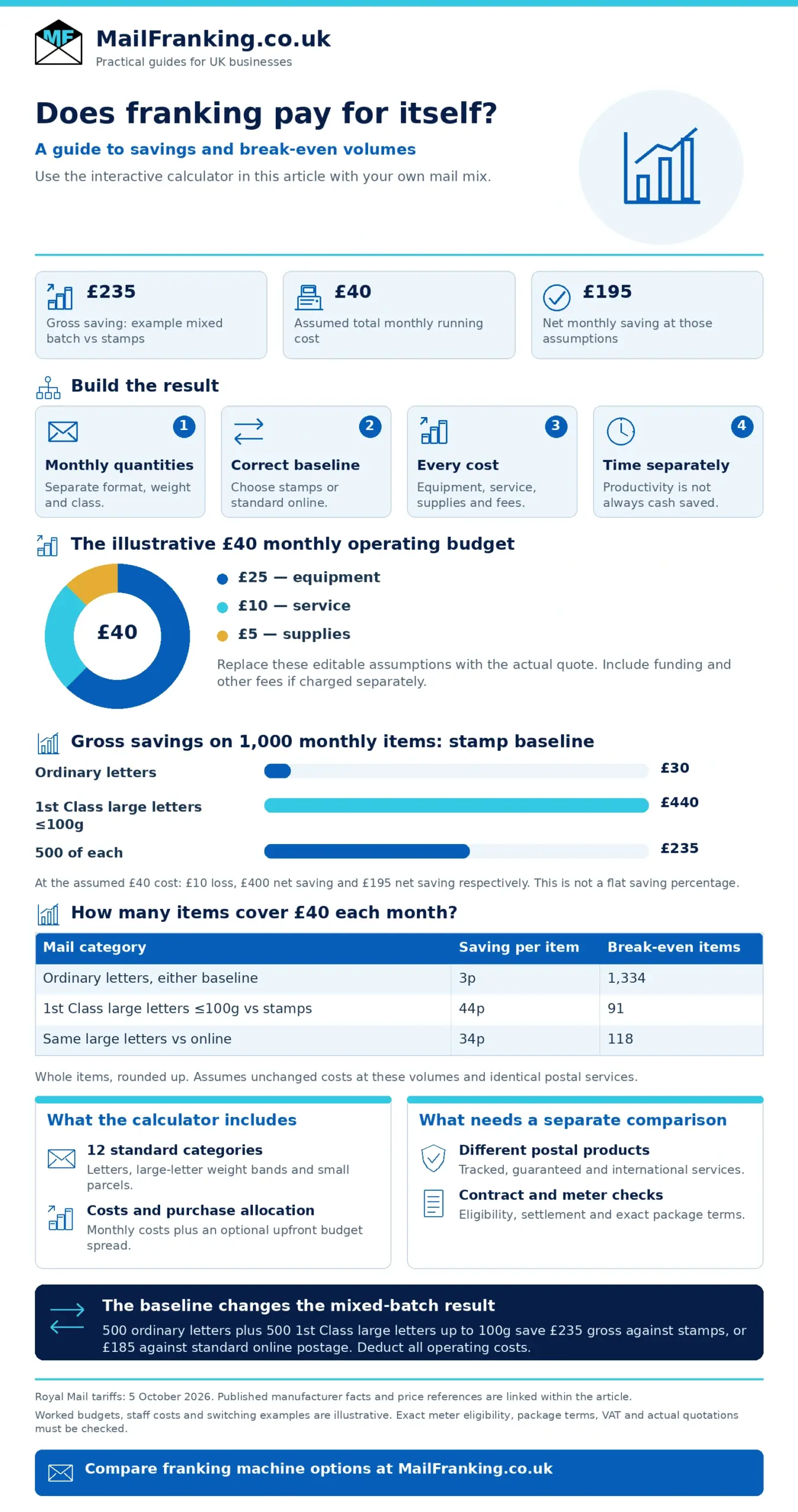
With a uniform mail category, divide the monthly operating cost by the saving per item. At £40 monthly and a 3p saving, the result is 1,333.33, so at least 1,334 items are needed to cover the assumed cost. At 44p, the threshold is 91 qualifying items instead.
| Assumed monthly running cost | Ordinary letters saving 3p | 1st Class large letters up to 100g saving 44p vs stamps | Same large letters saving 34p vs online |
|---|---|---|---|
| £25 | 834 | 57 | 74 |
| £40 | 1,334 | 91 | 118 |
| £75 | 2,500 | 171 | 221 |
| £150 | 5,000 | 341 | 442 |
These are postage-only thresholds at unchanged unit savings and unchanged running costs. If printing more items increases ink, labels or service charges, update the monthly allowance. A flat £40 budget that works for 100 items may not cover the supplies needed for 5,000.
There is no universal minimum number of letters per day that makes every machine worthwhile. Twenty working days, twenty-two working days and seasonal batch posting produce different daily averages. For a business sending only ordinary letters, an old calculation based on a much larger historic stamp discount can give a misleading result today.
Four examples showing why the mail mix matters
Assume a £40 monthly running cost and compare with stamps. The examples below keep the arithmetic simple so you can check it against your own pattern of post. They exclude staff time and any change in the cost allowance as volumes rise.
| Monthly posting pattern | Gross postage saving | Running cost | Net monthly result | Net annual result at unchanged assumptions |
|---|---|---|---|---|
| 500 ordinary letters | £15 | £40 | £25 loss | £300 loss |
| 1,500 ordinary letters | £45 | £40 | £5 saving | £60 saving |
| 500 qualifying 1st Class large letters up to 100g | £220 | £40 | £180 saving | £2,160 saving |
| 500 ordinary letters plus 500 qualifying large letters | £235 | £40 | £195 saving | £2,340 saving |
Against standard online postage, the final mixed example falls to £185 gross and £145 net monthly. The difference comes from using 34p rather than 44p for the large-letter category. Neither calculation changes the machine’s specification; only the alternative being compared changes.
A £5 monthly margin is also fragile. One additional funding charge, an unexpected ink purchase or a quieter month can remove it. A larger margin gives you more room for changing volumes, but should still be tested against actual invoices after installation.
Which running costs should you enter?
Start with the equipment payment on the correct calendar basis. Multiply a weekly price by 52 and divide by 12 for an average calendar-month budget. Divide a quarterly invoice by three. Do not multiply a weekly quote by four and assume that represents all twelve calendar months.
Add service and inspection if charged separately, an appropriate ink allowance, usable labels, postage-funding charges and software costs. Include fixed tariff-update charges by spreading their actual expected cost across the relevant period. Our hidden-cost guide explains how these items appear on a quotation.
If your genuine inclusive service price already covers a cost, avoid entering it twice. Equally, the word inclusive should not make every field zero: check exclusions, allowances, delivery, overage charges and conditions. Postage itself is not normally the equipment rental payment.
For purchase planning, the calculator can allocate an upfront cost over your chosen period. A £1,200 purchase across 60 months adds £20 monthly before service and supplies. This is a budgeting allocation without financing cost or residual value; it is not accounting depreciation or evidence that the unit will remain supported for five years. Use the Mailstation review for clearly identified refurbished price references, then replace the calculator’s equipment and supplies inputs with the actual offer.
Value the time saving without overstating cash savings
An office may justify equipment because staff can process a batch more quickly or allocate postage across departments. To estimate the time benefit, measure the whole task using actual envelopes, not just the speed of the print head. Include preparation, sealing, weighing, sorting, replenishing and clearing errors.
At £18 per hour, eight minutes saved across 22 working days is worth £52.80 in staff capacity monthly. If postage produces a £25 monthly loss after machine costs, the combined estimated benefit is £27.80. The calculator shows these results separately so you can see why a decision may still be reasonable.
Do not describe the full £52.80 as money removed from payroll unless it actually reduces paid hours or another expense. It may instead allow an administrator to handle invoices, customer enquiries or other useful work. For a realistic business case, identify that alternative use before assigning a value. The manual vs automatic guide shows a complete-batch example and separates released capacity from cash expenditure that actually disappears.
Test quieter months and a changing service mix
Try at least three scenarios: your recent normal workload, a quieter month and a peak month. Keep fixed equipment costs in every scenario. Adjust consumables as appropriate and consider whether a cheaper postal service can meet the delivery need.
For example, an office sending 500 qualifying large letters monthly may show an attractive return. If the business then emails most documents and sends only 100, a rental commitment remains while postage savings fall. Check whether the agreement allows a lower-volume package, and assess the cost of being tied to the original model.
Switching more items from First to Second Class also changes the calculation. It may save more postage overall even though the franking discount becomes smaller. Compare the cheapest suitable service first; buying a faster postal product to make a machine’s discount look bigger would defeat the purpose.
What the calculator does not decide
It cannot establish whether a particular second-hand meter is eligible, whether its service agreement permits third-party supplies, or whether your business can leave an existing lease. It also does not convert standard post into a tracked or guaranteed product. Those are separate buying and service checks.
Use the result alongside our UK franking machine prices guide, small-business buying guide and supplier comparison. Ask suppliers to price the same mail mix and attach their complete equipment, service and funding schedule. Keep a copy of the assumptions so the quoted savings can be checked later.
After installation, compare at least one full month’s actual invoice and postage report with the estimate. A calculator is most valuable when it becomes a way to reconcile real spending, rather than a one-off sales illustration. Update its tariff assumptions whenever Royal Mail changes the relevant prices.
Frequently asked questions
There is no single threshold. At £40 monthly running costs and a 3p saving per ordinary letter, at least 1,334 letters are needed to cover that cost. A First Class large letter up to 100g saves more, so the threshold for that category is much lower.
It uses standard domestic tariffs effective from 5 October 2026, identified beside the calculator. It does not update automatically or quote negotiated account rates. Check the published guides when prices change, and compare the exact product, size and weight you actually intend to send.
Only the example amounts entered in the fields are included. Replace them with your quotation or actual costs, and avoid entering costs already covered by an inclusive package twice. Include separate funding fees, labels and service where applicable to obtain a useful net result.
Yes. Choose the standard online baseline. Some online prices differ from stamps, particularly for First Class large letters and parcels. The calculator then uses those differences against Mailmark. Tracked, guaranteed, international and negotiated business-account products need a separate service-specific comparison.
Yes. Enter an upfront purchase amount and the number of months over which you want to spread it for budgeting. The calculator adds that allocation to monthly costs. It does not estimate interest, residual value, tax treatment or whether support will last for the selected period.
Time released can help your business without reducing payroll. The separate result allows you to distinguish a postage cash saving from an estimated productivity benefit. Measure the full mailing task and use a realistic loaded hourly cost rather than assuming that the machine’s maximum speed applies throughout.