
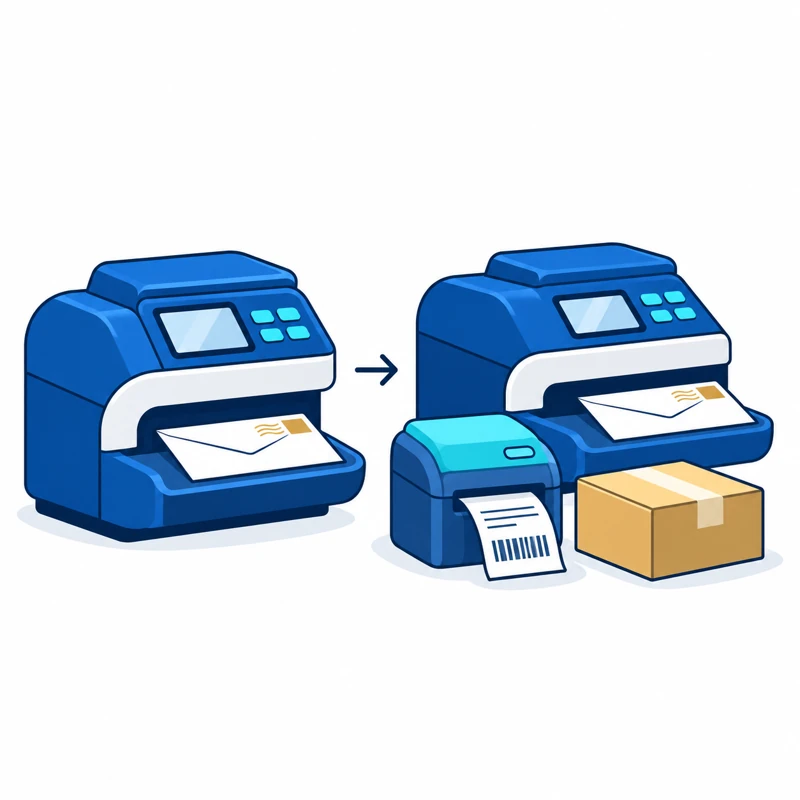
Pitney Bowes SendPro C and SendPro+ sit above entry-level manual meters, combining envelope franking with connected mailing tools. Their names are similar, but the proposed equipment, throughput and parcel-label setup can differ. Comparing the full package is more useful than choosing the model with the larger headline speed.
For a UK business, the central question is whether the additional capability of SendPro+ earns its extra cost. This guide compares published UK specifications and refurbished prices, then works through the speed premium, postage savings, consumables and contract terms that can change the result.
SendPro C vs SendPro+ at a glance
| Comparison | SendPro C | SendPro+ |
|---|---|---|
| Advertised maximum speed | Up to 50 letters per minute | Up to 65 letters per minute |
| Feeding in UK buying guide | Semi-automatic | Semi-automatic |
| Weighing in UK buying guide | Up to 7kg | Up to 7kg |
| Interface | Connected touchscreen system | Connected touchscreen system |
| Parcel emphasis | Verify included software and label hardware | UK product page highlights integrated parcel-label workflow |
| Key buying test | Full cost and practical batch time | Additional features and time saved against the premium |
The Pitney Bowes UK buying guide distinguishes the 50 and 65 letters-per-minute figures. Combined support pages sometimes describe the family using its highest rate; that does not turn every SendPro C into a 65-letter-per-minute machine. Confirm the exact model and installed configuration.
The guide also gives suggested daily volumes, but those are selection aids rather than hard daily limits. A business sending a few large batches faces different handling demands from one sending an equal monthly total in small sessions. Bring the shape of your workload into the comparison.
- Takes 2 minutes
- Receive quotes to compare
- Easy and no commitment
Published UK prices: compare the same condition
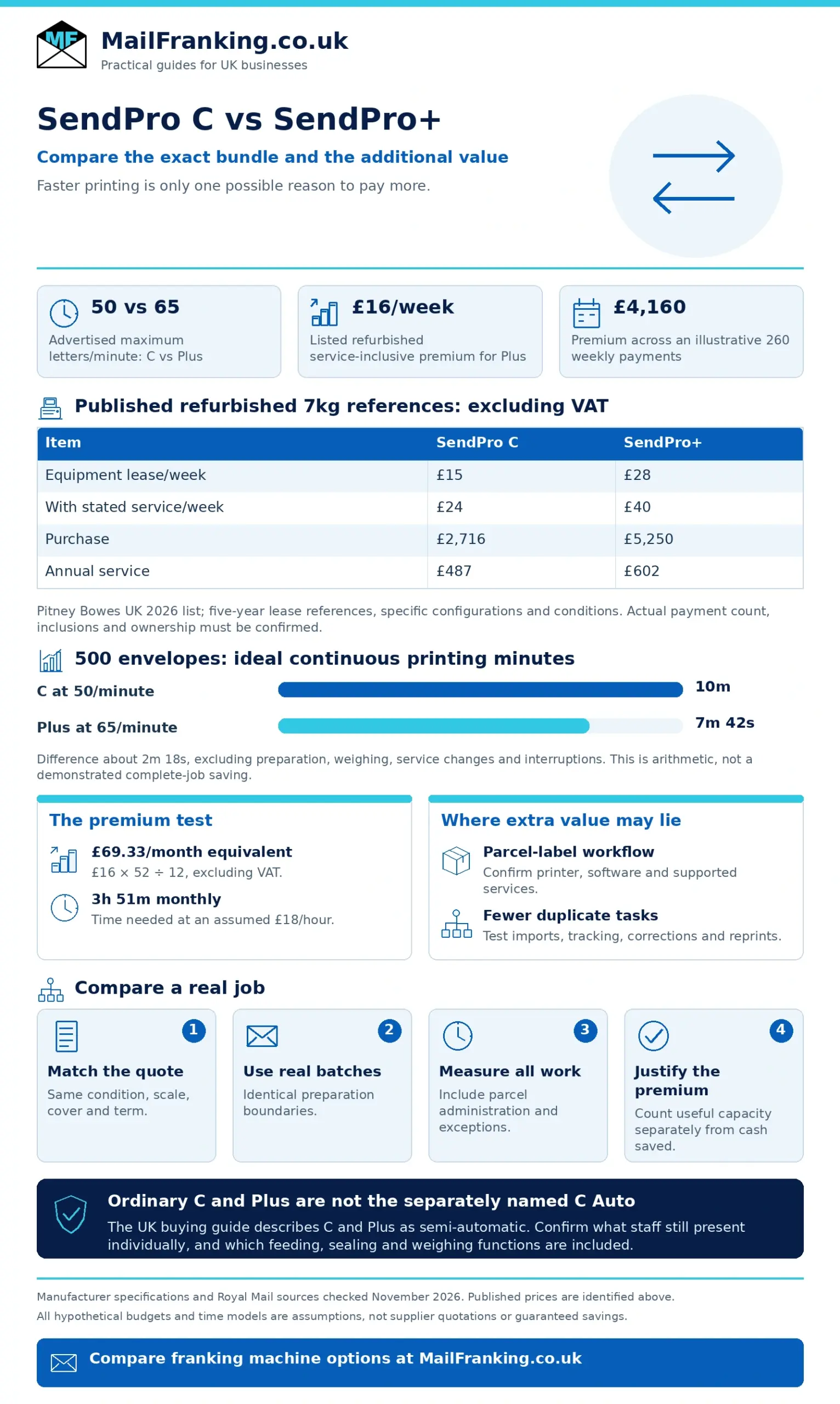
The manufacturer’s 2026 UK price brochure lists specified refurbished SendPro C and SendPro+ equipment with 7kg scales. These provide a public comparison, excluding VAT. They should not be presented as universal prices for new machines or as a substitute for a current quote.
| Refurbished 7kg configuration | SendPro C | SendPro+ |
|---|---|---|
| Weekly equipment lease reference | £15 | £28 |
| Weekly lease including stated service | £24 | £40 |
| Purchase reference | £2,716 | £5,250 |
| Annual Inclusive Service reference | £487 | £602 |
The published price list describes five-year leases and conditions applying to service pricing. Ask whether delivery, installation, operator training, software and any initial payments are included. Check that each quotation uses the same new or refurbished condition and equivalent support.
Converting the service-inclusive weekly figures using 52 ÷ 12 gives approximately £104 a month for C and £173.33 for Plus. These are calendar-month budgeting equivalents, not advertised monthly payment schedules. The premium is £16 a week, £832 a year or approximately £69.33 a month.
Across an illustrative 260 weekly payments, those figures total £6,240 and £10,400 respectively, a £4,160 difference before other costs and VAT. Actual payment counts and end-of-term arrangements must come from the agreement. A lease payment does not automatically mean you own the equipment at the end.
- Give your requirements
- Receive quotes to compare
- Choose a provider or walk away - your choice!
The purchase-reference difference is £2,534. The listed annual service difference is £115. Ownership, warranty, financing and eventual disposal still need evaluating separately; adding one upfront number and one annual fee does not establish that the packages are otherwise identical.
Does the faster printer justify the premium?
At the advertised maximum rates, processing 500 envelopes would take ten minutes on a 50-per-minute machine and approximately seven minutes 42 seconds at 65 per minute. The idealised difference is about two minutes 18 seconds. For 1,000 envelopes it is about four minutes 37 seconds.
Those figures exclude setup, weighing, document preparation, inserting, service changes, interruptions and tidying. They illustrate why a 30% increase in nominal printing speed need not create a 30% reduction in the complete mailing job. Time the work from the first preparation task to the final ready-to-post batch.
| Ideal continuous printing example | C at 50/minute | Plus at 65/minute | Theoretical difference |
|---|---|---|---|
| 100 envelopes | 2 minutes | 1 minute 32 seconds | 28 seconds |
| 500 envelopes | 10 minutes | 7 minutes 42 seconds | 2 minutes 18 seconds |
| 1,000 envelopes | 20 minutes | 15 minutes 23 seconds | 4 minutes 37 seconds |
Using an assumed staff cost of £18 per hour, the £69.33 monthly equipment premium requires about three hours 51 minutes of useful time savings each month. Across 20 working days, that is roughly 11 minutes 33 seconds per day. Speed alone may therefore be a weak justification at modest volumes.
The result can change if the Plus package removes separate parcel tasks, duplicate data entry or repeated trips between systems. Measure those savings explicitly. Released staff capacity is valuable, but it becomes a cash saving only where it avoids an actual cost such as overtime, temporary cover or outsourced work.
Feeding: semi-automatic is not a stack feeder
Terminology can be confusing because a machine may help transport an envelope while still requiring an operator to present each one. The ordinary SendPro C and SendPro+ entries should not be confused with the separate C Auto products listed by Pitney Bowes.
If the supplier calls a machine automatic, ask exactly what is automatic: envelope transport, stack feeding, sealing, weighing, format recognition or software selection. These are separate functions. Watching a prepared batch pass through is the clearest way to understand the operator’s remaining role.
For mixed mail, check how the machine handles changes in thickness, format and weight. An impressive demonstration using identical envelopes may say little about a batch containing invoices, document packs and padded envelopes. Include your less convenient items when testing the equipment.
Ask whether sealing equipment, differential weighing or other accessories are standard, optional or unsupported on the exact configuration. Record the answer in the quote. Our guide to manual and automatic franking machines explains how the different handling stages affect real productivity.
Parcel labels and shipping software
The SendPro+ UK product page highlights its parcel-label printer and digital weighing workflow. The SendPro C page should be checked against the proposed software and hardware bundle, rather than assuming the model names establish identical shipping capability.
List the products you actually need: ordinary parcels, tracked services, signed services and international goods can involve different information and labels. Ask the supplier to demonstrate each required product using a real destination and a representative package. A generic carrier logo on a screen is not a complete service specification.
For an online seller, test order import, address correction, tracking-number return, label reprints and shipment searches. A system that prints a label quickly can still be inefficient if staff manually retype orders or reconcile tracking references afterwards. Check any shipping subscription and per-label or activity charges.
International goods require the appropriate customs information and electronic processes. Do not assume that buying postage completes customs compliance. If overseas shipments form a meaningful share of your work, read our international franking guide and test the proposed system’s current supported process before committing.
Weighing, space and network access
The UK buying guide lists scales up to 7kg for both models, and the refurbished price entries specify 7kg configurations. That does not guarantee that every advertised offer includes the same scale. Confirm capacity, platform size, placement and whether bulky parcels obscure the display or rest against surrounding furniture.
The combined UK support specifications describe a 7-inch tablet interface and a main unit around 419 × 394 × 286mm. Allow additional operational space for the scale, label printer, input and output mail. A desk that fits the bare unit may not support an efficient workflow.
Both the network and the associated software matter. Ask about wired and wireless requirements, supported office computers, permissions and any optional connectivity hardware. Agree who handles configuration changes and how postage is prepared if the network or service is temporarily unavailable.
Postal format selection remains an operator responsibility unless the exact system demonstrably automates it. A scale measures weight; it does not automatically prove compliance with letter or large-letter dimensions. Use the finished item and an appropriate format guide before selecting the service.
Postage savings are mostly a mail-mix question
Using the same eligible Mailmark product on C and Plus does not normally create a different basic tariff simply because one machine prints faster. Compare each proposal against your present purchasing route, using current prices for the same class, weight and format.
From 5 October 2026, ordinary Mailmark letters up to 100g are £1.77 for 1st Class and 88p for 2nd Class. Corresponding stamps are £1.80 and 91p, a 3p saving per item. A 1st Class large letter up to 100g is £2.86 Mailmark versus £3.30 by stamp, giving 44p.
For 1,000 ordinary letters, a 3p postage difference creates £30 gross savings: less than either service-inclusive equipment reference. For 1,000 qualifying large letters, 44p against stamps creates £440 gross savings before equipment and other costs. Comparing with standard online postage changes the saving again.
The Royal Mail Mailmark tariff and online price guide allow the baseline to be checked. Do not apply the large-letter saving to an ordinary letter batch, and do not compare standard untracked postage with a tracked product as though they offer identical features.
Consumables, service and funding costs
Request an annual consumables estimate based on your actual volume and printing pattern. Ink yield depends on use, and advertised impression counts are not a guarantee for every combination of postage marks, messages and maintenance cycles. Confirm automatic ink-supply arrangements, delivery charges and unused-stock handling.
Label costs matter where direct envelope printing is impractical. Ask whether the quoted parcel printer uses compatible thermal labels, what quantities are supplied and which approved replacements are available. Include wasted labels and occasional reprints in the budget instead of assuming every purchased label becomes a successful shipment.
Service cover needs its own schedule. Clarify whether a response promise means a telephone callback, remote diagnosis, site attendance or a restored working machine. Check parts, labour, travel, accidental damage, consumables and loan-equipment provisions. Our maintenance guide provides a practical comparison framework.
Funding arrangements can also differ. The Pitney Bowes list includes refill and account-related charges for specified arrangements; an actual bundle may include, replace or alter them. Obtain an itemised quote and separate postage money from fees. Compare the same VAT basis, reflecting whether your business can recover relevant input VAT.
Which model should you choose?
SendPro C is worth shortlisting where its confirmed envelope workflow and software meet the requirement at the lower complete cost. Avoid paying the Plus premium solely because 65 sounds substantially faster than 50. For small batches, the absolute printing-time difference can be modest.
SendPro+ becomes more attractive where its included shipping setup removes measurable work or supplies features missing from the competing C quote. Ask for a side-by-side demonstration and a written annual cost covering hardware, software, service, supplies and account charges. Include busy days and exceptions in the assessment.
This comparison uses published UK manufacturer material, the specified refurbished price list and Royal Mail tariffs; it is not a hands-on laboratory test. Compare at least one alternative system and ask how costs change if your volumes fall. A well-matched smaller machine can be better value than excess capacity tied to a long agreement.
Frequently asked questions
The UK buying guide lists SendPro C at up to 50 letters per minute and SendPro+ at up to 65. The Plus product page also emphasises parcel-label integration. Compare the exact software, scale and printer bundle: model names alone do not establish which functions are included in a particular quotation.
The cited refurbished service-inclusive references are £24 a week for C and £40 for Plus, excluding VAT. That is £16 weekly or £832 annually. A 260-payment illustration creates a £4,160 difference, but actual finance terms, included features and payment counts must be checked against the agreement.
The ordinary C and Plus models are described as semi-automatic in the UK buying guide. Do not confuse them with separately named C Auto equipment. Ask whether staff still present each envelope and which feeding, sealing and weighing functions are included. Test a real batch before relying on an automation claim.
For the same eligible Mailmark product, class, format and weight, a faster machine does not by itself create a lower ordinary postage tariff. Savings depend on your baseline and any separately qualifying postal products. Evaluate equipment and handling differences independently from the basic postage price comparison.
Its UK product page highlights parcel labels and weighing, but the included software, supported services and order integrations need checking. Demonstrate order import, address editing, label reprints and tracking updates with representative shipments. Include subscriptions, labels, collections and any activity charges when comparing it with existing online shipping.
Choose according to demonstrated workflow and complete cost. If C performs the required work reliably, the Plus premium may be difficult to justify through printing speed alone. If Plus removes several parcel-handling tasks, its wider time savings may support the extra cost. Compare actual batches and written quotations rather than suggested volumes alone.