

Franking machine maintenance can range from basic support to a package covering repairs, parts and replacement equipment. The annual price depends on the model, age, workload and exclusions, so a cheap service plan is useful only if it covers the failures that would disrupt your business.
Compare maintenance separately from equipment finance, postage funding and consumables, even when they appear in one bundle. Ask for a written explanation of what happens when the machine stops working, how quickly support responds and which charges you could still face.
This guide sets out published service-price examples, explains inspection and repair arrangements and shows how to build a realistic downtime budget. Supplier list prices are identified separately from the illustrative repair and labour assumptions used in the calculations.
What does a maintenance agreement cover?
A maintenance package may include telephone or remote support, diagnostic work, engineer attendance, labour, certain replacement parts and access to a replacement machine. It may also include rate updates or consumables, but those should be stated explicitly rather than assumed from the word “service”.
- Takes 2 minutes
- Receive quotes to compare
- Easy and no commitment
Pitney Bowes’ invoice guidance distinguishes equipment rental, supplies, maintenance, chargeable call-outs and rate-related fees. It says uncovered call-outs can involve travel, labour and parts charges. This is a useful reason to request separate lines on a quotation, even if the supplier ultimately invoices them together.
The key document is the agreement for the exact unit and installation address. A manufacturer’s general website can describe several packages, while an older lease or third-party maintenance plan may use different terms. Keep the signed schedule and exclusions alongside the equipment serial number.
Published annual service-price examples
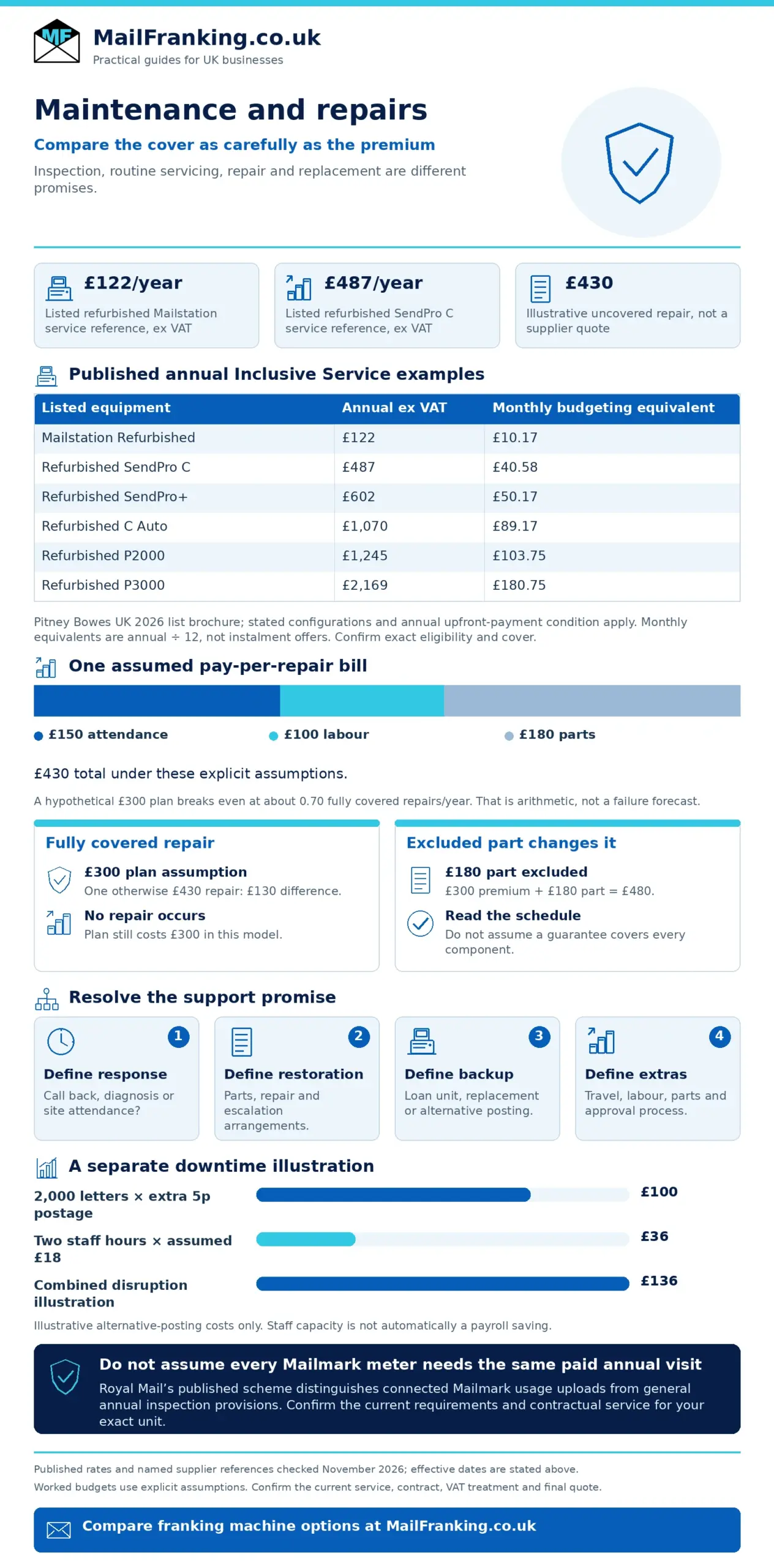
The following figures are from Pitney Bowes’ UK 2026 list-price brochure, checked in November 2026. They are annual Inclusive Service list references excluding VAT, with the brochure’s stated annual-upfront-payment condition. They are not prices for all suppliers or quotations for an unidentified used machine.
| Equipment description in the brochure | Annual service excluding VAT | Monthly budgeting equivalent |
|---|---|---|
| SendPro Mailstation Refurbished | £122 | £10.17 |
| Refurbished SendPro C with 7kg platform | £487 | £40.58 |
| Refurbished SendPro+ with 7kg platform | £602 | £50.17 |
| Refurbished SendPro C Auto with 7kg platform | £1,070 | £89.17 |
| Refurbished SendPro P2000 with shipping | £1,245 | £103.75 |
| Refurbished SendPro P3000 with shipping | £2,169 | £180.75 |
Monthly equivalents are annual figures divided by 12 and rounded; they are not advertised monthly instalment offers. At standard-rate VAT, for example, £487 becomes £584.40 for a business that cannot recover the tax. Check the provider’s current written price and eligibility before using these figures as your budget.
- Give your requirements
- Receive quotes to compare
- Choose a provider or walk away - your choice!
The broad spread reflects different equipment and workloads. Comparing a £122 desktop reference with a £2,169 high-volume system does not show that one provider is overpriced; it shows why the model and coverage must match. Larger systems can require more complex support and have a different operational impact when unavailable.
Inspection, servicing and repairs are different
An inspection is not necessarily preventive servicing, and neither automatically includes fixing a failed part. Ask what checks are performed, what evidence you receive and whether the visit includes cleaning, adjustment or only compliance-related inspection.
Royal Mail’s franking guidance directs users to authorised maintenance providers. The published Franking Post Scheme distinguishes Mailmark’s data-centre connection and usage upload from the general annual-inspection requirement, while retaining inspection rights. Do not accept an unsupported claim that every Mailmark machine requires an identical paid annual physical visit.
The supplier may still specify service or inspection arrangements in your agreement. Ask it to identify the basis for the charge, whether any remote process applies and what is included beyond that process. Confirm authorisation for the particular model rather than choosing a general office-printer engineer.
The exclusions that change the value
Read the exclusions before comparing premiums. Possible questions include the printhead, battery, scale, feeder, sealer, accessories, accidental damage, unsuitable supplies, relocation and use above the equipment’s rated specification. The answer may differ between the repair promise and other parts of the package.
Pitney Bowes’ published product-performance guarantee contains conditions and exclusions, including particular components and certain causes of malfunction. Ask the supplier to reconcile the guarantee, service schedule and quote if their wording appears inconsistent. A written explanation is more useful than assuming a broad headline covers every item.
Also establish whether an initial warranty is still active. Buying a service plan does not necessarily extend every original warranty right, and an expired warranty does not tell you what a separate maintenance agreement provides. Keep warranty dates, service dates and equipment finance dates as separate records.
Response time is not repair time
“Next-day response” can mean a call back, remote diagnosis or an engineer visit. It does not necessarily mean your machine is repaired by the next morning. Ask what starts the clock, which business hours count and what happens when a part is unavailable.
For a small office, a temporary online postage route may be enough during a short interruption. For a mailroom preparing thousands of deadline-sensitive letters, a loan unit, replacement arrangement or alternate production route may be worth more than a slightly lower annual premium.
Have the provider describe a realistic incident: the failure is reported at 3pm on Friday, a part is needed and Monday’s mailing must go out. Who diagnoses it, who authorises the part, when is it sent and what backup is available? This exposes gaps that a simple response-time label can hide.
Worked comparison: service plan or pay-per-repair
Consider an illustrative machine with an annual service quotation of £300 excluding VAT. The alternative is no fixed cover, with assumed charges of £150 attendance, £100 labour and £180 parts for one repair. The uncovered repair totals £430. These are modelling assumptions, not published industry prices.
| Assumed repairs during one year | Pay-per-repair at £430 each | £300 plan if every repair is fully covered |
|---|---|---|
| 0 | £0 | £300 |
| 1 | £430 | £300 |
| 2 | £860 | £300 |
The simple financial break-even is £300 ÷ £430, or about 0.70 such repairs a year. That is not a prediction that the machine will fail at that frequency. It is a way to understand the trade-off once the quoted cover and potential charges have been established.
Change the assumptions if the plan excludes the £180 part. One covered attendance and labour visit would then leave £180 payable, taking the plan-year total to £480. The apparent £130 advantage over an uncovered £430 repair disappears. This is why the coverage schedule matters as much as the premium.
Put a value on downtime
Suppose a mailroom has 2,000 letters ready when its machine fails. An alternative posting route costs an illustrative 5p more per letter and requires two extra staff hours at an assumed £18 an hour. The direct postage difference is £100 and the additional staff capacity is £36, giving a £136 disruption illustration.
That £136 excludes missed deadlines, customer contact and any emergency transport. Add those only where you can justify them, rather than using a dramatic unsupported figure. Conversely, do not treat the machine as having zero disruption cost if staff must abandon other work to complete the dispatch.
Track incidents for your own equipment: fault type, time reported, response, restoration, backup used and extra expense. Over a year, this creates better evidence for choosing a service package than a generic claim that franking machines are either completely reliable or expensive to maintain.
Safe operator checks before an engineer visit
Follow the model’s official instructions for ordinary user tasks. Depending on the equipment, that may include checking the displayed error, paper or envelope path, supply levels, network connection and print quality. Record the message and what happened immediately before the fault.
Avoid repeatedly printing paid impressions while experimenting with a fault. Use an approved test-print routine where available and retain evidence of spoiled paid mail. Our postage credit and refunds guide distinguishes a failed impression from unused funds remaining in the meter.
Do not open sealed meter components, bypass security features or fit a part simply because it resembles an ordinary printer component. If there is a concern about electrical safety or damaged equipment, stop using it and contact the authorised provider. Ask support which user-level actions are permitted before trying them.
Network and tariff problems need clear ownership
A machine may be mechanically sound but unable to download funds or rates. Establish whether support covers network diagnosis and what your own IT team must provide. Record whether the system uses wired Ethernet, Wi-Fi or a managed connection so that fault reporting starts with accurate information.
Ask how the provider handles a tariff update that fails before a busy posting day. Does it check that the correct rate table is installed, and is that support included? A repair contract covering motors and rollers may not automatically include every software subscription or optional shipping application.
Our hidden costs guide explains the wider fee categories. Include separate update or software charges in the total if the supplier has not included them in the service agreement, and avoid adding them again when they already form part of the bundle.
Maintaining a used or older machine
Before buying used equipment, obtain confirmation that an authorised provider can register and support the exact meter. Check the model identifier, condition, parts availability, connection requirements and any announced withdrawal of support. A low purchase price is not attractive if the unit cannot be used as intended.
Ask whether the maintenance quote is conditional on an initial inspection or refurbishment. Establish who pays for existing faults and whether there is a minimum agreement term. The price for a known working machine may not apply to an untested unit bought privately.
Our used-machine buying guide covers these checks. Compare repair and replacement over the remaining useful supported life, including contract commitments and any setup or return charges. Do not assume that a new rental automatically cancels an old finance agreement. The licence guide explains user changes and registration. Current support for a serial number and a valid licence are related checks, but neither substitutes for the other.
How to compare maintenance quotations
Send each bidder the same model, serial identifier, installation location, annual volume and description of connected accessories. Request a written schedule showing annual cost, payment timing, price reviews, term, renewal, cancellation notice, covered parts, labour and travel.
Then compare operational commitments: support hours, reporting channels, remote diagnosis, site attendance, parts availability, loan equipment and replacement conditions. Ask for examples of chargeable work and whether approval is obtained before attendance or fitting an excluded part.
| Quote item | Evidence to request |
|---|---|
| Coverage | Named unit, accessories and schedule of included work |
| Exclusions | Written component and cause-of-failure list |
| Support | Defined response, repair and escalation arrangements |
| Costs | Premium, VAT, excesses and uncovered-work rates |
| Contract | Minimum term, review, renewal and notice rules |
| Continuity | Backup or replacement arrangements and conditions |
Choosing the right level of cover
An occasional sender with an easy backup route may reasonably prioritise low fixed costs. A busy mailroom can rationally pay more for dependable support and continuity. Neither conclusion follows from the machine’s purchase price alone.
Use our supplier comparison to identify options, then make the coverage and total cost review specific to your equipment. The best maintenance arrangement is one that makes the likely charges understandable and gives your team a workable plan when the machine cannot process the day’s mail.
Frequently asked questions
It varies by model and coverage. Pitney Bowes’ published 2026 annual Inclusive Service references range from £122 for its listed refurbished Mailstation to £2,169 for its listed refurbished P3000 configuration, excluding VAT. Obtain an exact quote and check exclusions, payment conditions and support commitments before comparing prices.
Only if the specific agreement says so. Equipment service, supplies, rate updates and postage funding can be separate or bundled. Ask for the included quantities, usable yields and exclusions in writing. Do not add an item twice when included, or assume an unlimited allowance from a general headline.
Not necessarily. It may refer to contact, remote diagnosis or attendance during defined working hours. Ask when the clock starts, what happens when parts are unavailable and whether replacement equipment is provided. Assess the restoration process against your posting deadlines, not just the response label.
Do not assume an identical requirement for every unit. Royal Mail’s published scheme distinguishes Mailmark data-centre connections and usage uploads from general annual inspection provisions. Ask your authorised provider to explain the current requirements and any contractual service or inspection charge for your particular equipment.
Use a provider authorised for the exact franking equipment. The meter has postal and security requirements beyond an ordinary printer. Follow official user instructions for routine checks and contact support before opening components or changing parts. Confirm model-specific authorisation when considering an independent service company.
Compare the repair quote, continuing support, parts availability and expected workload with the full replacement cost. Include existing finance commitments, setup and return charges. A low repair price is useful only if the meter remains eligible and supportable; replacement is not automatically cheaper simply because it is newer.