

Franking postage credit is the money available to pay for impressions printed by your machine. It is separate from the machine rental or purchase price, and it can also be separate from the balance held in your supplier’s online postage account.
The distinction matters when you top up, reconcile a bill, replace a meter or request a refund. A £500 postage download is not the same thing as a £500 equipment charge, while a separate refill fee can be a real additional operating cost.
This guide explains the main balances, published fee examples and refund routes for UK businesses. Use the examples to check your agreement rather than assuming that every supplier, payment method or account package applies the same charges.
The four figures to keep separate
A typical setup can involve funds in the meter, money or credit in the supplier account, a bank payment and a supplier fee. Those figures may appear in different places and on different dates. Treat them as a small reconciliation process, not one interchangeable “postage balance”.
- Takes 2 minutes
- Receive quotes to compare
- Easy and no commitment
| Figure | What it represents | What to check |
|---|---|---|
| Meter balance | Postage available on the machine | Opening funds, downloads, use and closing funds |
| Supplier account balance | Money or credit held or owed on the account | Funding, downloads, invoices and credits |
| Bank payment | Cash collected or transferred | Date, amount and matching account transaction |
| Funding or account fee | Charge for the applicable service | Agreement, frequency, VAT and invoice |
For example, transferring £500 from a supplier balance to the meter may move funds already paid for rather than create another £500 of cash expenditure. Equally, a direct-debit arrangement can collect after a download. Ask the supplier to explain its actual sequence before designing your records.
Prepaid funding and pay-as-you-go arrangements
Providers can offer different ways to fund postage, including prepaid balances and arrangements that collect payment when you add funds or use shipping services. The labels differ, and “pay as you go” does not by itself mean that every transaction is free or that the account is a credit facility.
Pitney Bowes’ published UK price brochure describes PrePay and Pay As You Go funding and lists refill charges. Read those alongside your own schedule, because a negotiated or inclusive package can differ from a public list reference. Your equipment payment can also remain payable even when you send no post.
If a provider offers deferred payment, request the actual agreement showing payment dates, limits and fees. Do not assume that the word “credit” means an interest-free loan or the same terms as your equipment finance. Give the accounts team the postage agreement as well as the machine contract.
- Give your requirements
- Receive quotes to compare
- Choose a provider or walk away - your choice!
Published postage top-up fee examples
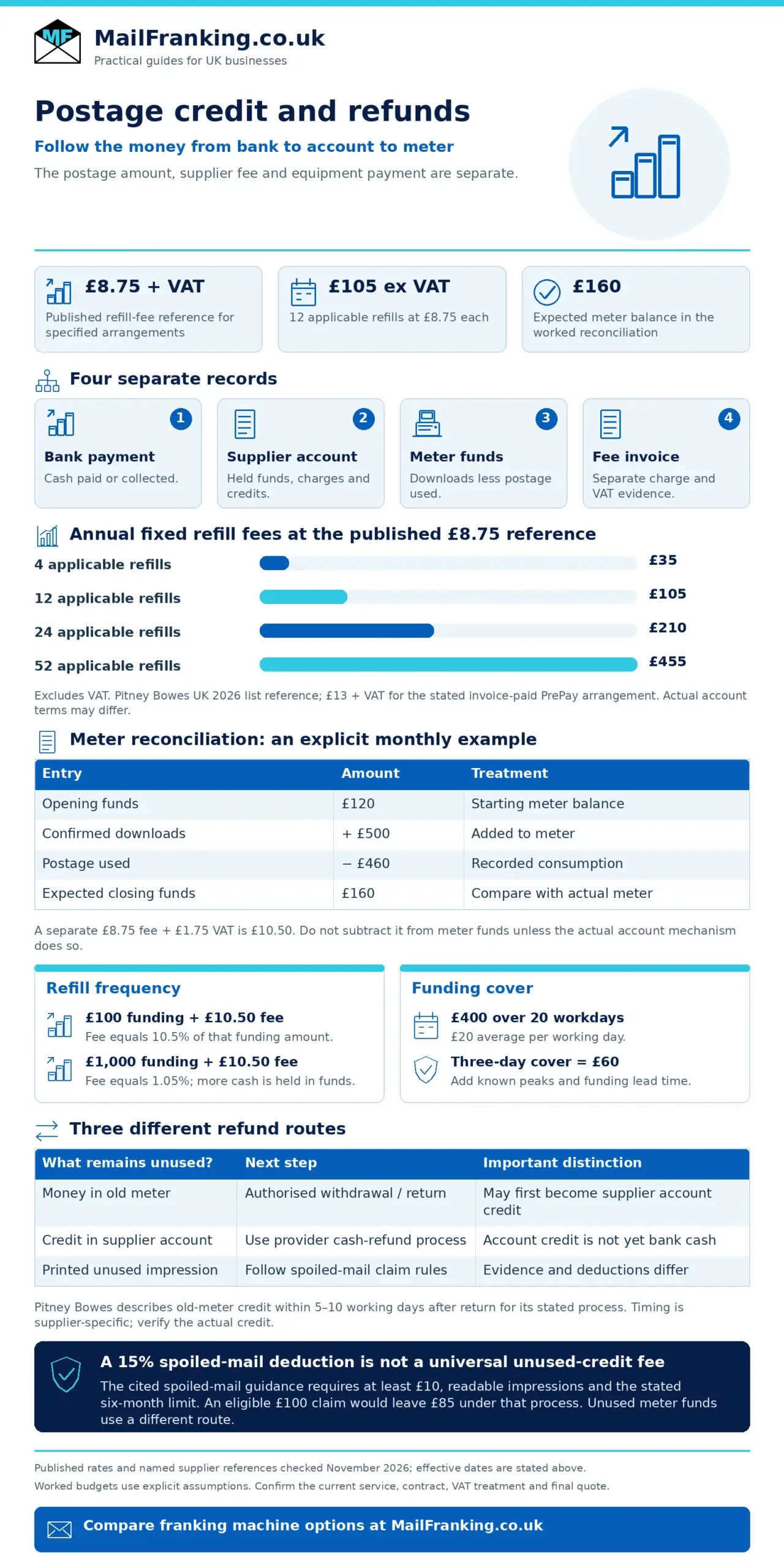
The Pitney Bowes brochure lists £8.75 plus VAT per refill for the stated PrePay and Pay As You Go arrangements, and £13 plus VAT for PrePay paid by invoice. These are supplier list references checked in November 2026, not universal Royal Mail fees. Confirm whether a refill fee applies to your package.
| Refills per year | At £8.75 excluding VAT | Including 20% VAT | At £13 excluding VAT |
|---|---|---|---|
| 4 | £35.00 | £42.00 | £52.00 |
| 12 | £105.00 | £126.00 | £156.00 |
| 24 | £210.00 | £252.00 | £312.00 |
| 52 | £455.00 | £546.00 | £676.00 |
These calculations show the effect of frequency, not the postage bought. Twelve refills of £500 purchase £6,000 of postage funding; twelve applicable £8.75 fees add £105 excluding VAT. Do not call the whole £6,105 a fee or count the £6,000 again when reconciling the bank payment.
For a business unable to recover VAT, a single £8.75 fee costs £10.50 gross. Against a £100 top-up that is 10.5% of the funding amount; against £500 it is 2.1%; against £1,000 it is 1.05%. Those percentages concern the example fee and top-up size, not a surcharge rate applied to every impression.
Choosing a sensible refill size
Larger, less frequent refills can reduce fee events where a fixed charge applies. They also tie up more cash and can leave a larger balance to reconcile when a machine is replaced. Choose a funding amount using workload, lead time, limits and cash-flow needs rather than simply loading the largest possible amount.
Suppose a business spends £400 on postage during a 20-working-day month. Average use is £20 a working day. If it wants three working days of cover, an initial alert level of £60 is a reasonable modelling starting point, before allowing for peak batches and any delay in getting money to the meter.
Now consider a £300 month-end mailing. A £60 alert based on daily averages would be insufficient for that batch. Forecast scheduled peaks separately, then check the account and meter before starting. An effective funding rule recognises the next real job as well as average consumption.
How to avoid an unnecessary duplicate download
If a top-up appears to fail, record the message, transaction reference, meter balance and supplier account activity. Check whether the machine received funds and whether the supplier recorded a download before repeating the action. A slow confirmation screen is not proof that nothing happened.
Follow the model’s official support procedure and contact the provider if the balances do not match. Do not repeatedly submit the same amount while changing network settings. Several small downloads can create both excess funds and additional fee events under some agreements.
Set a simple authorisation rule for larger refills. For example, require a second person to approve funding above the normal batch amount, and ensure the account administrator can see downloaded statements. The threshold should suit your actual spending, not be copied from another company’s policy.
A monthly reconciliation example
Start with the machine’s opening balance. Add confirmed downloads, subtract recorded postage use and compare the result with the closing meter balance. Then perform a separate check against supplier transactions and bank movements. They connect, but they are not necessarily identical records.
| Meter calculation | Example amount |
|---|---|
| Opening postage balance | £120 |
| Confirmed downloads during month | £500 |
| Postage used | £460 |
| Expected closing meter balance | £160 |
If the supplier invoice also includes an £8.75 refill fee plus £1.75 VAT, that £10.50 is a separate charge. It should not reduce the expected meter balance to £149.50 unless the provider’s actual records show that mechanism. Obtain an explanation of any difference rather than forcing the numbers to match.
Give your bookkeeper the meter report, supplier account statement, fee invoice and bank record. Ask them to apply the appropriate accounting and VAT treatment. A cash transfer between postage balances should not be confused with a new supply of equipment or a second purchase of the same postage.
Not every shipping charge is a refill fee
Some systems combine envelope franking with a shipping application. An application charge can therefore appear alongside postage funding and equipment payments. Check which activity triggers each charge and which part of the package it relates to.
The cited Pitney Bowes brochure separately lists a shipping activity charge based on the greater of £1 plus VAT or 1% plus VAT of total monthly transactions for the applicable application. Do not add this automatically to every franking account; establish whether that application and charging arrangement apply to your contract.
Our hidden costs guide provides a broader fee checklist. Request one complete schedule covering funding, account administration, software, service and supplies so you can compare packages without overlooking a small recurring charge.
Refunding unused funds when replacing a meter
Money still available in the old meter is different from unused printed impressions. The supplier normally needs to follow its withdrawal or replacement process and transfer or reconcile the meter balance. Record the amount before the equipment leaves your premises and keep the return reference.
Pitney Bowes’ unused-postage guidance says that, during cancellation or replacement, unused meter postage is transferred to the applicable account within 5–10 working days after the meter is returned. Its guidance also describes an authorised self-withdrawal route that credits the postage account immediately. Follow the instructions for your exact meter rather than improvising a withdrawal.
An account credit is not necessarily cash returned to your bank. Check the account statement, confirm any remaining liabilities and make a separate refund request where required. Ask the provider to state the expected steps and timescale in writing when you arrange the equipment return.
Requesting a cash refund of account credit
A postage account can hold credit because of unused meter funds, an overpayment or a credit adjustment. First establish that the account is actually in credit and that the relevant transaction has arrived. A balance shown only on the old meter is not yet the same as a refundable supplier-account credit.
Pitney Bowes’ account refund instructions describe submitting a financial-support request through its account portal. Use the current process and supply the evidence the provider requests through its designated channel. Keep the case reference and reconcile the eventual payment against the credit entry.
Before closing the account, download statements and ask how any final bills, credits or later adjustments will be handled. Our cancellation guide covers the equipment and contract side; account closure should be confirmed separately from physically returning the machine.
Refunds for spoiled or incorrectly printed mail
A paid impression already printed onto an unused envelope is a different refund category. Do not post an item with an incorrect impression while expecting the account balance to repair itself. Retain the whole envelope or required label evidence and follow the current claim instructions.
Pitney Bowes’ published Royal Mail spoiled-mail guidance states a minimum total value of £10, readable impressions within six months of the franked date and a 15% administration deduction for the described claim. Check the current requirements and return address before submitting originals.
On that basis, £100 of eligible unused impressions would produce an £85 refund after the £15 deduction. £20 would produce £17. Those examples apply to spoiled printed postage under that process; they do not establish a 15% deduction on every unused balance returned from a meter.
Plan balances before switching suppliers
When moving to a different provider, reduce avoidable excess funding near the agreed changeover without running the office short of postage. Record the old meter, supplier account, pending payments and any new account separately. Do not assume funds can be transferred directly between unrelated providers.
Schedule the last significant download against the remaining mailing workload and expected closure date. If an automatic funding rule is active, ask how it should be changed or stopped as part of the authorised closure process. Avoid cancelling a payment mandate before the provider has explained outstanding obligations.
Our switching guide helps coordinate the old contract and new installation. A careful balance handover prevents an apparent equipment saving being obscured by duplicate funding, unresolved credits or missing final statements. The registration and closure guide explains the equipment-use notifications alongside the financial reconciliation; ending the licence alone does not prove a bank refund has completed.
Questions to ask before accepting a funding arrangement
Ask what triggers a fee, whether it is fixed or percentage-based, which payment methods cost more and whether minimum or maximum downloads apply. Confirm how low-balance alerts work, who can authorise refills and what support is available if funds do not arrive.
Then ask about meter withdrawal, account-credit refunds, claim evidence and closure. Keep the answers with the service and equipment schedules. Understanding the route of the money makes it much easier to compare franking suppliers and to identify a genuine billing issue when one occurs.
Frequently asked questions
Usually it is a separate cost unless an offer explicitly includes a stated postage allowance. Check the agreement rather than assuming an equipment payment buys postage. Also distinguish funds available on the machine from money held in the supplier account and any separate funding or administration fees.
Charges depend on the provider and package. Pitney Bowes’ cited 2026 list brochure shows £8.75 plus VAT per refill for specified arrangements, or £13 plus VAT for PrePay paid by invoice. Confirm your own terms, including whether an inclusive package removes or changes the charge.
That can reduce fixed fee events, but it also holds more cash in postage balances. Choose an amount using normal use, peak batches, account limits and funding lead time. Keep enough cover for the next mailing without loading funds you are unlikely to use before replacing or closing the meter.
Follow the provider’s authorised withdrawal or return process. Unused meter funds may first move to the supplier postage account, after which a separate cash-refund request is needed. Record the balance, keep return evidence and reconcile the credit before assuming the money has reached your bank.
No. Spoiled-mail claims concern unused impressions already printed onto envelopes or labels. Unused-credit refunds concern funds remaining in a meter or account. The evidence, timing and deductions can differ. A spoiled-mail administration deduction should not be assumed to apply to every unused account balance.
Keep opening and closing meter balances, download records, usage reports, supplier account statements, fee invoices and bank payments. Match references and dates, allowing for the provider’s actual funding sequence. Give the complete records to your bookkeeper so transfers, postage use and separate charges are treated consistently.