

Hybrid mail and franking machines solve different parts of the business-post process. Hybrid mail sends a digital document to a provider that prints, envelopes and posts it. A franking machine keeps physical preparation in your office and prints the paid postage impression on the envelope or label.
The cheaper route depends on your letter volume, document length, staff time, delivery requirement and existing equipment. Compare the complete cost of producing and posting the same letter, rather than comparing an outsourced print-and-post price with postage alone.
For many businesses, a mixed approach is sensible: outsource routine digital correspondence and retain a way to send original documents, unusual enclosures or urgent exceptions. This guide explains the costs and operational checks needed to decide which work belongs where.
How hybrid mail works
Typically, staff create a document, check the address and submit it through a portal, print driver, automated folder or API. The provider then produces the physical letter and hands it into the postal network. The submission method, print options, production location and available delivery services vary by supplier.
- Takes 2 minutes
- Receive quotes to compare
- Easy and no commitment
Royal Mail’s hybrid-mail overview describes the broad digital-to-physical model. Some figures on older promotional pages reflect historic postage costs, so use a provider’s current rate card and an itemised quotation for the actual comparison. A headline saving percentage is not a replacement for a priced sample letter.
Before changing systems, separate document creation from document fulfilment. Hybrid mail does not necessarily write the letter, correct a wrong address or verify the commercial information. Your business still needs an approval process that prevents the wrong document being sent to the wrong person.
How in-house franking differs
With franking, your team prints the contents, folds and inserts them, checks the envelope, weighs the finished item and applies postage. You also manage the machine, supplies and posting handover. Direct envelope printing can be convenient where physical documents are already being handled in the office.
The important comparison is therefore between two complete workflows. Hybrid mail can remove printing and inserting tasks but introduces document submission and provider controls. Franking gives you immediate physical access but leaves production work with your staff. Both routes require accurate addresses, suitable services and a clear dispatch record.
- Give your requirements
- Receive quotes to compare
- Choose a provider or walk away - your choice!
Our guide to using a franking machine explains the in-house process. If the real alternative is buying labels online while continuing to prepare letters yourself, use the separate franking vs Click & Drop comparison. The feeding comparison helps measure which preparation and handling tasks remain in-house; changing the franking stage does not automatically remove printing, folding and inserting.
A published hybrid-mail price example
Intelliprint’s public pricing page, checked in November 2026, lists the following C5 letter prices. The page identifies its rate card as effective from 5 January 2026, defaults to prices excluding VAT and states that standard-rate VAT applies. Confirm the current quote and contents specification before ordering.
| C5 letter service | Published price excluding VAT | Price including 20% VAT |
|---|---|---|
| 2nd Class | £0.84 | £1.008 |
| 1st Class | £1.94 | £2.328 |
| 2nd Class Signed | £3.51 | £4.212 |
| 1st Class Signed | £4.34 | £5.208 |
| Special Delivery by 1pm | £11.35 | £13.62 |
The listed base includes one A4 side, printing, envelope and postage, with extra sides shown at 6p excluding VAT. These are one provider’s published figures, not a market-wide tariff or a recommendation. Fractional pennies above show the calculation; final invoice rounding may operate at line or invoice level.
Check whether “side”, “sheet” and “page” mean the same thing in a quotation. A two-sided document can use one sheet when printed duplex, but still attract two printed-side charges. Confirm colour, paper, envelope size, maximum enclosure capacity and the service used for the final postal leg.
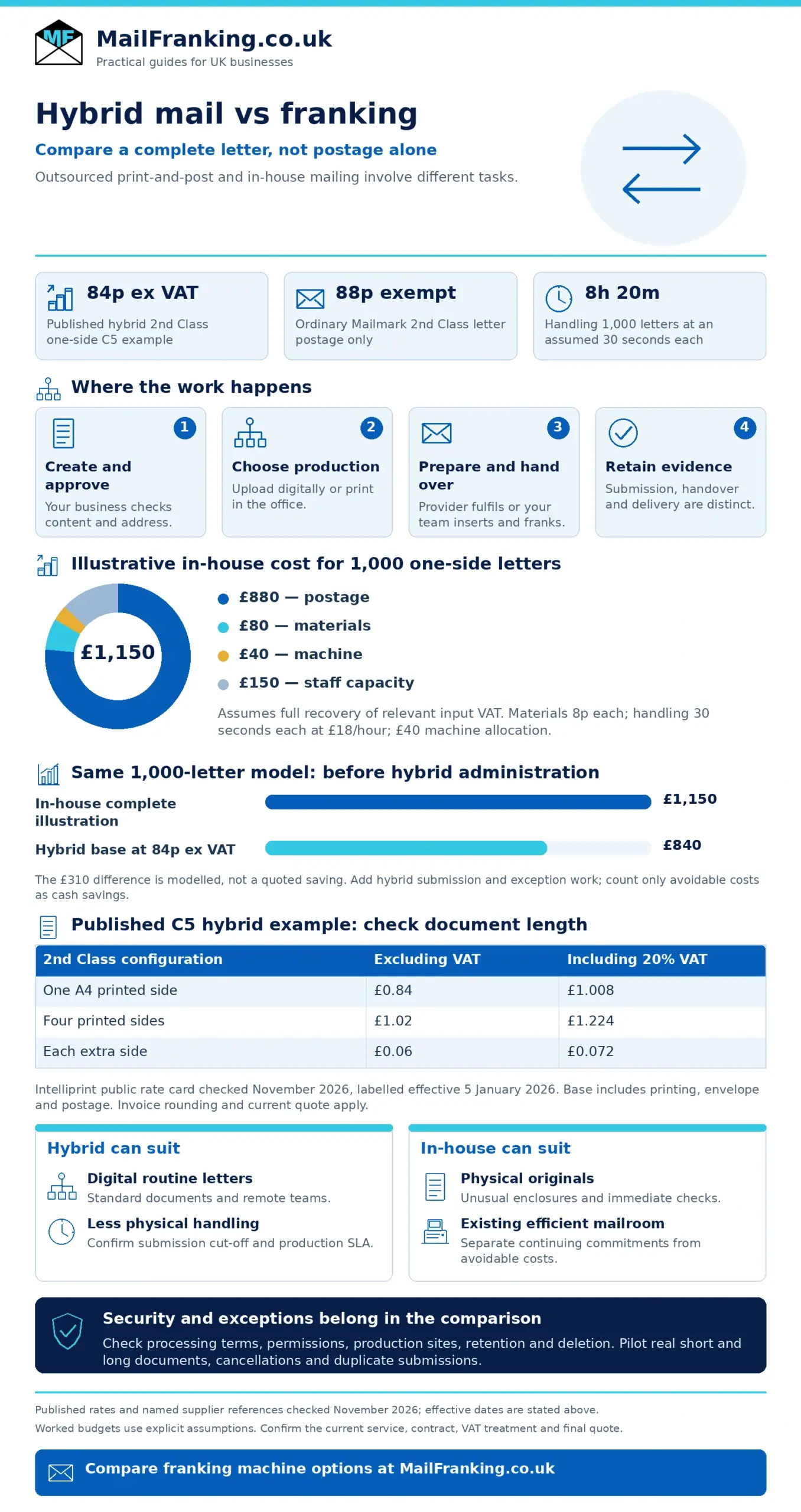
Compare a one-page letter on the same basis
Standard Mailmark postage for a 2nd Class letter up to 100g is 88p under Royal Mail’s October 2026 wallchart. Unlike the illustrated hybrid service, ordinary standard postage is VAT exempt. It is only one component of the in-house cost.
Consider a VAT-registered business able to recover all relevant input VAT. Assume it sends 1,000 one-page letters a month, buys paper, print and envelopes for an illustrative 8p per item excluding recoverable VAT, and allocates £40 monthly to its machine. Allow 30 seconds of handling per letter at an assumed loaded staff cost of £18 an hour.
| Monthly component | In-house franking example | Hybrid example |
|---|---|---|
| Postage or base print-and-post service | £880.00 | £840.00 |
| Paper, print and envelopes | £80.00 | Included in stated base |
| Machine allocation | £40.00 | No new meter assumed |
| Physical handling capacity | £150.00 | Not included in this column |
| Modelled total before hybrid administration | £1,150.00 | £840.00 |
The modelled difference is £310, but this is not a quoted saving. Add hybrid submission, proof checking and exception handling, and remove any in-house costs you cannot actually avoid. If a staff member remains employed for the same hours, the £150 represents released capacity rather than an automatic payroll reduction.
VAT can change the low-volume result
A business that cannot recover VAT should compare gross charges. For 100 letters, the same assumed in-house inputs produce £88 postage, £9.60 materials including VAT, £48 equipment including VAT and £15 staff capacity: £160.60. The hybrid base is £100.80 including VAT, before submission work.
Now suppose the meter and staff capacity are existing unavoidable costs. The immediately avoidable in-house postage and material cash cost is £97.60 for that batch. Against a hybrid base of £100.80, outsourcing is £3.20 dearer before considering the value of time released. The same operation can therefore show a different answer depending on which costs genuinely disappear.
Identify those assumptions explicitly. Compare a new purchase decision using all new costs; compare moving one batch away from an existing mailroom using avoidable costs and capacity separately. Do not claim a machine saving if its rental continues unchanged after the work moves elsewhere.
Document length and enclosure rules
Extra printed sides can materially alter the cost. On the example rate card, a four-side document adds three chargeable sides to the base: 3 × 6p gives 18p excluding VAT. The illustrated 2nd Class total becomes £1.02 excluding VAT, before other options or format changes.
For a 1,000-letter batch, that is £180 more than the one-side base. Longer documents can also change the required envelope format and postage weight. Ask the provider to price your actual sample documents, including the longest routinely used version, rather than relying only on a one-page demonstration.
In-house handling needs the same attention. An office printer’s quoted cost per page may exclude paper or maintenance, while manually inserting several sheets takes longer than one sheet. Measure the complete task and account for reprints, spoiled envelopes and any existing folding or inserting equipment.
Dispatch time is different from delivery time
Hybrid providers often publish a daily production cut-off. Confirm what happens to a file submitted after that time, at weekends or on bank holidays. A “same-day print and post” commitment concerns production and handover; it does not mean the recipient gets the letter that day.
With in-house franking, check your own printer availability, operator cover and posting handover. Being able to print at 5pm is not useful for a deadline if the last accepted collection has already left. Evaluate the end-to-end timetable for the actual postal service and destination.
Separate routine letters from deadline-critical documents. If original signatures, enclosures or a specific guaranteed delivery service are necessary, confirm both that the provider can handle them and that the evidence it supplies meets your requirement. Do not replace a specialist dispatch process solely because a standard letter is cheaper.
Data protection and document security
When a hybrid provider processes personal information on your instructions, establish the parties’ roles and the relevant processing terms. The ICO’s controller–processor contract guidance explains the need for a binding agreement and the types of provisions required where that relationship applies.
Ask about access controls, user permissions, production sites, subcontractors, retention, deletion, incident reporting and audit evidence. Find out who can view uploaded documents and whether staff can download another user’s correspondence. Use sample or anonymised material for early demonstrations.
The in-house route also needs controls. Printed letters left on a shared printer, envelopes matched to the wrong inserts and uncollected trays can expose information. Compare the actual safeguards on both sides. A certificate or encryption claim is helpful evidence to examine, but it does not replace checking how your particular documents are handled.
Reports, audit trails and integrations
Decide which events you need to record: file submitted, approved, printed, handed over, returned or delivered where the service supports that event. These are distinct stages. A portal status such as “processed” should not be treated as proof of recipient delivery unless the provider defines it that way and supplies supporting evidence.
Test whether staff can export records using your customer or case reference. For regular statements or invoices, automatic submission from a business system may reduce manual steps, but there may be integration costs and testing work. Confirm how duplicate submissions are identified and prevented.
Keep a clear exception queue. Documents with missing addresses, unsupported page sizes or print problems should be visible to an accountable person. A silent failed upload can be more disruptive than a visible printer jam because staff may assume a letter has already entered the post.
What remains in the office?
List the items that cannot move easily to standard hybrid production: original certificates, handwritten enclosures, product samples, unusual paper, return packs and work requiring immediate physical checks. This establishes whether the office still needs a printer, envelopes, postage access and possibly its existing meter.
If you keep the machine, negotiate the right service package for the reduced workload. A lower letter volume does not automatically reduce a fixed-term rental payment. Our cancellation guide and switching guide explain the commitments to check before assuming that outsourcing eliminates them.
Conversely, if nearly all correspondence starts as a standard digital file, an expensive high-volume machine may be difficult to justify. Compare hybrid production with both an appropriately sized meter and a simpler online postage route rather than assuming the old mailroom arrangement is the only alternative.
Run a realistic pilot
Select 50–100 representative letters covering short documents, longer versions, different envelope needs and address exceptions. Use the same approval standard for both routes. Record preparation minutes, rejected files, reprints, dispatch confirmation and the actual invoiced cost.
Include at least one change after submission, one cancellation request and one duplicate-file test. Ask staff who will operate the system to do the work, rather than relying entirely on a supplier demonstration. This reveals training needs and the effort of handling imperfect documents.
After the pilot, separate verified cash costs from assumed productivity benefits. Calculate a low-volume month, a normal month and a peak month. A system with no fixed subscription can fit irregular sending, while an existing efficient mailroom may perform better with predictable large batches.
Questions for comparable quotations
Give each provider the same document basket, monthly volumes and deadline requirements. Request a written schedule covering base letter cost, additional sides, colour, envelopes, delivery options, minimum charges, account fees, onboarding, integration, support and price-change terms.
For the meter comparison, include purchase or rental, service, supplies, rate updates and funding charges. Our franking prices guide and maintenance guide help build that side of the budget. The decision should be based on the cost and reliability of your actual workflow, with a practical route for exceptions.
Frequently asked questions
Hybrid mail lets staff submit a digital letter to a provider that prints, envelopes and posts it. The available upload methods, paper, delivery services and reporting vary. Your business still needs accurate addresses, document approval and an appropriate process for sensitive information and dispatch exceptions.
It can be, especially when it replaces printing and inserting work. Compare the complete service against postage, materials, equipment and handling on the same VAT basis. Existing rental commitments may continue, and staff time released is not automatically a cash saving. Price representative documents before choosing.
Not necessarily. A base price may include only one printed side, with additional sides charged separately. Check whether the provider counts sides or sheets, whether printing is duplex and when the envelope or postage format changes. Ask for prices using your actual short and long documents.
A standard digital print-and-post service recreates uploaded content; it does not normally send a physical original sitting in your office. Ask about any specialist fulfilment arrangement for originals or unusual enclosures. Keep a suitable office dispatch route for work that cannot use the standard service.
Check the provider’s invoice treatment. The published hybrid example in this guide applies standard-rate VAT to its services, while ordinary standard Mailmark postage is exempt. Businesses able to recover VAT should compare recoverable amounts consistently; other businesses should compare the full gross charges they pay.
Establish processing roles, contract terms, authorised users, production locations, subcontractors, retention and deletion. Test the approval process and how documents are matched to addresses. Compare these controls with your own printer and mailroom practices, and verify what each status in the dispatch report actually proves.