

FP Mailing PostBase Qi9 can only be assessed properly against the exact UK meter, installed options and service agreement. This review explains the useful specifications, the limits of the published information and the costs to compare before committing.
The key buying issue is whether it suits an office considering a supported older automatic PostBase package. An older product name or a historic headline price is not enough to establish current UK availability, support or value.
FP Mailing PostBase Qi9 specifications
| Item | Detail |
|---|---|
| Product generation | Older PostBase/Qi family |
| Speed identification | Confirm the unit’s UK speed licence and reference manual |
| Feeding | Check whether the quoted package includes the automatic feeder |
| Weighing | Verify the scale capacity and differential-weighing licence |
| Availability | Do not describe it as FP’s newest model |
| Current comparison | FP’s current UK catalogue includes Fusion and PostBase One |
The Qi9 is an older generation, not a new launch. Its name should not be used as a substitute for a complete configuration. FP’s current support resources cover PostBase equipment; obtain the UK manual and written confirmation for the actual speed, scale and service compatibility before buying.
Specification reference: manufacturer or official product documentation. Maximum speeds are laboratory or mechanical ratings; finished-mail productivity also includes weighing, sorting, selecting services, feeding and dispatch preparation.
- Takes 2 minutes
- Receive quotes to compare
- Easy and no commitment
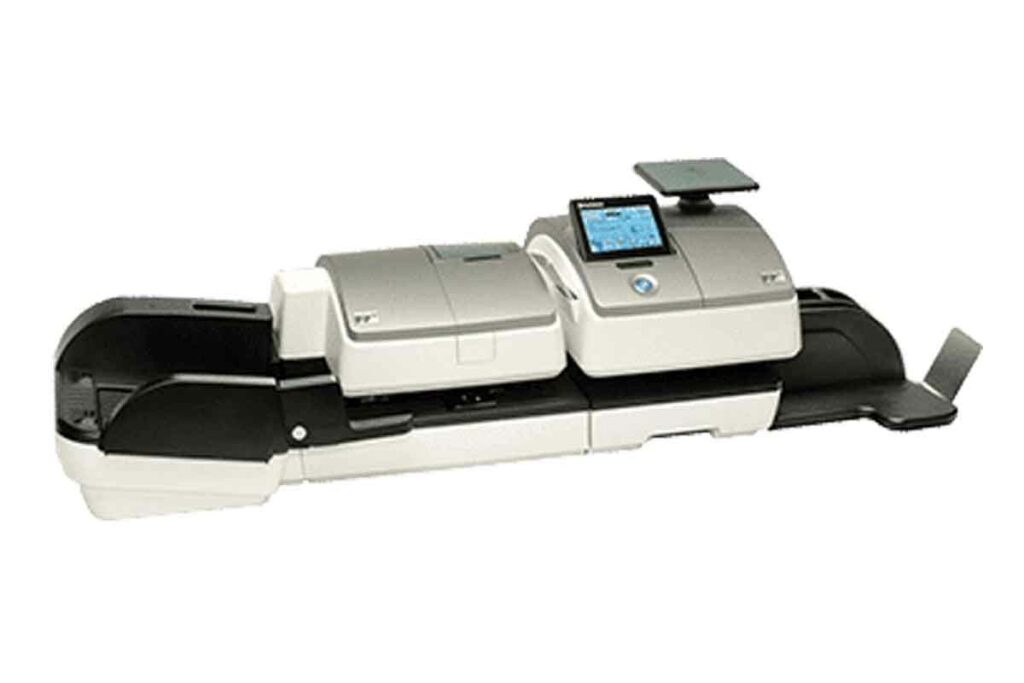
Check the identification plate and meter number on the actual machine offered. Product photographs can show optional equipment, so request an itemised specification instead of relying on the image.
Features and practical limitations
An automatic feeder and a static scale do not necessarily provide dynamic weighing as letters move through the transport. Ask the supplier to demonstrate a mixed batch and identify the rate settings, supported barcodes and current download connection.
For parcels, frank a compatible label where the service and equipment support it; never force an oversized package through an envelope transport. Scale capacity, transport thickness and Royal Mail format limits are separate measurements. A heavier external scale does not increase the maximum weight allowed by a postal service.
Ask the supplier to show how staff select a product, weigh the packed item, change between classes and print a clear impression. Try your thickest routine envelope and a mixed batch. For departmental charging, confirm the number of accounts, report exports, software fees and whether those functions are enabled on this unit. Use the higher-volume shortlist and feeding comparison if the Qi9 no longer meets the workload. Assess the complete preparation and weighing process as well as the rate through the printer.
- Give your requirements
- Receive quotes to compare
- Choose a provider or walk away - your choice!
FP Mailing PostBase Qi9 purchase and rental costs
Price status: we have not verified a current public UK equipment tariff for this exact configuration. The figures below are illustrative budget assumptions for comparing payment methods, not current supplier offers, market averages or evidence of new-stock availability. Replace them with a dated written quotation.
| Budget scenario | Assumed equipment cost | What this establishes |
|---|---|---|
| Illustrative purchase allowance | £2,000–£3,000 | A test budget only; installation, support and VAT must be checked |
| Illustrative monthly rental allowance | £50–£100 | A test budget only; no specific term or inclusions assumed |
| 36-month rental payments at those assumptions | £1,800–£3,600 | Equipment payments before extras and VAT |
| 60-month rental payments at those assumptions | £3,000–£6,000 | Check price increases, exit and return costs |
These budget allowances are not a manufacturer price list. A refurbished unit, a new system and a fully maintained rental are different purchases. A cheap used meter may cost more after recommissioning or may not be usable at all; obtain support confirmation before paying.
What would the running costs mean for your business?
Illustrative calculation: assume £75 monthly equipment rental and £10 for ink, labels and any service charges not included. The total is £85 a month or £1,020 a year, excluding postage and VAT. These are explicit planning assumptions, not an advertised price for this machine.
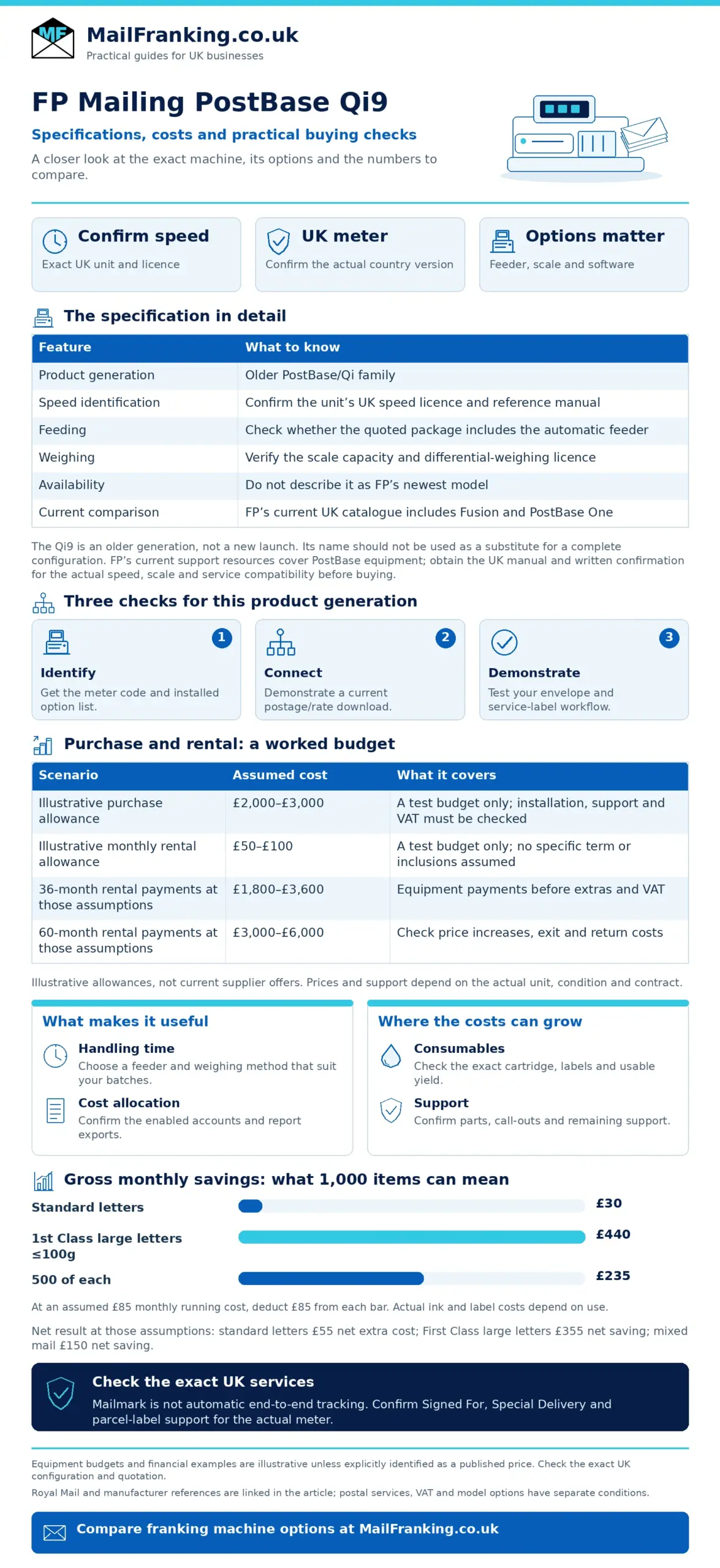
| Monthly mail mix | Gross saving against stamps | After the assumed £85 monthly running cost |
|---|---|---|
| 1,000 standard letters at 3p saving each | £30 | £55 net extra cost |
| 1,000 First Class large letters up to 100g at 44p saving | £440 | £355 net saving |
| 500 standard letters and 500 First Class large letters up to 100g | £235 | £150 net saving |
At a 3p postage saving the assumed £85 monthly running cost needs about 2,834 letters to break even. At 44p it needs about 194 qualifying large letters. These thresholds assume the stated average consumables allowance remains adequate; actual ink and label use can rise with volume. Staff time, installation and finance costs are separate.
Use actual volumes from the last three months rather than your busiest day. A machine may still be valuable for handling speed, departmental accounting and a professional imprint, but count those benefits separately from a postage saving. Our franking machine cost guide explains how to compare whole-contract costs.
Licence, services and ongoing support
Arrange the Royal Mail franking licence through the provider and make sure it matches your business, address and meter. For a second-hand unit, obtain written confirmation that it can be recommissioned before paying. An old meter with ink and power is not necessarily usable for current UK postage.
Mailmark is a postage payment and data format, not a promise of end-to-end tracking on every letter. Royal Mail Signed For, Special Delivery and international goods may require a supported barcode or separate shipping-label workflow. Ask the supplier to demonstrate the specific services you need on the exact UK unit.
Check the supplier in Royal Mail’s authorised franking services directory. Confirm current connectivity, rate downloads, usage-data uploads, replacement parts and ink availability. Ask who provides repairs, whether carriage and call-outs are included, and what happens if the equipment cannot be brought back into service. For the support and transition costs, use the maintenance and repair guide and registration guide to check the exact unit, provider responsibilities and any change of user or address.
What to ask for in the quotation
- Exact model, meter identification, UK Mailmark capability and new or refurbished condition.
- Equipment price or every monthly payment, contract length, VAT and any annual increase.
- Installation, licence administration, rate downloads, postage funding fees and software charges.
- The ink cartridge part number, realistic yield, label size and replacement prices.
- Service response, parts, loan equipment, return costs and early termination charges.
- A demonstration using your own envelopes, larger items and the postal services you send.
Compare the total payable over the same term. A £40 monthly agreement totals £1,440 over 36 months or £2,400 over 60 months before extras. A £60 agreement totals £2,160 or £3,600 respectively. Rental does not automatically include unlimited ink, servicing or an upgrade; a finance lease does not automatically transfer ownership.
Our assessment
FP Mailing PostBase Qi9 is worth considering only where the confirmed specification fits an office considering a supported older automatic PostBase package and the supported whole-contract cost compares well with alternatives. For a low-volume sender, the small saving on ordinary letters can be outweighed by equipment and consumables; for larger letter batches, operator time may be the more valuable benefit.
Compare small-business machines, rental terms and used-machine checks using the same monthly mail mix. This is a specification and buying review, not a claim that we have physically tested the equipment.
Frequently asked questions
The Qi9 is an older generation, not a new launch. Its name should not be used as a substitute for a complete configuration. FP’s current support resources cover PostBase equipment; obtain the UK manual and written confirmation for the actual speed, scale and service compatibility before buying.
An automatic feeder and a static scale do not necessarily provide dynamic weighing as letters move through the transport. Ask the supplier to demonstrate a mixed batch and identify the rate settings, supported barcodes and current download connection.
Obtain an itemised quotation for the exact model, condition and contract. Public prices are often tailored. Compare the equipment payment with ink, labels, service, rate updates and postage funding fees. The numerical budgets in this guide are illustrations unless explicitly identified as a supplier’s published price.
For standard letters up to 100g, the October 2026 Royal Mail tables show a 3p saving against stamps for either class. A First Class large letter up to 100g saves 44p. Equipment and consumables must be deducted, and online or business-account postage may price differently.
Mailmark does not make ordinary First or Second Class post a fully tracked service. Tracking, signature and compensation depend on the postal product purchased. Check the supported label or barcode workflow for Signed For, Special Delivery and international services before choosing an older machine.
Yes. The provider normally arranges your Royal Mail franking licence. It identifies the business, address and meter. Tell the provider when those details change. Before buying a used machine, confirm that it can be registered and supported for your intended UK postal services.
Usually postage is funded separately from the equipment agreement. Ask for a written breakdown of included credit, funding fees, ink, labels, service and tariff updates. Introductory postage credit should be shown separately from the recurring equipment charge so that you can compare the full contract.
Compare total costs over the same period and check support for the whole term. Buying avoids rental payments but can leave you responsible for repairs and updates. Renting spreads the cost, although cancellation, renewal and return obligations can make it a substantial long-term commitment.