

A Royal Mail franking licence authorises the use of a specified franking machine for the registered user and operating address. Buying, renting or inheriting the equipment does not remove the need to arrange the appropriate licence before using it to prepare Royal Mail post.
For most businesses, the practical route is through an authorised manufacturer or supplier. This guide explains registration, used-machine transfers, office moves, fees and closure, while distinguishing the Royal Mail licence from equipment finance, service cover and postage funding.
What does a franking licence cover?
Royal Mail’s published franking scheme sets out the relationship between the registered user, the equipment and its use. The required information includes the user’s name, the address where the equipment is used, the model and identifying details such as the serial number or die identifier.
The Franking Letters and Parcels Scheme is the primary source for the provisions discussed here. Royal Mail’s current non-contract terms index lists that scheme. The document’s 2018 date should not be replaced with an invented newer version simply because it is being consulted in 2026.
- Takes 2 minutes
- Receive quotes to compare
- Easy and no commitment
| Item | What it establishes | What it does not replace |
|---|---|---|
| Franking licence | Authorised use of specified equipment by the registered user | Purchase, rental or finance agreement |
| Equipment contract | Commercial rights and obligations for the machine | Royal Mail permission to use it |
| Service agreement | Defined maintenance and support cover | Postage credit or unrestricted repair cover |
| Postage account | Funding and applicable account arrangements | Ownership or automatic licence transfer |
A business should keep these records together but recognise that they are separate arrangements. Returning a leased unit, closing a postage account or changing a company name may require action with more than one organisation. Do not assume one cancellation automatically resolves everything else.
Do all businesses need to register before franking?
The scheme requires a user licence obtained through an authorised manufacturer or supplier before using the equipment. Royal Mail’s business franking information explains the supplier route. Ask the provider to confirm completion rather than assuming a delivery note is evidence that registration is active.
The licence is tied to the specified user and equipment. A business using several machines should not assume one licence automatically covers them all. The scheme states that separate equipment requires a separate licence, so list each serial number and operating location during setup.
The scheme also restricts use to the licensee’s own mail at the specified address. Do not assume your licence permits a general service franking unrelated businesses’ mail for payment. Shared-office, group-company or outsourced-mail arrangements should be described clearly to the provider so the appropriate authorisation can be established.
- Give your requirements
- Receive quotes to compare
- Choose a provider or walk away - your choice!
For a limited company, identify the correct legal entity, not merely the trading name printed on an envelope. For other business structures, ask what user details the provider requires. Inaccurate registration can create avoidable delays when changing suppliers, moving premises or closing the account.
How to arrange a licence
Start with an appropriate authorised provider and confirm it can register and maintain the exact machine. The Royal Mail franking-company directory provides a route for checking authorised businesses. An appearance in a directory should not be treated as a recommendation that one provider offers the cheapest contract or best service.
Supply the legal user details, operating address, model and serial number requested. The provider should explain the registration process, postage-funding setup and any documents requiring agreement. Ask which organisation holds each account and who should be contacted when details change.
| Setup stage | Practical check |
|---|---|
| Identify the machine | Confirm model, serial number, condition and current support |
| Identify the user | Use the correct legal entity and operating address |
| Arrange authorisation | Obtain provider confirmation that licensing is complete |
| Establish funding | Understand payment method, fees and postage balance records |
| Configure and test | Check rates, accounts, network and a permitted test process |
| Retain records | Keep confirmation, contracts, contacts and notice deadlines |
Do not print paid postage simply to experiment before registration and setup have been confirmed. Ask the installer to demonstrate the correct test method and how to avoid duplicate or unusable impressions. Establish a normal process for checking the selected product before every batch.
How much does a franking licence cost?
The Royal Mail sources reviewed do not establish a single universal licence fee that can be applied to every new, moved or second-hand machine. It would be misleading to state that every licence is free or that all businesses pay a fixed amount without a supporting current tariff.
Providers may quote setup, registration administration, installation, reconfiguration or used-machine transition work. Ask which charges apply, what each covers and whether it is already included in the equipment package. A supplier administration charge should not be relabelled as a universal Royal Mail statutory fee.
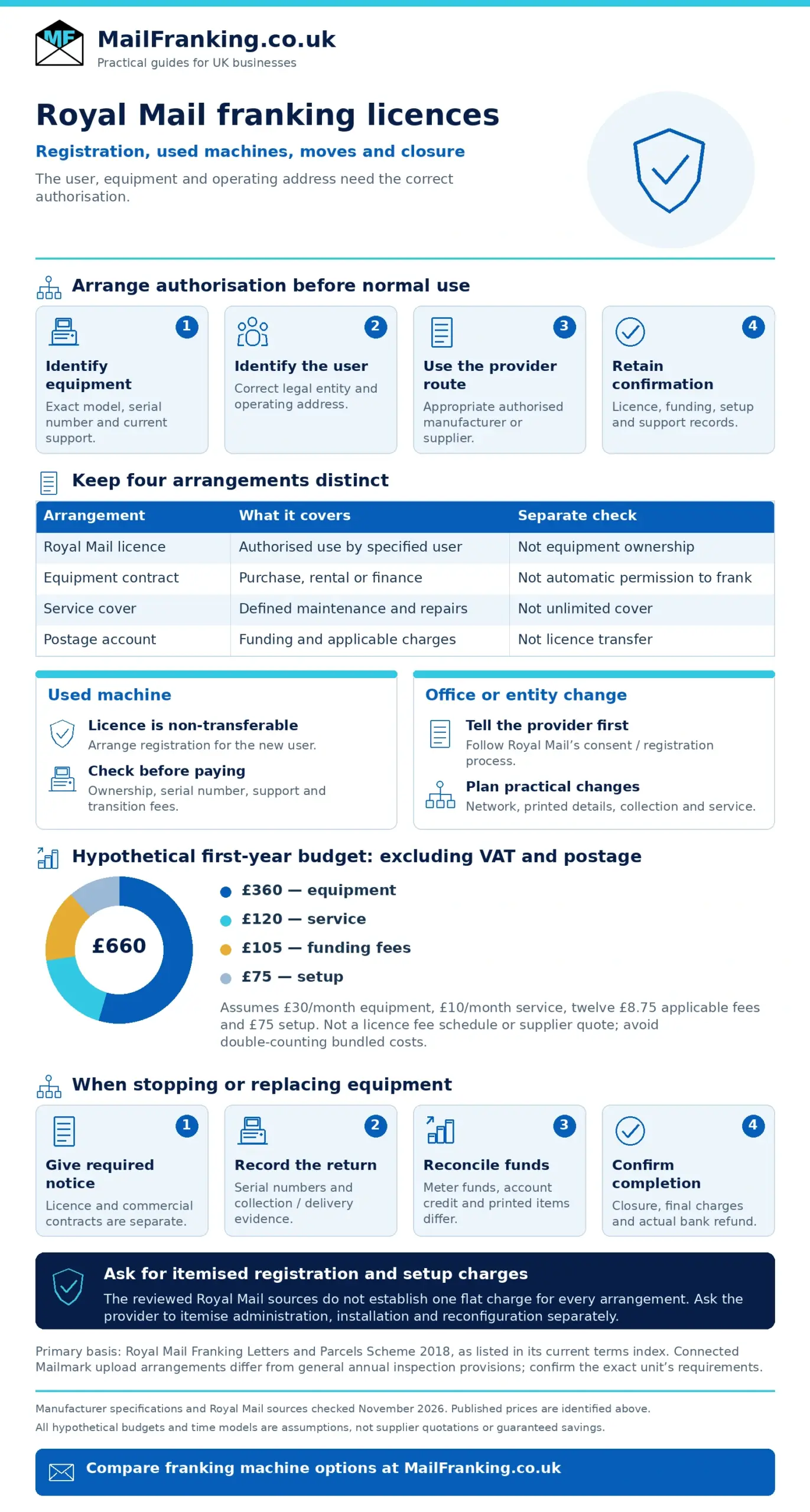
The following is an illustrative first-year budget, not an actual supplier quotation or Royal Mail fee schedule. It shows why a small one-off setup item is only part of the total cost.
| Assumed cost item | Calculation | First-year amount excluding VAT and postage |
|---|---|---|
| Equipment | £30 per month × 12 | £360 |
| Service | £10 per month × 12 | £120 |
| Applicable funding fees | Assumed £8.75 × 12 | £105 |
| Setup administration | Assumed one-off amount | £75 |
| Total of these assumptions | Excludes ink, labels and other unlisted charges | £660 |
The £8.75 reference appears in specified Pitney Bowes arrangements, but it is not a charge that should be assumed for every supplier or licence. Your actual package may include funding or service items. Remove duplicates and replace all assumptions with the itemised quote.
Buying a second-hand machine
The scheme makes the user licence non-transferable. Buying the physical machine from another business therefore does not automatically give you the previous user’s authorisation. Arrange the appropriate new user registration through a suitable authorised provider before use.
Obtain the serial number before paying and ask whether the unit remains supported for current UK services. Confirm who will release or decommission the old arrangement, clear relevant records, register the new user and supply compatible consumables. A low purchase price can be outweighed by transition costs or unavailable support.
Ask about the equipment’s ownership and any remaining finance obligations. A seller’s possession of a leased device is not evidence that it can be sold without restriction. Request appropriate evidence of title or permission to transfer, along with the refurbishment or condition information offered.
Unused postage requires a separate process. Do not assume a displayed balance can simply be sold with the machine or transferred into your new account. The provider needs to establish the correct withdrawal, credit or refund route for the old user’s arrangement.
Moving office or changing business details
The scheme requires changed details, including a changed operating address, to be dealt with through the manufacturer or supplier and Royal Mail’s consent process. Contact the provider before moving rather than waiting until the unit is unpacked at the new address.
Give the proposed address, move date, legal-user details and machine identification. Ask whether a new licence or amended registration is required, how the printed impression and account records will be updated and when normal use can resume. Obtain written confirmation of the completed change.
An office move can also affect network access, postage supplies, collections and service attendance. Plan those separately from licensing. A correctly registered machine can still be unusable if the new Wi-Fi, firewall or physical workspace prevents the required connection and operation.
If the business changes legal entity, do not treat that as merely a cosmetic trading-name update. Explain the change to the provider and ask how the old and new arrangements should be handled. Keep the licence, equipment agreement and postage-account responsibilities distinct throughout the transition.
Changing suppliers or replacing equipment
Before switching, identify every agreement involved: equipment finance, rental, service, software and postage funding can have different notice periods. A new supplier’s installation date does not prove the old contract has ended. Keep written cancellation and collection confirmations.
For replacement equipment, confirm the new machine’s registration and the old unit’s closure process. Record both serial numbers so invoices, support calls and balances are not mixed up. Arrange secure handover and retain the return receipt or collection evidence.
If a supplier proposes using the existing machine under a new arrangement, ask whether it is authorised for that model and exactly how registration and account changes are handled. Do not assume every authorised franking company supports every machine in every configuration.
Our switching franking-machine supplier guide covers the commercial comparison. Licensing is one part of the process; the complete decision also includes service continuity, consumables, ownership, notice deadlines and recovery of unused postage.
Maintenance and inspection responsibilities
The licence is not a comprehensive repair contract. The scheme contains maintenance and inspection provisions, including use of appropriate authorised maintenance arrangements. Ask the provider what applies to the exact model and which services are included in the commercial agreement.
Avoid assuming every connected Mailmark machine needs the same paid annual physical visit. The scheme distinguishes the general annual inspection provision from connected Mailmark data-upload arrangements. The applicable requirement and the supplier’s optional or contractual service offer should be explained separately.
Check rates, the printed impression and any warnings as part of normal use. A valid licence does not remove responsibility for selecting correct postage. Wrong format, weight or class can still lead to insufficient postage and potential surcharges under the applicable postal rules.
Our franking maintenance guide explains how to compare inspection, routine servicing, breakdown repair and replacement cover. Request clear response and restoration terms rather than assuming the word “licensed” means Royal Mail will repair the machine.
Stopping franking and recovering unused funds
The scheme requires notification when equipment is permanently taken out of use. Contact the relevant Royal Mail administration route and the manufacturer, supplier or maintainer as required by the stated process. Ask the provider to coordinate the steps and confirm completion in writing.
Read the commercial cancellation requirements before stopping payments or returning equipment. Closing a licence and ending finance are different actions. Retain the final account statement, return evidence and any confirmation that no further equipment or service charges remain due.
Unused meter funds, supplier-account credit and unused printed impressions are different categories. A supplier may first move eligible old-meter funds into account credit, with a separate process needed for a bank refund. Do not assume a closed account means the cash has already been returned.
Follow the provider’s current postage-credit and refund process and keep balance evidence. The scheme addresses verified unused postage subject to its conditions; it does not establish that every fee, rental payment or spoiled impression is refundable on the same basis.
A practical registration checklist
- Confirm the correct legal user, operating address and exact serial number.
- Check the provider’s authority and support for the specific machine.
- Obtain written licensing and installation confirmation before normal use.
- Separate equipment payments, service charges, funding fees and postage money.
- Record how moves, entity changes and replacement equipment must be reported.
- Keep cancellation, return and unused-credit procedures with the contract records.
This guide summarises the published scheme and practical provider questions rather than reproducing a licence or offering a personalised legal interpretation. For an unusual shared-mailroom, group-company or transfer arrangement, give the authorised provider the actual facts and obtain confirmation of the appropriate registration before relying on it.
Frequently asked questions
The published franking scheme requires a user licence before using the specified equipment for Royal Mail franking. Arrange it through an appropriate authorised manufacturer or supplier and obtain confirmation. Buying or renting the machine, holding postage credit or signing a service contract does not independently replace that authorisation.
No. The scheme makes the user licence non-transferable. A buyer needs the appropriate registration for their own use rather than relying on the seller’s licence. Obtain the serial number and confirm support, ownership, transition work and costs with a suitable authorised provider before committing to the purchase.
The sources reviewed do not establish a universal fee or a blanket guarantee of free registration. Ask for itemised provider charges covering setup, administration, installation or reconfiguration, and check what is bundled. Do not confuse a supplier’s commercial administration charge with a standard Royal Mail fee applying to every user.
Yes. The published scheme requires changes such as the operating address to be handled through the provider and Royal Mail’s consent process. Contact the supplier before moving and obtain confirmation of the updated authorisation. Network access, collections, service attendance and printed details may also need separate changes.
Do not assume so. The scheme specifies separate licensing for separate equipment. Give the provider each machine’s identification and operating details, including shared or multi-site arrangements. The registration is distinct from a group purchasing contract, central postage account or reporting dashboard that may cover more than one unit.
Notify the relevant parties under the scheme and follow the supplier’s closure process. End equipment, service and funding arrangements separately where required, retain return evidence and reconcile unused postage. Meter funds, supplier-account credit and printed unused impressions follow different routes; closure alone does not prove money has reached your bank.