

The advertised rental is only one part of a franking machine’s cost. Your business may also pay for service, inspections, ink, labels, postage funding, software and changes to the agreement. Some packages combine several charges, while others leave them on separate invoices.
The way to avoid an expensive surprise is to compare the whole contract with the same expected workload. This guide explains the fees to check, uses published supplier charges where available and shows how apparently cheaper equipment can become more expensive once the extras are counted.
The costs that belong in your comparison
| Cost | What to establish | How to compare it |
|---|---|---|
| Equipment | Purchase, rental or finance payment; exact model and condition | Total payments over the same period |
| Maintenance | Labour, parts, response, transport and replacement equipment | Included obligations and exclusions |
| Inspection | Who performs the required checks and what is included | Separate charge or part of the service |
| Ink | Cartridge, usable yield, delivery and subscription conditions | Cost at your actual printing volume |
| Labels | Label size, usable count and which items need one | Cost per usable label, not per sheet |
| Postage funding | Fee per refill, account charges and payment method | Annual cost at expected refill frequency |
| Tariff updates | Included products and any update charge | Written scope of updates and price |
| Software | Accounts, reports, shipping functions and support | Licence term, limits and renewal |
| Start and finish | Delivery, setup, return and settlement charges | One-off cash cost and timing |
These are categories to investigate, not charges every provider necessarily makes. An agreement can be economical because it genuinely includes service and supplies. Another can be economical because it leaves you free to buy them separately. The numbers and obligations need to support the choice.
Use our main prices guide for the wider equipment comparison and the rental guide for the distinction between rental and finance. Here the focus is the expenditure that a headline payment can leave unclear.
- Takes 2 minutes
- Receive quotes to compare
- Easy and no commitment
A published example of postage top-up fees
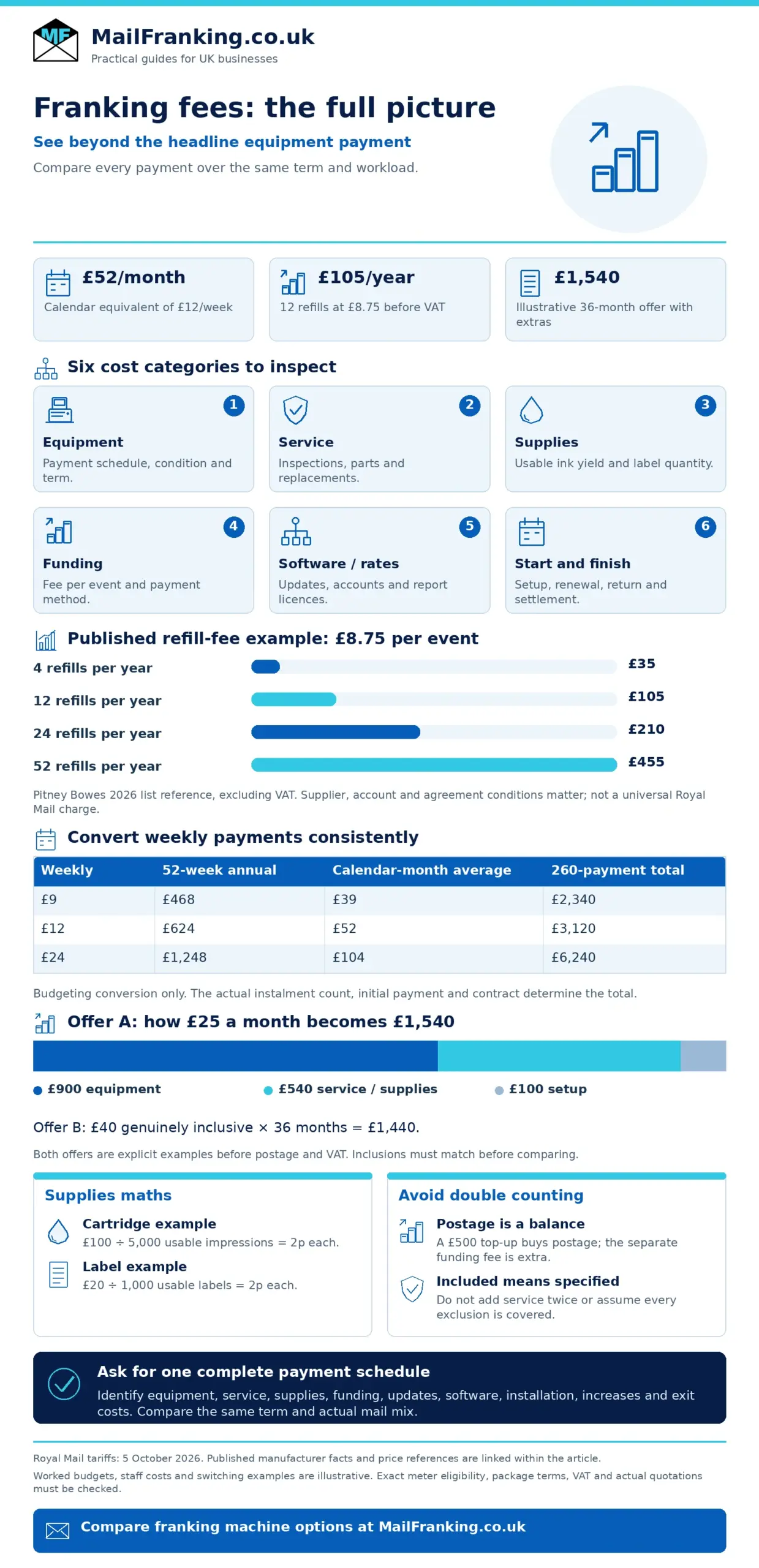
Pitney Bowes’ 2026 equipment and service price list identifies a £8.75 plus VAT re-credit fee for its stated Pay As You Go and PrePay arrangements, with £13 plus VAT specified for PrePay paid by invoice. These are supplier-specific published references, not Royal Mail charges applying to every machine.
| Refill pattern | At £8.75 plus VAT per refill | At £13 plus VAT per refill | Difference before VAT |
|---|---|---|---|
| 4 refills per year | £35 | £52 | £17 |
| 12 refills per year | £105 | £156 | £51 |
| 24 refills per year | £210 | £312 | £102 |
| 52 refills per year | £455 | £676 | £221 |
A business topping up weekly at £8.75 pays £350 more in annual refill fees than one topping up monthly at the same fee. That does not mean every business should deposit a year’s postage in advance. Larger balances tie up cash, and the account’s conditions, available credit and security controls still matter.
Ask whether an inclusive agreement waives any reset charges, whether the fee changes by payment method and whether a failed payment attracts another charge. A sales description saying that you can refill remotely explains convenience, not necessarily price.
Postage credit is different from the fee
If you add £500 of postage and pay an £8.75 funding fee, the £500 is a balance used to buy postal services. It should not also be charged as an equipment operating expense in a comparison that already includes the same postage spend. The fee is the additional cost of that funding event.
- Give your requirements
- Receive quotes to compare
- Choose a provider or walk away - your choice!
There can also be money in more than one place: on the meter and in a supplier-managed account. Reconcile the opening balance, additions, postage used, adjustments and closing balance. An unused balance is not the same as ink stock or an unpaid rental invoice.
For a switch or cancellation, ask how each balance is recovered, what deductions may apply and how the refund is paid. Our guides to switching suppliers and cancelling a contract explain the sequence of checks.
Our guide to postage credit, top-up fees and refunds separates meter funds from supplier account balances and shows how to reconcile downloads, fee invoices, unused credit and spoiled printed postage.
Weekly quotes can disguise the calendar-month budget
Convert payments to the same basis before comparing them. A £12 weekly payment totals £624 over 52 weeks, or an average £52 per calendar month. Multiplying by four gives £48, which leaves four weeks of payments out of a full year’s budget.
| Quoted weekly payment | Annual equivalent at 52 weeks | Average calendar month | Five years at 260 weekly payments |
|---|---|---|---|
| £9 | £468 | £39 | £2,340 |
| £12 | £624 | £52 | £3,120 |
| £24 | £1,248 | £104 | £6,240 |
| £78 | £4,056 | £338 | £20,280 |
The payment schedule and actual number of instalments in your contract remain decisive. This table is a budgeting conversion, not a supplier quotation. Check whether an initial payment is additional, whether service is included and whether the equipment is owned at the end.
For a direct published illustration, the Pitney Bowes list marks its Mailstation offer as refurbished and shows different weekly figures with and without inclusive service. Preserve that condition label when comparing it with a new machine. A refurbished list price cannot be presented as the purchase price of a new unit.
Maintenance, inspections and breakdown cover
A maintenance agreement should explain what happens when equipment fails, who diagnoses the problem and whether repair takes place on site or at a service centre. Response time, repair time and replacement dispatch time are different commitments. A promise to respond tomorrow is not necessarily a promise that your post will leave tomorrow.
Royal Mail states that franking-machine maintenance is performed by authorised providers. Check authorisation for the exact model, including any ageing or discontinued unit. A cheap service plan has limited value if replacement parts or the required postal functions are no longer available.
The Pitney Bowes price list separately identifies inspection at £90 per year when purchased alone. Treat that as a specific published price, not the cost of a full repair agreement. Ask about print heads, scales, batteries, transport, accidental damage and replacement equipment before assuming they are covered.
Allow for operational disruption as well. If a temporary replacement changes the postage process or requires staff training, record the time and cost. A business with an important daily mail run may rationally pay more for a better defined recovery service than for the cheapest annual inspection.
Use the maintenance and repair costs guide to compare published annual service prices, exclusions and downtime budgets. It also explains the distinction between Mailmark data reporting, inspection and contractual service cover.
Ink, labels and the cost per impression
A cartridge’s advertised impression yield is not the same as a guarantee for every office. The length of the printed message, logo coverage, cleaning, print quality and the time between uses can affect the usable result. Compare like-for-like cartridges and ask which consumption assumptions underpin the quote.
In an illustrative example, a £100 cartridge producing 5,000 usable impressions costs 2p per item. At 2,500 usable impressions it costs 4p. Add a 3p label where a label is actually required and the combined example becomes 5p or 7p. Direct envelope printing may avoid that label, but not the ink.
Check whether labels are counted as individual usable labels or sheets. A pack of 500 sheets containing two usable labels per sheet provides 1,000 labels. At £20, that is 2p per usable label, rather than 4p. Use the exact stock dimensions supported by the machine.
Our ink and labels guide compares these purchasing issues in more detail. Before buying third-party supplies, establish the accepted ink, cartridge compatibility and any effect on your service agreement. A cheaper product listing does not by itself establish postal acceptance or contractual cover.
Rate updates and software subscriptions
Ask which Royal Mail tariffs are updated, whether the charge covers every required update and whether the meter must remain connected to receive them. A free domestic update does not automatically establish that every international or shipping function is included.
Software can also change what you are buying. Departmental accounting, exportable reports, parcel labels and cloud services may depend on separate licences, hardware or account arrangements. Request the name of each entitlement, its price and what happens to your data when the subscription ends.
The published FP rental terms, labelled 2020 version 1.4 10/22, illustrate why the agreement matters: they distinguish certain packages with included tariff updates from arrangements where updates are chargeable. This is an example from that document, not a statement that every current FP quotation uses the same terms.
Avoid paying for reporting that duplicates an existing process without adding useful control. If you need to recharge departments or clients, test the actual report on sample data. A list of account numbers on a screen may not provide the export your finance team requires. The SendPro C vs Plus comparison illustrates why printer hardware, software access and shipping functions must be identified separately before comparing the headline payment.
Compare a cheap headline with a complete offer
Consider two illustrative 36-month proposals. Offer A charges £25 monthly for equipment, then £15 monthly for supplies and service plus £100 setup. Offer B charges £40 monthly and genuinely includes those same supplies, service and setup. Neither includes postage or VAT in this example.
| Cost over 36 months | Offer A | Offer B |
|---|---|---|
| Equipment payments | £900 | £1,440 |
| Supplies and service | £540 | Included in the assumed £40 |
| Setup | £100 | Included |
| Comparable total | £1,540 | £1,440 |
| Average monthly cost | £42.78 | £40 |
Offer A’s headline is £15 lower, yet its total is £100 higher. If it also attracts 12 funding fees annually at £8.75, that adds £315 over three years. Only add that difference if Offer B’s written terms really include the equivalent funding events; otherwise compare the fees on both sides.
Test a lower-volume scenario too. An expensive inclusive-ink package may be poor value if the machine prints only a few items a week. Conversely, a large printing volume can make an inadequately costed supplies allowance unrealistic. The right package depends on use, not the word inclusive alone.
Renewal, upgrades and the cost of leaving
Read the minimum term, notice provisions and what happens at expiry. A five-year equipment obligation is different from a monthly cancellable software subscription. A replacement machine or upgrade may introduce a new term; obtain a written explanation of the old balance and the new payment schedule.
An early-exit illustration shows the scale. If 18 monthly payments of £45 remain, the scheduled payments total £810. A settlement quotation may use a different calculation and include or exclude particular amounts, so do not present £810 as a universal cancellation fee. Add return costs and any overlap separately.
Check whether a supplier’s contribution towards an old agreement is a cash payment, a credit or an amount built into the new finance. A £500 incentive accompanied by a higher five-year payment can be less valuable than it appears. Compare total future cash outlay, including any remaining old liability.
The questions to put in every quote request
- What exact UK model, meter, condition, scale and feeder are included?
- What are all payments, their frequency, the minimum term and any increases?
- Which inspections, repairs, parts, transport and replacements are included?
- How are ink, usable labels, updates and software charged?
- What does each funding event cost under my payment method?
- What notice, renewal, return and settlement provisions apply?
Ask for an itemised schedule and keep it with the signed agreement. A useful proposal should let you calculate one comparable total without guessing which invoice covers which promise. Use our savings calculator with that complete monthly cost before deciding whether the equipment pays for itself.
Frequently asked questions
No. Fees depend on the supplier, payment method and agreement. Pitney Bowes’ 2026 published list includes stated re-credit charges, while particular inclusive offers may differ. Ask for the charge per event and calculate the annual cost using your likely number of refills.
Do not assume so. Equipment rental and postage are separate cost categories. An introductory credit or allowance should be identified separately from recurring equipment charges. Check funding fees and any included credit in writing, then compare the ongoing cost after an introductory offer finishes.
Only the items specified in the agreement. Check ink, labels, tariff updates, inspections, repairs, parts, transport and replacement equipment individually. Look for allowances and exclusions, and distinguish response time from repair time. A generic description does not establish the scope of your particular package.
Multiply a weekly figure by 52 and divide by 12 for an average calendar-month budget. For example, £12 weekly is £624 annually, equivalent to £52 monthly. Then compare the actual number of instalments and any initial payment in the contract, rather than relying on that conversion alone.
It may, but compare usable yield, delivery and the exact meter’s supply requirements. Establish whether the cartridge and ink are accepted for the unit and compatible with your service conditions. A low purchase price can be poor value if it causes unreadable impressions or avoidable support costs.
Include equipment, service, supplies, funding fees, software and expected one-off charges, with postage shown separately. Use a consistent VAT basis and avoid counting included costs twice. Test lower and higher volumes, since a supplies allowance suitable for occasional use may fail at a busy office’s output.