

To cancel a franking machine contract, first identify every agreement involved, confirm the earliest end date and give notice using the required method. Equipment, finance, maintenance, supplies and postage funding can be separate arrangements, so returning the machine alone may leave payments outstanding.
The safest practical sequence is to obtain written terms and settlement figures, agree the end date, follow the return process and reconcile all money afterwards. This guide explains how to organise that process, compare leaving now with waiting and prepare a clear cancellation request without assuming every UK business has the same rights or charges.
Start with the agreement you actually signed
Find the current signed contract and any later upgrade or renewal paperwork. Check the named customer and provider, agreement number, equipment identifiers, payment schedule, minimum term, notice provisions and return obligations. A brochure or current website may not reproduce the version incorporated into your agreement.
Ask for copies where records are missing. If there is a finance company, request its agreement and account statement separately. Make a list of what ends automatically with the equipment and what requires another instruction. Do not treat a conversation with a salesperson as proof that a finance company has released you.
- Takes 2 minutes
- Receive quotes to compare
- Easy and no commitment
| Arrangement | Cancellation question | Evidence to obtain |
|---|---|---|
| Equipment rental | When can it end, and what notice is required? | Accepted notice and confirmed end date |
| Finance or lease | What remains payable or what settlement applies? | Dated settlement and confirmation of discharge |
| Maintenance | Does it end with the machine or renew separately? | Service closure and final charge |
| Supplies subscription | Are future shipments or minimum payments committed? | Cancellation reference and outstanding order status |
| Postage funding | How are account and meter balances recovered? | Final balances, credits and refund confirmation |
This is a record-keeping framework rather than a statement that all five arrangements exist in your case. If one agreement bundles several services, establish exactly which terms govern ending each part. Keep all responses in one file so conflicting instructions can be resolved before equipment leaves your premises.
Is there a cooling-off period?
Do not assume that the familiar consumer fourteen-day cancellation rule applies to a business franking agreement. Trading Standards’ business-to-business guidance explains that businesses do not automatically receive the same cooling-off rights as consumers when buying at a distance or on business premises.
A contract may offer its own short cancellation window, and particular finance arrangements can require separate legal analysis. The customer’s legal status, type of agreement and circumstances matter. Where a significant amount is disputed, obtain advice on the actual documents rather than relying on a generic online answer.
For example, the published FP equipment rental terms, labelled 2020 version 1.4 10/22, contain a limited seven-day route with conditions concerning unused, unopened equipment and promotional items. That is a provision in that version of those terms, not a universal seven-day right for all brands or current FP agreements.
- Give your requirements
- Receive quotes to compare
- Choose a provider or walk away - your choice!
Check notice and renewal before calculating costs
Read when notice must arrive, who must receive it and when termination can take effect. A notice period expressed as three months can interact with an end-of-term requirement. It does not necessarily mean you can end any agreement three months after sending an email.
The same published FP document illustrates the issue: it describes at least three months’ written notice to expire at the end of the minimum term and provisions for successive renewal periods. The terms attached to your own agreement may differ, so establish the version and dates instead of applying that example automatically.
| Detail to confirm | Practical action |
|---|---|
| Minimum-term end | Obtain the date from the agreement and provider |
| Notice deadline | Calculate from the contractual wording and seek confirmation |
| Delivery method | Use the specified address, portal or other accepted method |
| Proof | Keep the message, attachment, acknowledgement and delivery evidence |
| Renewal | Ask exactly what happens if notice is late or no notice is given |
| Final payment | Request its amount, date and the period it covers |
Avoid giving a speculative cancellation date that has no basis in the agreement. You can ask the provider to confirm the earliest permitted date while making clear that you do not want an unintended renewal, subject to the proper notice provisions.
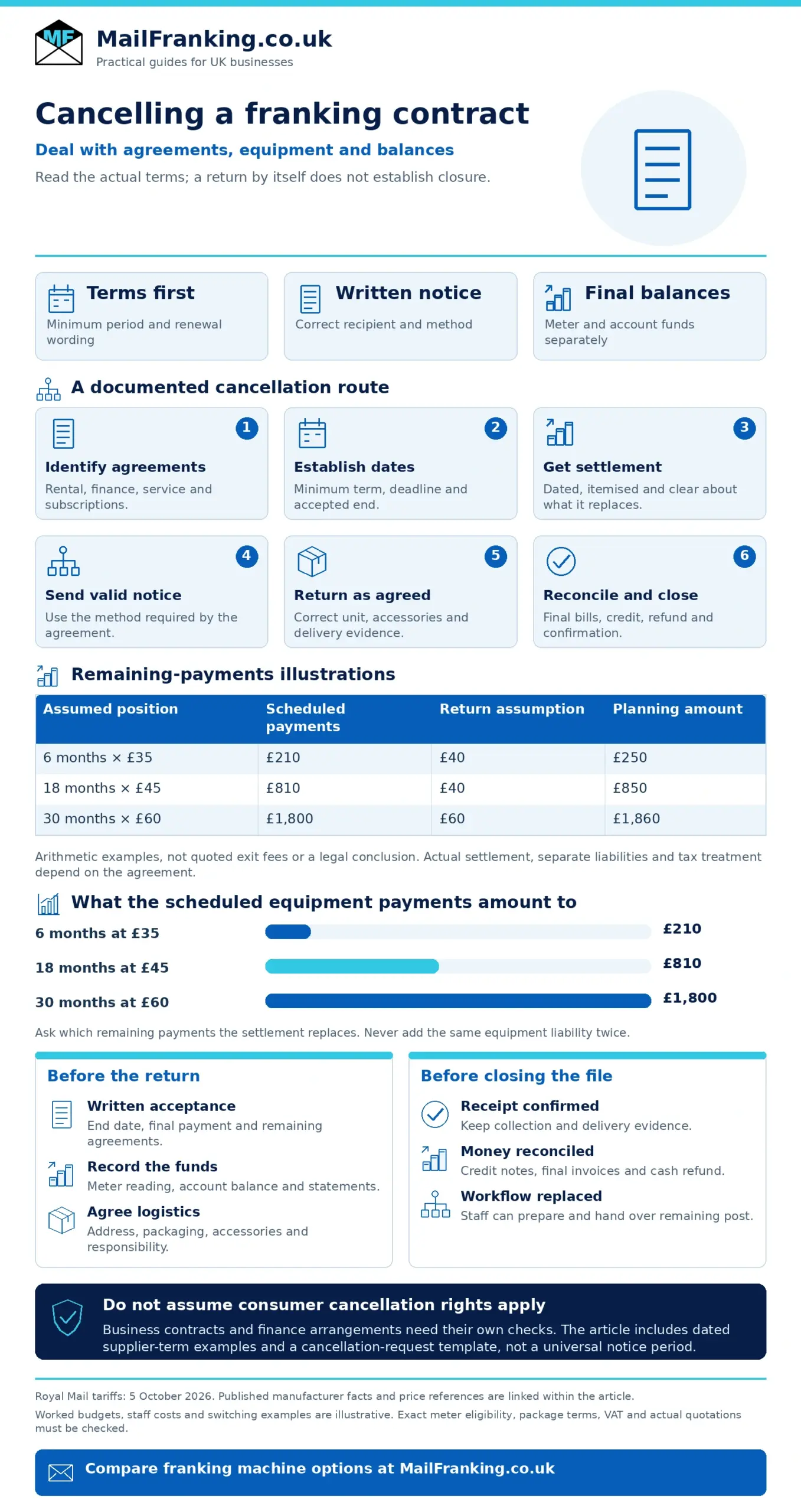
What could early cancellation cost?
The agreement and written settlement determine the actual charge. A useful first planning figure is the scheduled payments remaining, but that is not necessarily the settlement. Separate service, return costs, tax and any other contractual amounts may be treated differently.
| Illustrative position | Remaining scheduled equipment payments | Separate assumed return cost | Planning amount before other adjustments |
|---|---|---|---|
| 6 months at £35 monthly | £210 | £40 | £250 |
| 18 months at £45 monthly | £810 | £40 | £850 |
| 30 months at £60 monthly | £1,800 | £60 | £1,860 |
These are arithmetic illustrations, not supplier fee quotations or legal conclusions about recoverable damages. The FP terms cited above give an example of provisions referring to all rentals remaining in the relevant term, subject to specified exceptions. Other agreements may use different calculations.
Ask for an itemised settlement showing which obligations it replaces and how long the figure remains valid. If it includes the remaining equipment payments, do not add those same instalments again in your comparison. If maintenance continues separately, include that liability until it is also resolved.
Compare leaving now with waiting
Suppose 18 months remain and equipment payments are £45 monthly. Assume an agreed £810 settlement, £40 return cost and a genuine ability to end a separate £15 monthly service-and-supplies cost immediately. Leaving now would cost £850 in those stated exit amounts, before replacement postage preparation.
Continuing for 18 months would cost £810 in equipment plus £270 in that separate running cost, or £1,080, before the same eventual return cost if applicable. On those assumptions, ending now might avoid some variable expenditure, but replacing the workflow can consume the saving. Include any printer, labels, staff time and alternative service charges.
A switch to another machine is a different comparison again. If the replacement costs £40 monthly for those same 18 months, that adds £720 to the early-exit scenario. Do not describe the old agreement’s £810 settlement as money saved simply because a new supplier offers a lower headline payment.
Our switching guide explains how to compare those dated cash flows. It also covers supplier contributions towards settlement, which should be checked against the new agreement’s complete payments and term.
Send a clear cancellation request
Address the correct contracting entity and use the required notice channel. Identify the business, account, agreement, meter and proposed contractual end date. Ask for written acceptance and for the provider to identify any part it says will continue separately.
The wording below is a starting point for an ordinary end-of-term request. Adapt the dates and delivery method to the agreement. It is not a substitute for advice where you dispute the agreement, allege a breach or need to exercise a particular statutory right.
Subject: Notice concerning franking agreement [agreement number]
We give notice to end the agreement for [business legal name], account [number], covering [model and serial/meter number], at the earliest date permitted under its terms, which we understand to be [date].
Please confirm receipt, the effective end date, the final payment and any separate agreements requiring notice. Please also provide the equipment return instructions, an itemised statement of any amount you say remains payable, and the process for recovering unused meter and account postage balances.
If you consider a different end date applies, please identify the relevant contractual provision and explain the calculation. Please confirm how renewal will be prevented once valid notice has been accepted.
Keep the sent notice and the acknowledgement. If the recipient says another team or finance company must be contacted, obtain the correct details and complete that step promptly. A case reference shows a request exists; it does not necessarily prove the proposed end date has been accepted.
Follow the provider’s return instructions
Do not send equipment to a guessed warehouse or dispose of it because the machine no longer works. Establish the authorised return address, packaging, accessories, collection method, cost and any engineer involvement. Confirm when responsibility for the equipment ends under the agreement.
As a supplier-specific example, Pitney Bowes’ published UK process directs customers to request cancellation through their online portal. Following finalisation, its team provides return instructions; certain equipment may require an engineer. Use the process that applies to your own account rather than treating this as another manufacturer’s procedure.
Photograph the condition and serial number, record the accessories packed and keep collection and delivery evidence. Request confirmation that the provider has received the identified unit. An invoice labelled final should be checked against the agreed end date and return status, not simply filed without review.
Recover unused postage carefully
Record the meter balance and any separate supplier-account balance before withdrawal. Download the relevant statements and usage reports. Ask whether the return, withdrawal or remote procedure is needed to recover meter funds, and avoid attempting an unsupported reset or factory wipe.
Pitney Bowes’ unused-postage guidance describes a transfer to the customer’s Pay As You Go or PrePay account after the meter is returned, normally within the stated five-to-ten-working-day period. An account credit is a stage in the process; confirm how any cash refund is requested and whether outstanding amounts are deducted.
A spoilt-impression claim is a different issue from unused funds sitting on the meter. Ask for the correct procedure for each. Reconcile all closing balances, credit notes, final invoices and bank receipts so that credit is not lost simply because the equipment contract has ended. Our postage-credit guide separates unused meter funds, account credit and printed unused impressions, so the correct refund route can be followed.
What if the machine is faulty or service is poor?
Document the fault, dates, support cases, promised response and the business impact. Identify the relevant repair or service commitments and give the provider a clear written complaint with the remedy you want. A cheaper replacement offer does not resolve whether the existing contract has been performed.
Do not assume that a supplier’s service failure automatically terminates a separate finance agreement. The contractual relationships and available remedies need to be checked. Obtain appropriate advice before withholding disputed payments or declaring an agreement ended.
For a financial-services complaint, the FCA’s small-business guidance explains the route of complaining to the firm first and checking whether the Financial Ombudsman Service can help. Eligibility depends on the business and the complaint; that route does not cover every ordinary equipment-service dispute.
Keep communications factual. Attach the order, relevant terms, invoice and service history, then ask the provider to explain any disputed amount by reference to the agreement. A concise evidence file is more useful than repeated telephone conversations without written confirmation.
Do not overlook the replacement workflow
Before the last usable day, decide how your remaining mail will be prepared. That may be another franking machine, online postage or another appropriate service. Confirm the actual postal products, labels, collections and proof-of-posting process staff will use.
For low volumes, use the savings calculator and our Click & Drop comparison to test whether another machine is justified. If volumes remain high, compare higher-volume equipment and service support before committing to the next term.
The final closure checklist
- Every agreement has an accepted end date or documented continuing obligation.
- The equipment return is completed and receipt confirmed.
- Meter funds and account funds have been reconciled separately.
- Final invoices and settlement receipts match the agreed calculation.
- Future supplies and software renewals have been addressed.
- Necessary reports and correspondence remain accessible to the business.
Only close the file once the remaining financial and operational points are resolved. Cancelling a franking arrangement is complete when the agreements, equipment and money have all been dealt with, not merely when the machine leaves the office. The licence guide explains the permanent-closure notification process, which is separate from ending finance, service and funding agreements.
Frequently asked questions
Returning equipment is not, by itself, evidence that every contract has ended. Follow the notice and cancellation process, obtain written acceptance and confirm the finance and service position separately. Use the authorised return instructions and keep confirmation that the identified equipment has been received.
No. Business purchases do not automatically carry the same consumer cancellation rights. A contract may provide a particular window, and finance arrangements can raise separate issues. Check the actual agreement, legal status and circumstances before assuming you can cancel without cost shortly after signing.
There is no universal figure. Request an itemised written settlement under your agreement. Remaining scheduled payments provide a planning reference but may not equal the final settlement. Check what the quotation replaces, any separate service liability, return charges, tax treatment and the figure’s expiry date.
Ask for the procedure covering funds on the meter and money in the supplier account. Recovery may involve withdrawal or return of the unit, followed by an account credit and a separate cash-refund request. Reconcile the balances and deductions rather than assuming a credit note means cash has arrived.
A fall in volume does not by itself establish a right to end a fixed commitment without cost. Check cancellation, downgrade and renewal terms, then ask for options in writing. Compare continuing, settling and switching using the remaining equipment payments and the actual cost of a replacement workflow.
Gather the signed order, applicable terms, account statements and relevant communications. Explain the disputed point and requested remedy in a written complaint. For significant or complex matters, obtain advice on your circumstances. A separate finance company’s obligations and complaint route may differ from the equipment supplier’s.