

Paying for customers to return a form or document can remove friction, but the payment method makes a substantial difference to the budget. A prepaid return envelope generally incurs its postage cost when prepared, whether or not the recipient uses it. Licensed response services charge under their own arrangements for the replies received, alongside an annual licence.
The best option depends on response rate, volume, format, artwork and existing equipment. This guide compares the models, sets out published Royal Mail charges and shows how to calculate the crossover. It concerns incoming paper responses rather than routine outward postage, so it should be assessed separately from the machine’s everyday savings calculation.
Three names that need to remain distinct
Prepaid reply is not a general instruction to print an ordinary dated frank on any return envelope. Confirm the specific supported product and its conditions with the provider. Pitney Bowes’ PrePay Reply guidance for SendPro P describes UK First and Second Class letters up to 100g on the listed systems; that is a product-specific reference, not proof that every meter supports it.
Royal Mail’s Business Reply and Freepost Standard and Plus services use licensed designs. The customer responds without buying the return postage, and the business pays through the applicable response arrangement. Format and design requirements differ between options.
- Takes 2 minutes
- Receive quotes to compare
- Easy and no commitment
| Method | Main payment driver | What to confirm |
|---|---|---|
| Supported prepaid reply product | Envelopes prepared with prepaid postage | Meter compatibility, validity and unused-stock treatment |
| Business Reply or Freepost Plus | Replies received plus annual licence | Machine-readable letter design and artwork |
| Business Reply or Freepost Standard | Replies received plus annual licence | Permitted formats, design and actual returned weight |
| Freepost NAME | Replies under its tariff plus its licence | Address presentation and separate fees |
Published response-service prices
The following are from the Royal Mail Retail Letters price guide effective 5 October 2026, checked in November 2026. These prices exclude VAT at the standard rate. They are response-service charges, not ordinary Mailmark postage or universal prepaid-reply prices.
| Response product and format | 1st Class per reply | 2nd Class per reply |
|---|---|---|
| Plus letter up to 100g | £1.77 | £0.89 |
| Standard letter up to 100g | £2.02 | £1.16 |
| Standard large letter up to 100g | £2.51 | £1.35 |
| Standard large letter up to 250g | £3.40 | £1.87 |
Plus is restricted to the relevant letter format, while Standard provides broader format choices under its conditions. Do not select a cheap letter rate if respondents are likely to add documents that make the returned item larger or heavier. The cost model should reflect the envelope after the customer has filled it.
Annual licences and the VAT basis
The same guide lists £99.90 excluding VAT as the standard annual licence fee for the listed Business Reply and Freepost Standard/Plus services, with a separate rate for more than ten licences. Freepost NAME has a £408 first-licence fee and £240 for subsequent licences, also excluding VAT. Confirm the current arrangement and any deposit before committing.
For a straightforward cash illustration at 20% VAT, £99.90 becomes £119.88, a 89p reply becomes £1.068 and a £1.16 reply becomes £1.392. Keep sufficient decimal precision in volume calculations and round the final invoice estimate appropriately. A business entitled to recover VAT may assess a different economic cost from its cash outlay.
- Give your requirements
- Receive quotes to compare
- Choose a provider or walk away - your choice!
Do not mix an exempt prepaid product with a taxable response rate without addressing the difference. Ask finance to establish a consistent basis for the organisation. Charity status or small-business status alone should not be used to assume every VAT outcome, and the quotation should identify the tax treatment of each separate supply.
Worked example: 1,000 return envelopes distributed
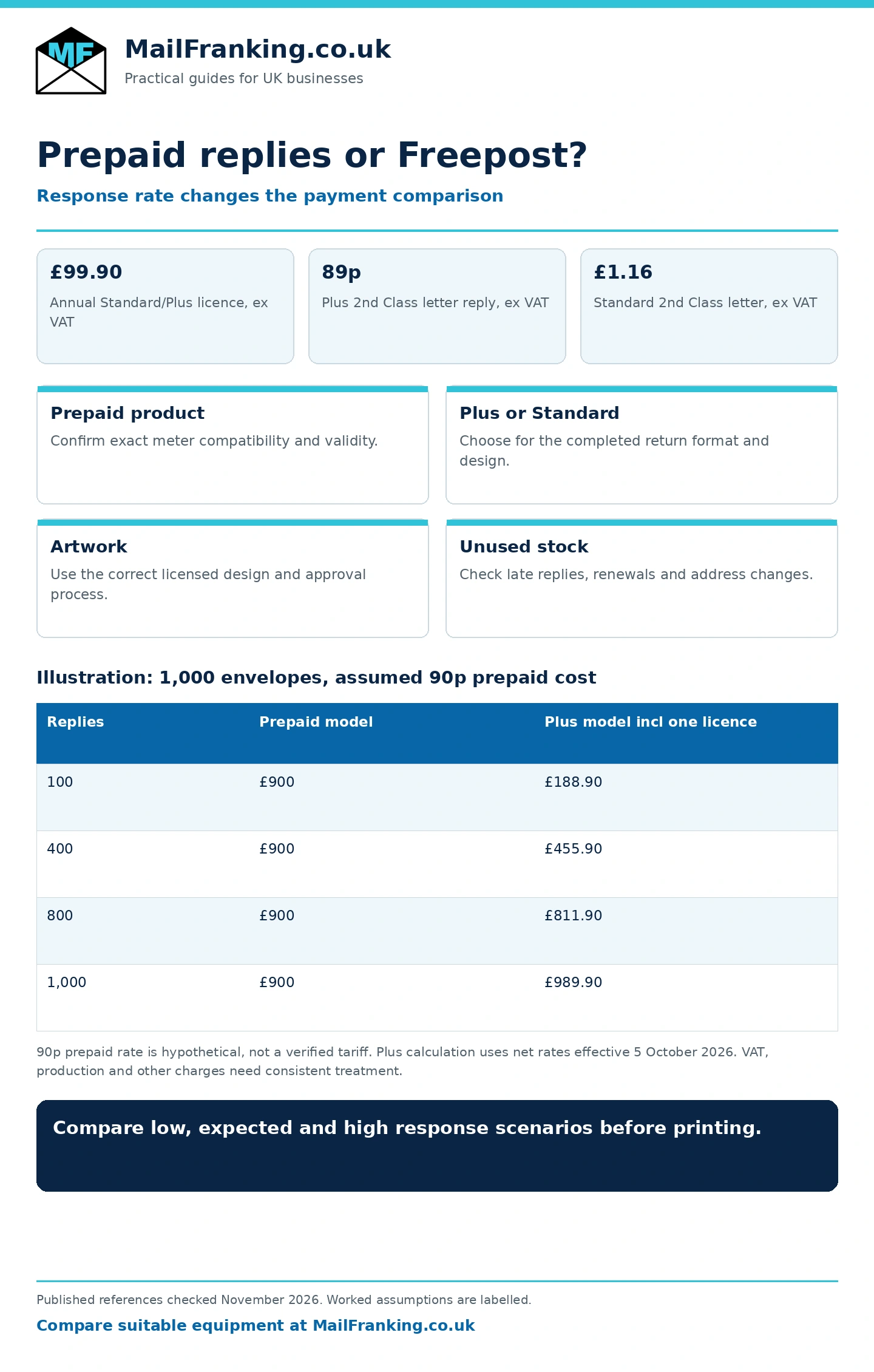
Assume a business compares a hypothetical prepaid cost of 90p per distributed envelope with Plus 2nd Class responses at the published net 89p rate and one £99.90 annual licence. The 90p is an assumption, not a verified current PrePay Reply tariff. The model uses comparable net costs for an organisation able to use that basis and excludes envelope production.
| Replies received | Assumed prepaid postage on 1,000 envelopes | Plus replies and one licence | Difference |
|---|---|---|---|
| 100 | £900 | £188.90 | Plus £711.10 lower |
| 400 | £900 | £455.90 | Plus £444.10 lower |
| 800 | £900 | £811.90 | Plus £88.10 lower |
| 1,000 | £900 | £989.90 | Prepaid £89.90 lower |
This example shows the response-rate effect; it is not a recommendation to use Plus without confirming eligibility. Add artwork, envelopes, preparation, account administration and any incremental equipment cost. Where several campaigns share an existing annual licence, allocate its cost sensibly instead of charging a full new fee to every batch.
Calculate the response-rate crossover
Use four inputs: envelopes distributed, the actual prepaid unit cost, the response unit cost and the incremental annual or campaign licence cost. The response model is cheaper on these inputs when licence cost plus replies multiplied by response unit cost is below distributed envelopes multiplied by prepaid unit cost. For annual renewal forms and member surveys, our membership organisation mailing guide places this response-rate calculation alongside outward letters, welcome packs and the complete annual equipment cost.
In the preceding illustration, £900 less £99.90 leaves £800.10 for replies. Dividing by 89p gives approximately 899 replies, or about 89.9% of the distributed quantity. That is the approximate crossover before envelope and other cost differences. Use unrounded figures when comparing a result close to the boundary.
Now test uncertainty. If the response forecast is 40% but a successful campaign produces 70%, the reply bill rises. If fewer responses arrive, prepaid unused stock can represent a larger share of total cost. A low response rate may reduce postage spending but still be a poor campaign outcome, so keep commercial success separate from postal efficiency.
Standard versus Plus: flexibility has a price
For 1,000 qualifying 2nd Class letter replies, the published net unit difference between Standard at £1.16 and Plus at 89p is 27p, or £270. That can justify artwork work where the mailing qualifies, but the design and letter-format requirements need to be met consistently.
If customers may return thicker documents, several sheets or material of uncertain weight, assess Standard or another suitable product on the actual expected returns. Sending a small outer pack does not ensure its reply remains letter-format. Provide clear practical instructions without implying those instructions can override service conditions.
Ask the provider how incorrectly prepared or unexpected replies are handled and charged. Model a realistic exception allowance using your own history where available. A narrow nominal saving can disappear if staff must repeatedly investigate returned items or reconcile charges that were never included in the budget.
Artwork, licences and printing stock
Obtain the correct licensed artwork for the chosen service and address. Ask about required checks before printing, and send a sample to the appropriate provider process where required. A logo or general return address is not a substitute for the authorised postage design.
Confirm whether each return address needs a separate licence and how changes of address or service affect existing stock. Avoid ordering years of envelopes solely to secure a lower unit print price if the organisation expects to move or change its response process. Include obsolete stationery in the cost comparison.
For in-house printing, test legibility, position and compatibility on the exact envelope. For external printing, pass the correct artwork and account details and approve the proof through the agreed process. Keep the approval and a retained sample so future reorders can be checked against the accepted design.
Prepaid reply compatibility and unused stock
Ask the meter provider to confirm that the exact UK unit and software support the specific prepaid product you intend to use. A support page for another model is insufficient. Request the price, envelope restrictions, date or validity conditions and treatment of unused impressions in writing.
Do not assume ordinary spoiled-postage or meter-credit rules apply to unused prepaid reply envelopes. Before producing a large batch, ask how changes in rates, equipment, business address or contract status affect use. The answer can materially change the amount of stock it is sensible to prepare.
Our licence guide covers meter registration separately, and the postage-credit guide explains funding balances. A response-service licence, the meter licence and unused postage are different matters even when the same supplier helps arrange them.
Campaigns, renewals and shared response addresses
An organisation using replies throughout the year should model the licence across its entire programme. A one-off campaign should consider whether a new licence is genuinely needed or an existing authorised arrangement can be used. Confirm the provider’s rules rather than informally sharing another organisation’s licence or artwork.
For a hypothetical four-campaign programme sharing one appropriate licence, dividing £99.90 equally produces £24.975 per campaign before VAT. Allocation by expected replies may be more useful where campaigns differ greatly. The overall annual cash commitment is unchanged, so avoid treating an internal allocation as an external discount.
Record renewal responsibility and the treatment of envelopes already distributed when the campaign or contract ends. Responses can arrive long after the outward mailing. Ask the provider how late returns are handled and ensure the organisation has budget and operational responsibility for that tail.
Replies containing confidential or valuable material
The reply service needs to suit the expected contents and operational requirement. Do not imply that any prepaid or Freepost envelope provides the tracking, protection or handling needed for every valuable or sensitive item. Ask the responsible business team to select the appropriate process and demonstrate any required evidence.
For personal information, address accuracy, packaging, controlled access and the handling of returned documents remain separate concerns. The ICO’s guidance on supplying information provides relevant context. The payment method does not establish the security of the complete response workflow.
If the content requires a tracked return or specialist handling, compare that product directly instead of forcing it into a letter-response calculation. Our parcel guide explains why general parcel or meter capability is not proof of every required service.
Which arrangement should you choose?
Shortlist supported prepaid replies where compatibility, validity and a high expected usage rate produce a convincing full-cost result. Shortlist licensed response services where paying for actual replies better matches the programme, and choose Standard or Plus according to the returned format and design requirements.
Ask for a written schedule covering annual fees, unit rates, VAT, deposits, artwork, address changes, exceptions and late returns. Compare expected, low and high response scenarios. Include envelope production and any new equipment or software cost rather than stopping at a per-reply tariff.
For organisations buying a meter mainly to create reply envelopes, assess that narrow requirement against the annual commitment before signing. Our equipment prices guide helps complete that calculation. The cheapest arrangement is the one that fits the real response programme after every relevant cost is included.
Frequently asked questions
Do not assume so. Confirm a specific supported prepaid-reply product and its current conditions with the provider. Ordinary outward franking, a licensed response design and a prepaid reply product have different purposes. Ask about compatibility, validity, weight, format and unused stock before printing a large batch.
Under the relevant licensed response arrangement, the recipient can respond without buying the return postage and the licence holder pays the applicable charges. Annual fees, product conditions and VAT also matter. Freepost describes the responder’s experience; it does not mean the service is free for the business receiving the replies.
Plus uses the applicable machine-readable letter design and format requirements, with lower published unit rates in the cited comparison. Standard allows broader formats under its conditions. Choose according to what customers will actually return, including added documents, rather than selecting a letter price that the completed reply may not qualify for.
The October 2026 guide lists £99.90 excluding VAT for the standard annual licence covering the listed Business Reply and Freepost Standard/Plus services. Different arrangements, including more than ten licences and Freepost NAME, have separate fees. Confirm the appropriate current licence, address requirements and any deposit before ordering envelopes.
Paying for actual replies can be attractive when relatively few distributed envelopes return, but the annual fee and production costs still matter. Compare several response scenarios using the actual prepaid price and eligible response tariff. A small one-off mailing may not justify a new licence even with a low reply rate.
Compatibility depends on the exact UK meter, enabled product and current provider conditions. A support article for another model is not confirmation. Ask for a demonstration and written details of the tariff, envelope restrictions, validity and unused-stock treatment before assuming your existing equipment can support the planned response programme.