

Franking machines for membership organisations should match renewal letters, welcome packs, certificates and other physical member correspondence. The number of members alone does not establish the equipment requirement: mailing frequency, publication formats and the balance between central batches and individual office post matter more.
A compact meter may suit rolling renewals and occasional packs, while an annual journal or membership-card run could be handled separately. This guide explains how to compare those workflows, calculate complete costs and avoid buying permanent equipment around one exceptional mailing date.
Separate membership activity from general administration
Start with the items your membership team actually sends. Distinguish renewal reminders, joining packs, replacement certificates, invoices, event correspondence and publications. A professional body with electronic renewals may have fewer routine letters than a smaller association that sends regular printed information to its members.
Fundraising correspondence is a separate workload where it exists. Our charity franking guide examines donor appeals and volunteer operation. This guide focuses on member administration, subscription cycles and publications, which can create different volumes, response patterns and preparation requirements.
- Takes 2 minutes
- Receive quotes to compare
- Easy and no commitment
Use a full year of records and identify which work is produced outside the office. If a journal printer already packages and posts the circulation, those items should not be used to justify the capacity of an office franking machine unless there is a genuine proposal to bring that production in-house.
Annual renewals and rolling membership need different models
A common renewal date creates a concentrated run, followed by reminders and late renewals. Rolling membership can spread smaller batches throughout the year. Both may produce the same annual envelope total, but their demand on office staff and equipment is different. Record batch size and available preparation time alongside volume.
For each run, count prepared items rather than assuming every database record produces a letter. Joint memberships, suspended accounts, international addresses, digital preferences and returned mail can change the eligible file. Confirm the final mailing population before calculating postage or asking a supplier to price a batch.
| Mailing type | Operational question | Comparison to make |
|---|---|---|
| Rolling renewal letters | How many items on a normal day? | Compact meter versus current office method |
| Annual renewal batch | How much preparation and checking? | In-house production versus print-and-post |
| Welcome packs | Which weights and enclosures vary? | Mixed-mail handling and separate exceptions |
| Certificates and journals | What is the finished postal format? | Office dispatch versus specialist production |
| Returned forms | How many recipients actually reply? | Prepaid stationery versus licensed response service |
Measure printing, folding, inserting, checking and franking separately. A quicker meter does not solve an inaccurate renewal file or a bottleneck in assembling welcome packs. Our folder inserter guide explains when preparation equipment merits its own evaluation.
- Give your requirements
- Receive quotes to compare
- Choose a provider or walk away - your choice!
Published postage references for member mail
Checked in November 2026, the Royal Mail current price guides show an ordinary letter up to 100g at £0.88 for 2nd Class Mailmark against a £0.91 stamp. The corresponding 1st Class references are £1.77 and £1.80. The gross difference is 3p per ordinary letter in either example.
For a 1st Class large letter up to 100g, the Mailmark reference is £2.86 against a £3.30 stamp, giving a 44p gross difference. A 2nd Class large letter up to 250g costs £1.81 against a £1.90 stamp, a 9p difference. Service and weight selection can therefore change the economics of member packs substantially.
These comparisons do not establish that changing service is suitable. Your organisation should decide the required service for each mailing. Compare equipment against the same approved service and actual baseline, including an existing account or outsourced arrangement where relevant, rather than using the most favourable stamp comparison for the whole circulation.
Worked annual renewal example
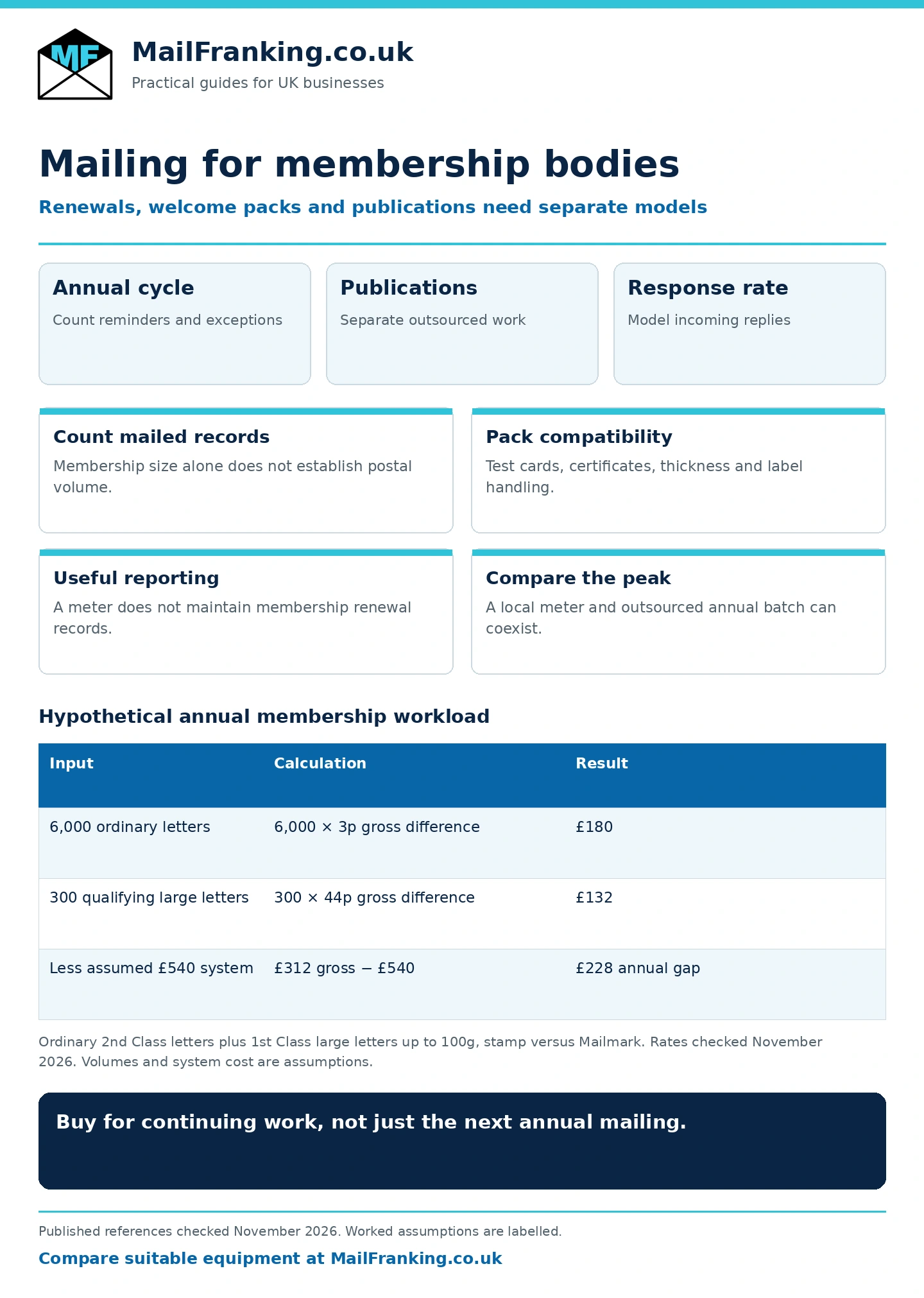
Assume a hypothetical association sends 4,000 ordinary 2nd Class renewal letters and another 2,000 ordinary 2nd Class reminders across the year. It also sends 300 qualifying 1st Class large-letter welcome packs up to 100g. The baseline below is stamps for those same services, not an existing discounted mailing contract.
| Annual input | Calculation | Gross difference |
|---|---|---|
| Renewal letters | 4,000 × £0.03 | £120 |
| Reminder letters | 2,000 × £0.03 | £60 |
| Welcome packs | 300 × £0.44 | £132 |
| Combined postage difference | £120 + £60 + £132 | £312 |
| Assumed system allowance | £45 × 12 | £540 cost |
The assumed system allowance exceeds the £312 gross postage difference by £228 annually before other costs or benefits. This is not evidence that every membership organisation should avoid a machine. It demonstrates why a large-looking annual renewal run is insufficient on its own to justify a continuing commitment.
If the welcome packs instead use 2nd Class large-letter postage up to 100g, their gross difference is only £9 across 300 packs. The total benefit would fall to £189. Use the actual approved mix and a lower-volume forecast, particularly if digital renewal uptake is growing during the proposed equipment term.
Equipment prices and complete annual cost
Pitney Bowes’ broad UK guidance gives entry-level purchase references around £500–£1,000 and leasing around £15–£100 or more monthly, depending on features. These are general equipment figures. They are not quotations for a complete membership office package, and VAT and inclusions need confirmation.
Request the equipment or finance payment, meter arrangements, service, installation, training, ink, labels, software and funding charges separately. Include delivery charges, minimum consumables orders and increases. Compare the total over the same period using our rental guide and hidden-cost checklist.
An assumed £45 monthly package costs £2,700 across five years before increases and exclusions. A one-off purchase needs its ongoing support and meter costs added too. Keep postage usage separate from equipment expenditure, and ask finance which VAT treatment applies to the organisation and the specific services being compared.
Choose equipment around continuing office work
For modest routine volumes, compare compact manual-feed equipment such as the Quadient iX-1 and SendPro Mailstation. Check the exact UK package, supplied weighing capacity, labels, connectivity and reporting. Ease of use may be especially useful where office colleagues share duties.
If regular batches are taking substantial operator time, compare desktop and automatic-feed alternatives using real filled envelopes. Our manual versus automatic guide explains the relevant distinction. Do not equate an advertised maximum speed with the number of complete renewal packs your team can produce in an hour.
One annual surge can be evaluated separately. Compare a permanent larger system with retaining a compact meter and outsourcing the peak. Include the existing office equipment cost in the mixed arrangement. Otherwise the outsourced option can appear cheaper simply because one side of the comparison omits a machine that will still be paid for.
Welcome packs, cards and certificates need physical tests
Weigh finished packs with every insert, including return stationery and protective packaging. A membership card, lanyard or certificate folder can affect thickness and flexibility as well as weight. Test the package against the chosen postal format and the machine’s handling limits rather than assuming every flat-looking item is a letter.
Ask suppliers to demonstrate both the lightest and heaviest routine pack. Check whether postage is printed directly or applied using a label, and include the label cost and extra handling time. Keep suitable materials for awkward items available so operators do not improvise at the end of a dispatch session.
Review damaged or returned packs during the trial. Cheaper packaging is not an improvement if certificates need frequent replacement. Record reprint, repacking and repeat postage costs as well as the initial mailing price. Physical protection and accurate address data can affect the result more than a small equipment payment difference.
Journals and publications deserve a separate comparison
A journal circulation may involve a printer, mailing house and account product rather than the office meter. Compare the complete production and dispatch arrangement before bringing it in-house. Include storage, packing, staff time, undeliverable copies and international exceptions alongside the postage figure.
Do not assume a member newsletter automatically qualifies for a particular Publishing Mail or bulk product. Ask the postal supplier to confirm eligibility, content conditions, volume and preparation requirements for the actual publication. Our franking versus PPI guide explains the difference between a payment impression and the underlying account service.
For a publication quoted per copy, identify exactly what the figure includes. Printing, wrapping, data handling and postage may be bundled or separate. Ask for prices at the expected circulation and a lower one. A minimum production commitment can become expensive if printed circulation falls while digital readership grows.
Reply envelopes and response rates
Renewal forms, ballots and member surveys may include return stationery. Compare the number of envelopes distributed with the number expected to return. Prepaying every envelope can produce a different cost profile from a licensed response service where postage is charged on replies received, with licence and production costs considered separately.
The prepaid reply versus Freepost guide provides a detailed framework. Confirm the exact product, artwork, completed return format, VAT basis and licence arrangements before ordering stationery. Ordinary outward postage credit does not establish that a response service is included or that an impression can be reused for returns.
Run low, expected and high response scenarios. The financial result can change even when the number mailed is identical. Include the cost of late replies, obsolete stock, a future address change and any licence renewal needed while members still hold envelopes. A short campaign can leave stationery in circulation for much longer.
Reporting should support membership administration
Useful accounting categories might include membership administration, publications, events and regional offices. Ask for an export showing the exact information available from the quoted system. Test a correction and an interrupted batch. Confirm whether reporting is included or requires a paid software option and ongoing subscription.
A postage account code is not a membership database record. The meter does not automatically update renewal status, record consent or remove an undeliverable address from the circulation. Assign responsibility for reconciling returned items and correcting the membership system so the same unsuitable address is not repeatedly mailed.
Avoid unnecessary complexity. If only four budget totals are required, a long selection list of individual members could add error and staff time without producing a useful decision. Keep personal data in demonstrations fictional and define physical document checks, particularly where certificates or personalised letters contain different information for each recipient.
Compare hybrid production and protect continuity
Predictable renewal templates are candidates for hybrid mail, where approved documents are produced and posted externally. Request a price for the actual pages, print specification, envelope and postal service, including setup, reprints and minimum charges. Compare it with the complete internal job rather than postage alone.
Trial the workflow using fictional records first. Check file acceptance, production reporting and postal handover as separate stages. Agree who resolves rejected records, duplicates and returned items. A local meter can remain useful for replacement certificates and unusual welcome packs that do not suit the standard outsourced template.
Finally, test normal operation with both the usual administrator and a cover colleague. Record supply replacement, funding authorisation, connection failure and the fallback dispatch process. Ask shortlisted suppliers for comparable itemised quotations against the real annual membership workload, then select the arrangement that remains affordable and usable beyond the next renewal season.
Frequently asked questions
It depends on continuing office mail, not membership size alone. Measure renewals, reminders, welcome packs and exceptions across a full year, excluding work already posted by a printer. Compare gross postage differences with complete equipment costs and assess whether a separate service could handle any exceptional annual batch.
The finished item must meet the relevant postal product and equipment handling requirements. Test weight, dimensions, thickness and label use. Large publication runs may be better evaluated as a separate printer or mailing-house service. Do not assume a newsletter automatically qualifies for a particular bulk or Publishing Mail product.
Compare outsourcing when one concentrated run requires substantial printing, preparation and checking. Include the exact documents, envelope, service, exceptions and minimum charges. A compact office meter may still serve routine correspondence. Evaluate the combined annual cost and trial the production reports before changing the complete renewal process.
A franking machine does not automatically maintain renewal status, communication preferences or returned addresses. Accounting codes generally serve postage allocation, with features varying by configuration. Confirm any proposed integration separately. Assign responsibility for updating the membership system and reconciling undeliverable items rather than relying on meter usage reports.
Do not assume so. Outward postage funding and licensed reply services are separate arrangements. Compare prepaid stationery with the exact response product, including artwork, licence costs, expected returns and VAT treatment. Confirm compatibility before printing envelopes, particularly where unused stock could remain with members after a campaign ends.
Use the same annual workload, formats, services and evaluation period. Include equipment, maintenance, supplies, reporting, funding charges, increases and exit arrangements. Demonstrate normal packs and recurring batches, then test a lower postal-volume scenario. Choose for continuing work rather than paying permanently for capacity needed on one annual date.