

Switching franking machine suppliers can reduce your costs or improve support, but the change needs more planning than ordering a different machine. Equipment ownership, finance, maintenance, postage funding and the meter’s registration may involve separate arrangements.
Start by establishing what you already pay, when you can leave and which parts of the service you want to change. Then compare written proposals over the same period. A lower monthly equipment price is useful only if the complete switching cost and the new service make sense for your business.
Decide what you actually want to switch
| Possible change | Main checks | What not to assume |
|---|---|---|
| Replace the machine and supplier | Old agreement, settlement, return, new meter and installation | The new supplier can cancel every old agreement |
| Change maintenance provider | Ownership, current obligations and model-specific authorisation | Any service company can support every meter |
| Change postage funding arrangement | Provider terms, account balances and payment method | Postage credit transfers automatically between brands |
| Change brand at renewal | Exact UK services, equipment condition and complete contract | The brand alone determines Royal Mail postage rates |
| Consolidate several machines | Site addresses, volumes, collection and departmental reporting | One faster machine solves every location’s workflow |
Some businesses need a replacement because the existing unit cannot support the required postal service. Others are happy with the equipment and want better maintenance or clearer prices. Describe the actual problem before requesting quotes, so suppliers do not solve it by selling unnecessary capacity.
Royal Mail says authorised providers maintain franking equipment and does not recommend one provider over another. Use its authorised directory to check the proposed provider, then establish support for your specific meter. Directory membership is a starting point, not a guarantee of a particular service level.
- Takes 2 minutes
- Receive quotes to compare
- Easy and no commitment
Step 1: collect the existing paperwork
Find the signed equipment agreement, any finance schedule, service contract, supply subscription and postage-account terms. Request copies if you cannot locate them. Include amendments, upgrade paperwork and renewal notices, since the original order may no longer describe the current obligation.
Record the contracting legal entity and account number for each arrangement. The sales brand on the machine, the business providing maintenance and the company collecting finance payments may not all be the same organisation. A cancellation request addressed to one does not prove the others have accepted it.
| Record | Information to capture | Why it matters |
|---|---|---|
| Equipment | Model, meter number, serial number and condition | Identifies the exact unit being replaced or retained |
| Agreement | Start, minimum term, payment frequency and expiry | Establishes remaining scheduled commitments |
| Notice | Deadline, required method and recipient | Helps avoid an unwanted continuation or renewal |
| Service | Included work, exclusions and renewal | Shows whether maintenance can be changed separately |
| Funding | Meter balance, account balance and reset fees | Identifies cash to reconcile and refund |
| Access | Portal owner and report-export access | Preserves invoices and usage data before closure |
Build a calendar from the actual contractual dates, rather than assuming a fixed universal notice period. Where wording is unclear, ask the existing provider to confirm the earliest end date and the notice they require. Obtain advice on disputed obligations before relying on an interpretation that affects payment.
Step 2: calculate your current complete cost
Use a representative twelve-month period where available. Add equipment payments, service, ink, labels, updates, software and funding fees. Keep postage spend separate so you can see which cost changes are due to the supplier and which are due to postal volume or product selection.
- Give your requirements
- Receive quotes to compare
- Choose a provider or walk away - your choice!
Divide a quarterly service invoice across the period it covers, rather than treating the invoice month as unusually expensive. For a weekly quote, use 52 weeks when making an annual comparison. Check whether VAT is recoverable and show the appropriate basis consistently.
Review our hidden-cost guide if the existing invoices are difficult to interpret. It is common for the equipment payment to be easy to find while supplies, funding and service sit on other statements. An incomplete current-cost figure can make a poor replacement proposal look attractive.
Step 3: give every supplier the same brief
Specify monthly quantities by service, size and weight, plus your busiest daily batch and deadline. Include the proportion of parcels, thick envelopes and international items. Average daily letters alone will not show whether automatic feeding or a particular label process is useful.
Tell suppliers which reporting outputs you need and how many departments or sites use the machine. Describe network requirements and the space available, including input and output trays. Ask for the exact hardware and software configuration rather than a broad family name.
For example, a sensible brief might say: 1,000 items monthly, including 600 ordinary letters and 400 large letters; peak 250 in one afternoon; 15 cost centres; one office; monthly CSV reporting; no requirement for a production feeder. These are illustrative specifications, not a recommendation that every business at that volume needs the same model.
Use our supplier comparison to form a shortlist. A manufacturer-direct offer and an independent supplier’s offer can differ in equipment condition, finance and support. Ask both to identify the organisation responsible for each obligation.
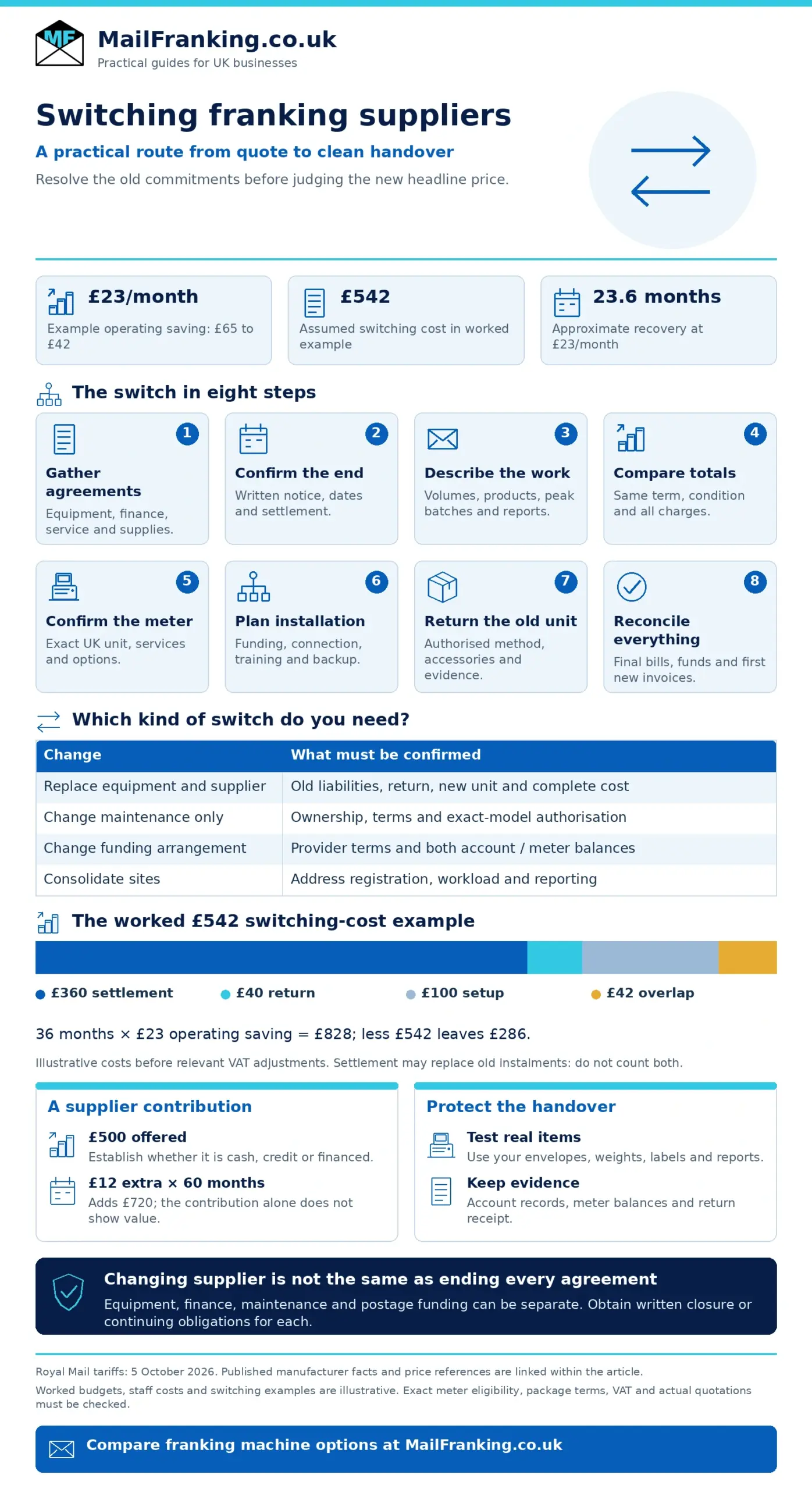
Step 4: test whether the saving covers the switch
Consider a worked example in which the current complete operating cost is £65 monthly and the new comparable proposal is £42. The apparent saving is £23 monthly, or £276 annually. That is the starting point; setup, settlement and overlap still need to be considered.
| Illustrative switch cost | Amount | Treatment |
|---|---|---|
| Old-agreement settlement | £360 | Written assumed settlement, not a universal fee |
| Return and transport | £40 | Confirm packaging and responsibility |
| New installation | £100 | Include training or setup only if quoted |
| One-month equipment overlap | £42 | Allow for the agreed transition |
| Total switching cost | £542 | Before any different VAT treatment |
At £23 monthly, the £542 switching cost takes about 23.6 months to recover. Over a 36-month planning period, £828 in operating savings less £542 leaves £286. The saving is real at those assumptions, but much smaller than the headline £828 suggests.
Compare that with waiting until the existing agreement expires. If the £360 settlement disappears and the other assumed switching costs remain £182, recovery takes about 7.9 months once the new arrangement starts. However, waiting also means paying the old operating cost in the meantime. Compare both complete dated cash flows rather than simply choosing the smallest setup figure.
Do not subtract the same remaining old payments twice. If the settlement quotation replaces those payments, include either the settlement or the replaced instalments in that scenario. Separately continuing service or finance payments still belong in the calculation.
Step 5: assess any settlement contribution
A new supplier may offer a contribution towards leaving the existing agreement. Ask how it is paid, when it becomes available and whether the old liability remains yours. Request a breakdown showing the replacement equipment price before and after the contribution.
Suppose the contribution is £500 but the replacement payment is £12 monthly higher over 60 months than an otherwise equivalent offer. The extra payments total £720. The contribution has not made the second offer £500 cheaper; at those assumptions, it costs £220 more over the term.
This does not establish that every contribution is poor value. It shows why the payment mechanism and complete finance schedule matter. Compare equivalent equipment, service and term before deciding which offer has the lower overall cost.
Step 6: confirm eligibility and arrange the new setup
The incoming provider should confirm the exact UK meter, supported products and registration arrangements before dispatch. Check how funding is opened, which connection is required and what staff must do to install or test it. A familiar model name is not evidence that a used unit is eligible for your intended service.
Ask for a demonstration covering your awkward items, not only a plain envelope. Test the actual weights, thick documents, labels and reports you use. If the business sends tracked parcels or international goods, demonstrate that precise workflow and the required data entry.
Read the relevant machine review and Mailmark guide alongside the quote. Product families can contain different feeders, scales or software packages. A proposal should identify those options clearly enough that the delivered unit can be checked against it. The licence guide covers new-user registration and operating-detail changes. Use the credit and refund guide to plan the old balance separately from the new equipment setup.
Step 7: plan the changeover and backup method
Agree delivery, installation, training, the first live posting date and the old machine’s withdrawal date. A short planned overlap may be more economical than missing an important mail run. Record who authorises the handover and who keeps the final usage and account records.
Choose a backup postal process for installation problems. Depending on your items, that might be online postage or a suitable Post Office service. Check the selected product’s handover and proof-of-posting requirements beforehand; a backup plan is only useful if staff know how to use it.
Avoid closing a postage account or returning equipment before the provider has explained how any meter-held funds will be recovered. Keep the business’s relevant portal access long enough to download final invoices, reports and cancellation confirmations.
Step 8: return and reconcile the old equipment
Follow the outgoing provider’s agreed return instructions. Photograph the unit, serial number and accessories, retain the packing and collection evidence, and ask for confirmation of receipt. A return should identify exactly which equipment has been handed back and on which date.
As a supplier-specific example, Pitney Bowes’ cancellation process starts with a portal request and provides return instructions after cancellation is finalised. Its unused-postage guidance describes transferring recovered postage to the customer’s funding account following meter return. Confirm the subsequent cash-refund process separately.
These published processes do not establish a universal switching timetable. Ask your own provider for written dates and reconcile meter funds, account funds, credit notes, final invoices and any cash refund. A closed equipment agreement can still leave an account balance to resolve.
When changing only maintenance may help
If you own eligible equipment and the existing agreements allow it, an authorised alternative maintainer may be worth investigating. Request written confirmation of model support, required inspections, repairs, rate updates, postage funding compatibility and how the change affects warranty or other obligations.
Do not assume this option transfers a manufacturer’s funding account or removes separate finance. It may also be impractical for an older unit with limited parts or service support. Compare a maintenance-only proposal with a complete replacement and with simply retaining the present arrangement until renewal.
If replacement is likely, our medium and high-volume buying guide helps identify when feeding and weighing features justify extra cost. For occasional post, review small-business options instead of upgrading solely because a supplier offers a faster machine.
Check the first full billing period
After switching, compare the delivered model, account settings and first invoices against the agreed schedule. Check for duplicate service charges, unexpected funding fees and remaining old payments. Report discrepancies promptly and keep the supplier’s response with the original proposal.
Repeat the savings calculation using actual costs after a representative month. A successful switch should deliver an identifiable benefit: a lower comparable cost, a better supported process or both. The quotation is the forecast; reconciled invoices and actual service show whether the change achieved it.
Frequently asked questions
You can investigate a switch, but existing obligations may remain. Obtain written equipment and finance settlement figures, check service terms and calculate overlap and return costs. Compare switching now with waiting until the earliest contractual end date before signing a replacement agreement.
Do not assume so. Confirm which agreements the new supplier will handle and require written acceptance from the relevant outgoing provider or finance company. Equipment, maintenance and postage accounts may be separate. Until each is resolved, a replacement machine does not prove the old liability has ended.
Ask both providers. Funds held on a meter and funds held in an account can require different recovery steps, particularly when changing brands. Obtain opening and closing balances and refund instructions. Do not assume a supplier’s promise of free postage is the transfer of your old balance.
Possibly, where ownership and existing agreements permit it and the incoming provider is authorised for the exact model. Confirm inspections, repairs, updates, funding arrangements and warranty implications in writing. An independent maintenance offer does not automatically transfer finance or remove other contractual obligations.
There is no universal timetable. Contractual notice, equipment availability, registration, installation, returns and balance recovery all matter. Agree the sequence with both providers and allow a suitable backup posting method. A delivery date alone does not confirm that the whole switch will be complete that day.
Give suppliers the same workload and compare equipment condition, configuration, term, all payments and service scope. Add settlement, setup, return and overlap costs. Check how any settlement contribution is funded, then compare complete future cash flows rather than only the replacement machine’s monthly headline price.