

A franking machine and a Printed Postage Impression, usually shortened to PPI, are two ways of preparing business post. Choosing between them means comparing the postal product, preparation work and account arrangements as well as the equipment. A printed postage mark does not, by itself, establish which service you have bought or how much the mailing will cost.
For an office sending varied correspondence throughout the day, a meter can provide a convenient way to weigh and pay for individual items. For repeatable batches, account mail with an appropriate printed mark may suit an existing print process. This guide explains the practical differences and the calculations to complete before changing either arrangement.
What is the difference between franking and PPI?
A franking meter prints a paid postage impression using credit held through the provider’s funding system. Staff select a supported service and the correct format and weight. PPI is an authorised printed postage mark associated with an account mailing process: it is not a prepaid stamp that anyone can copy and use without accounting for the items sent.
Royal Mail describes PPI as an alternative to stamps and franking. Your account product determines the price, preparation and submission conditions. That makes the first buying question quite specific: which product and posting process would replace the services your business uses today?
- Takes 2 minutes
- Receive quotes to compare
- Easy and no commitment
| Decision | Franking machine | PPI/account mailing |
|---|---|---|
| Equipment | Supported registered meter and compatible supplies | Approved printed mark within a suitable print process |
| Payment administration | Meter funding and provider statements | Relevant account and mailing declarations |
| Typical operational fit | Varied day-to-day office correspondence | Repeatable batches with controlled preparation |
| Price driver | Selected franking service and any qualifying scheme | Exact account product, format, volume and eligibility |
| Main comparison risk | Ignoring meter running costs | Assuming every PPI item earns a bulk discount |
Why the postal product matters more than the mark
Two envelopes can carry different marks while receiving broadly comparable delivery services. Equally, two account mailings can use similar-looking artwork but have different prices because one meets machine-readable requirements or a volume threshold. Compare service codes, class, format and VAT treatment before looking at the apparent discount.
Royal Mail’s October 2026 Retail Letters price guide lists multiple account options. There is no single universal PPI rate. A supplier should identify the specific product and the conditions attached to its proposal, including any barcode, addressing or presentation requirements.
Ordinary meter postage and qualifying Business Mail Advanced also need to remain separate in your model. The latter has its own qualification and adjustment process. Our Business Mail Advanced guide covers that arrangement; this comparison concerns the broader choice between a meter workflow and an account print workflow.
Published postage examples to compare carefully
The following references illustrate why VAT and product selection matter. These are published tariffs, not a personalised quote or a promise that your mailing qualifies for an account option. Prices are from Royal Mail’s guides effective 5 October 2026, checked in November 2026.
- Give your requirements
- Receive quotes to compare
- Choose a provider or walk away - your choice!
| Example up to 100g | Price per item | Price basis |
|---|---|---|
| Ordinary Mailmark 1st Class letter | £1.77 | VAT exempt |
| Ordinary Mailmark 2nd Class letter | £0.88 | VAT exempt |
| Standard account STL 1st Class letter | £1.80 | Excludes VAT at the standard rate |
| Standard account STL 2nd Class letter | £0.91 | Excludes VAT at the standard rate |
The Mailmark wallchart provides the meter references. For a business unable to recover VAT, £0.91 plus 20% becomes £1.092. For a business entitled to full recovery, the relevant economic comparison may differ from the cash payment. Check your own recovery position rather than mixing VAT-inclusive and exclusive totals.
Worked comparison: 1,000 ordinary letters
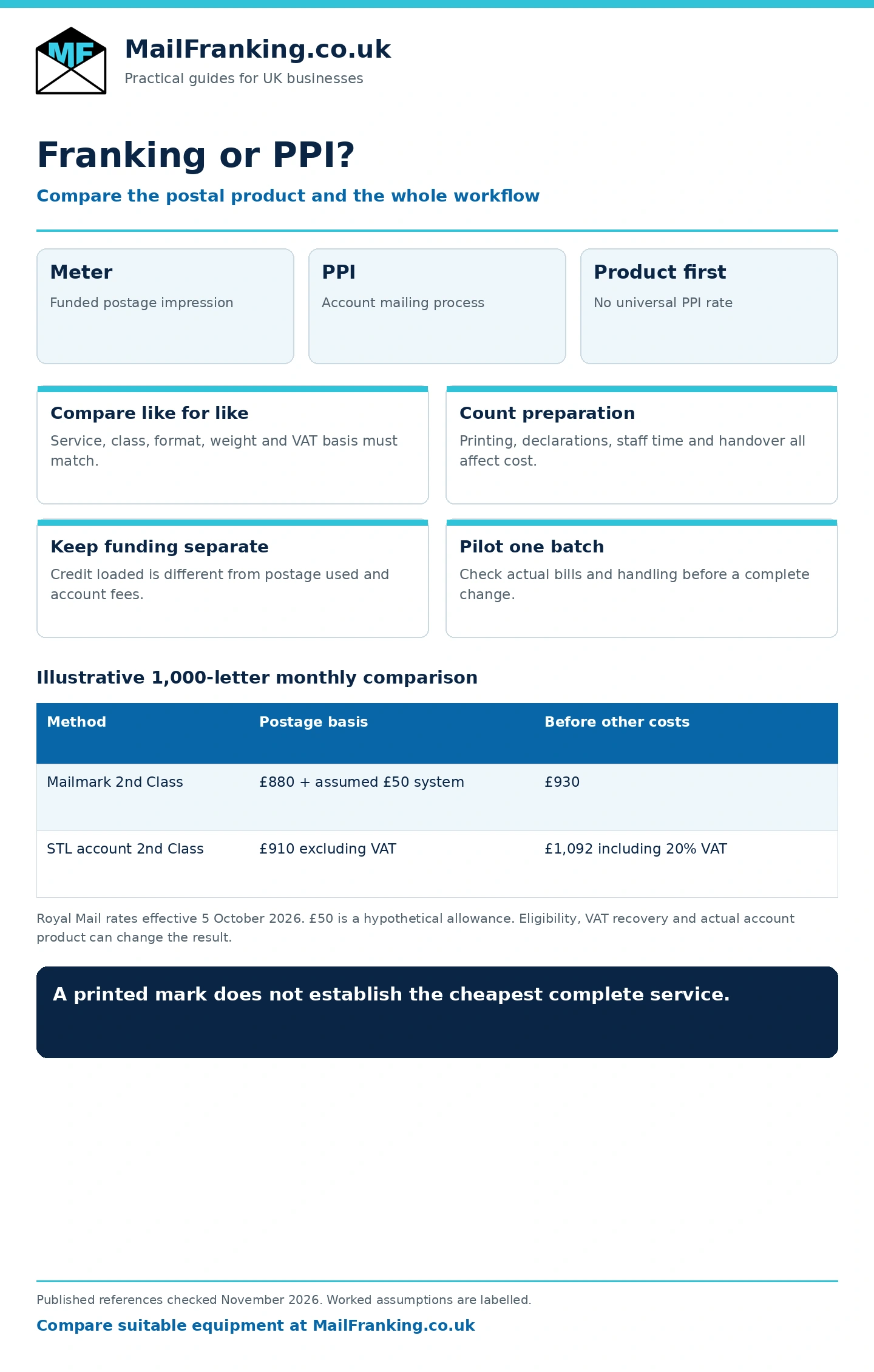
Assume a business sends 1,000 ordinary 2nd Class letters each month. At the stated Mailmark reference, postage is £880. Add an illustrative £50 monthly allowance for the meter, supplies and service and the model reaches £930 before any separately charged collection or funding item. That £50 is an assumption, not a supplier price.
At the standard STL reference, the same quantity is £910 before VAT, or £1,092 including it. An account customer may qualify for another product with a different tariff, but eligibility must be confirmed. This example shows why removing equipment does not automatically make the full mailing cheaper.
Now assume an eligible account proposal produces a net postage saving of £60 monthly against your actual meter bill. If extra printing, administration and collection costs add £25, the remaining improvement is £35. A £420 implementation cost then takes twelve months to recover. Substitute a written proposal for each assumption and include any old-contract settlement separately.
What equipment does each option require?
A meter arrangement needs a currently supported UK machine, suitable connection, registration and an agreed funding method. Add realistic ink, labels and service costs. Buying a cheap used device without confirmation of support can undermine the whole comparison; see our used franking machine guide before committing.
PPI can use preprinted envelopes, labels or an existing document and envelope print process, depending on the authorised product. It may avoid a dedicated meter, but you may still need artwork setup, suitable printers, label stock and staff time. An external printer’s minimum order can also tie up cash in envelopes carrying artwork that later changes.
Keep a separate line for each physical stage: printing documents, folding, inserting, sealing, applying the postage mark and preparing the handover. A folder inserter can address preparation time under either payment method. It does not choose or purchase the correct postal product for you.
Mailing declarations and reconciliation
The account process should make it clear who records the service, quantity, format and weight, and who submits the required declaration. Establish a correction process for cancelled batches and items removed after counting. A consistent handover record is more useful than a low headline rate accompanied by unreliable billing.
With a meter, reconcile postage loaded, usage and closing balances, allowing for authorised adjustments. With account mail, reconcile declared quantities, accepted mailings and invoices. Neither process should rely on a single person’s memory. Ask whoever will do the work to test a complete batch during the evaluation.
For a practical comparison, count administrative touches over two weeks. If a new method adds fifteen minutes on each of twenty posting days, that is five hours monthly. At an assumed loaded staff cost of £18 an hour, £90 of apparent postage savings could be consumed before printing or equipment costs are considered.
Mixed weights and irregular mail
A business sending a few invoices, an urgent document pack and occasional overseas correspondence has a different requirement from one printing identical monthly statements. With varied mail, staff need a reliable way to identify each service and format. A convenient meter can be worthwhile even when the postage arithmetic alone is close.
For repeatable batches, identify how many items genuinely share the same service, format and weight band. Do not assume that a total across several offices or several posting dates qualifies as one mailing. Confirm the product-specific rules with Royal Mail and record the evidence supporting your expected price.
Keep exceptions outside the standard process until the supplier demonstrates them. An oversized pack, a timed delivery and an international parcel can require different preparation. Our parcel franking guide explains why a label workflow and an ordinary envelope impression should be assessed separately.
Collections, acceptance and posting evidence
Include the actual collection arrangement in both proposals. Ask whether your existing collection covers the new products and presentation, what happens after the collection cut-off, and where exceptional items can be handed over. Avoid building a saving around a drop-off route that staff cannot use reliably.
Printing postage or declaring a mailing is not the same event as Royal Mail accepting the physical items. Establish which acceptance records, manifests or posting certificates apply to your services. If correspondence is deadline-sensitive, agree internal dispatch controls with the relevant business team rather than assuming a meter report proves delivery.
Test a missed collection scenario before changing. Identify who can arrange the fallback, how late a batch can be prepared and whether the fallback changes the cost. A small saving per letter can disappear if staff repeatedly travel to a distant handover location or must rework incorrectly prepared sacks.
Switching without paying twice
Moving to PPI does not automatically cancel meter finance, maintenance or software subscriptions. Obtain the current expiry dates, notice requirements, return instructions and postage-credit recovery process before calculating the saving. Our switching guide explains the separate obligations to check.
Build a transition budget covering both systems for any overlap period. Use up preprinted stock sensibly without delaying a necessary change. If artwork or account details change, establish whether unused envelopes can still be used appropriately; do not alter authorised postage marks informally to avoid wasting stationery.
Start with one repeatable mailing rather than moving every service immediately. Compare actual bills and handling time for the trial, record any correction charges, and review the results with finance. Expand the arrangement only when the predicted savings survive real preparation, handover and reconciliation.
Which option should your business choose?
Shortlist a meter where correspondence is mixed, volumes vary and office staff value a straightforward process for individual items. Shortlist account printing where batches are repeatable, data and preparation can be controlled, and an eligible product gives a demonstrable whole-cost advantage. Many businesses can sensibly keep different routes for different work.
Give bidders a sample month broken down by product, format and weight rather than a single annual spend. Request the proposed service codes, complete charges, print requirements, collection details and a sample invoice. Compare the same delivery needs and show all assumptions on one sheet.
The decision should remain valid if volumes fall. Recalculate with 25% fewer items and a higher exception rate. A proposal that only works at your busiest forecast may create an avoidable commitment. For equipment costs, use our franking prices guide alongside the actual account quotation.
Applying the comparison to a shared office
Different teams can need different routes even within one business. A property-management office might prepare repeatable statement batches while retaining a meter for varied branch correspondence. A healthcare practice may have tightly controlled routine and exceptional dispatch processes. Our guides for estate agents and property managers and GP practices apply those operational distinctions to specific buying scenarios.
Set a review date after the first complete billing cycle. Compare predicted and actual product counts, preparation time, fees and correction work. Keep a record of why exceptions used another route. That evidence makes the next decision more reliable than judging the change only by whether the new printed mark looks professional.
Frequently asked questions
No. A meter prints a paid franking impression using its funding arrangement. PPI is an authorised printed mark used within a relevant account mailing process. The underlying postal product determines prices and preparation requirements. Similar delivery services do not make the payment and administration processes identical.
No. Compare the exact eligible account product with your actual meter postage and running costs. Include VAT treatment, printing, staff administration, collection and implementation. Removing a meter charge can help, but an account tariff or additional preparation work can offset the saving. Use a representative month rather than an isolated batch.
Requirements depend on the specific account product and discount you want. There is no safe universal minimum to apply to every PPI mailing. Ask Royal Mail to identify the product, service code and qualification conditions, then check whether your batches meet them at the required posting frequency and location.
Yes, a mixed operation may use a meter for varied office correspondence and account printing for suitable batches. Keep the products, stock, declarations and reconciliation processes clearly separated. Include duplicate subscriptions or service costs when assessing the combined arrangement, and train cover staff to select the correct route.
Use authorised artwork and the account process agreed for your service. A downloaded or copied postage mark alone does not pay for a mailing. Confirm design, account identification, declarations and presentation before printing stock. Ask your provider to approve a sample and explain how artwork changes will be communicated.
Plan the trial and contractual notice dates together. Check finance, maintenance and software obligations separately, and obtain written instructions for returning equipment and recovering unused credit. A short controlled overlap can help establish whether the new workflow works, but include its cost in your transition calculation.