

Estate agencies and property managers can send a mixture of routine client letters, landlord statements, property documents and occasional larger packs. A sales branch with little remaining paper correspondence has a different requirement from a property-management team preparing monthly batches for hundreds of accounts. The same equipment recommendation should not be applied to both.
The useful buying comparison combines envelope handling, branch or portfolio reporting and the complete annual cost. This guide explains how to build that shortlist, assess centralisation and keep important dispatch records separate from a postage printout. All agency scenarios and equipment allowances are illustrative, not quotes or promises of savings.
Separate sales, lettings and management mail
Start with actual outgoing post by function. Routine sales correspondence may be irregular, while management statements can produce repeatable batches. Property packs may need larger envelopes or labels. Count completed items by format and weight and record their selected delivery requirements before discussing equipment. For tenant correspondence and recurring service charge packs in social housing, our guide to franking machines for housing associations covers the different workload and office arrangements.
For several branches, distinguish where documents are created from where they are printed and dispatched. A digital approval process can concentrate printing in one location without moving every exception there. Central purchasing can also standardise terms while retaining local machines, so avoid treating those choices as identical.
- Takes 2 minutes
- Receive quotes to compare
- Easy and no commitment
Measure the current work from document preparation through handover. If staff spend most of the time printing, matching and inserting statements, a faster meter addresses only the final stage. Compare a folder inserter or hybrid-mail route for that distinct requirement.
Which equipment belongs on the shortlist?
| Agency workflow | Approach to compare | Useful acceptance test |
|---|---|---|
| Small branch with occasional letters | Compact manual meter or online postage | Simple selection and full annual cost |
| Regular management-statement batches | Desktop system or automatic feeder | Completed batch ready before collection |
| Multi-branch central office | Suitable accounts and export software | Branch allocation and report reconciliation |
| Thick packs and mixed formats | Supported scale and compatible labels | Actual filled-item fit and service selection |
| Infrequent marketing runs | Separate batch supplier or account arrangement | Content eligibility and complete campaign price |
For compact machines, compare the entry-level options. For a larger desktop package, use the iX-4 vs SendPro C guide. A growing management mailroom can assess the automatic-feed comparison after confirming the batch requirement.
Budget the complete agreement
Request the exact hardware, scale, condition, software, installation, service and supplies in writing. There is no single verified estate-agent price for a franking system. A low weekly equipment payment may omit reporting, funding charges or service items that another proposal includes.
These hypothetical monthly allowances illustrate the commitment before postage. They are not manufacturer or dealer quotes and do not establish which model you will receive. Use the actual VAT basis and add any excluded costs when comparing proposals over the same period.
- Give your requirements
- Receive quotes to compare
- Choose a provider or walk away - your choice!
| Assumed monthly system allowance | Annual amount | Three-year amount | Five-year amount |
|---|---|---|---|
| £35 | £420 | £1,260 | £2,100 |
| £65 | £780 | £2,340 | £3,900 |
| £120 | £1,440 | £4,320 | £7,200 |
If a branch expects to move office or change its paper process, include that in the proposed term. Ask what relocation, return and account changes cost. Use our prices guide and hidden costs guide to make the schedule complete before approving the commitment.
Worked example: monthly landlord statements
Assume a management team sends 800 suitable ordinary 2nd Class letters monthly. At the October 2026 Mailmark reference of 88p, postage totals £704. The corresponding 91p stamp reference totals £728, giving £24 gross saving. Deduct an assumed £50 complete monthly system allowance and £26 still needs justification through other benefits.
The postage references are in Royal Mail’s current guides, checked in November 2026. If the agency already uses online postage or another account arrangement, compare against that actual price. If statements contain extra pages and exceed the assumed format, the calculation must change.
Now assume the system releases forty minutes on each of twelve monthly preparation days annually. That is eight hours. At an assumed £22 hourly loaded staff cost, the annual capacity value is £176. Keep that separate from the annual £288 gross postage difference, and deduct real running costs before claiming a net saving.
Packs, keys and unusual items
Demonstrate the completed document packs sent by the agency, including envelopes near the proposed machine’s limits. A scale capacity does not prove the platform can physically support every item, and a thick pack may require a label rather than direct printing. Check the full sequence with the intended operator.
Keys and other small objects can create unusual thickness and packaging needs even at low weight. Do not assume they can use the same format as a flat statement. The responsible agency team should select suitable packaging and service, then verify that the proposed workflow supports those choices.
Keep oversized or exceptional items outside the repeat batch until their process is established. If one in ten items requires separate handling, record that time in the demonstration. A nominal speed measured only on uniform envelopes will overstate the productivity of the agency’s mixed tray.
Branch reporting and portfolio allocation
Decide which totals are useful: branch, sales or lettings, management team, landlord or portfolio. A departmental report is different from a transaction file for individual client charging. Ask finance to define the minimum identifiers and reports before paying for hundreds of accounts.
Use anonymised account examples during the demonstration. Add a new branch, close an old code, correct a misallocation and export the result. Check identifier length and whether staff can find the correct code quickly. A complicated list can create errors even when the system technically supports enough accounts.
The agency should determine its own charging policy and accounting treatment. A meter does not establish whether any amount may be charged to a landlord, tenant or other client. The equipment question is whether the records support the agency’s approved process accurately, with appropriate controls and reconciliation.
Centralising mail across branches
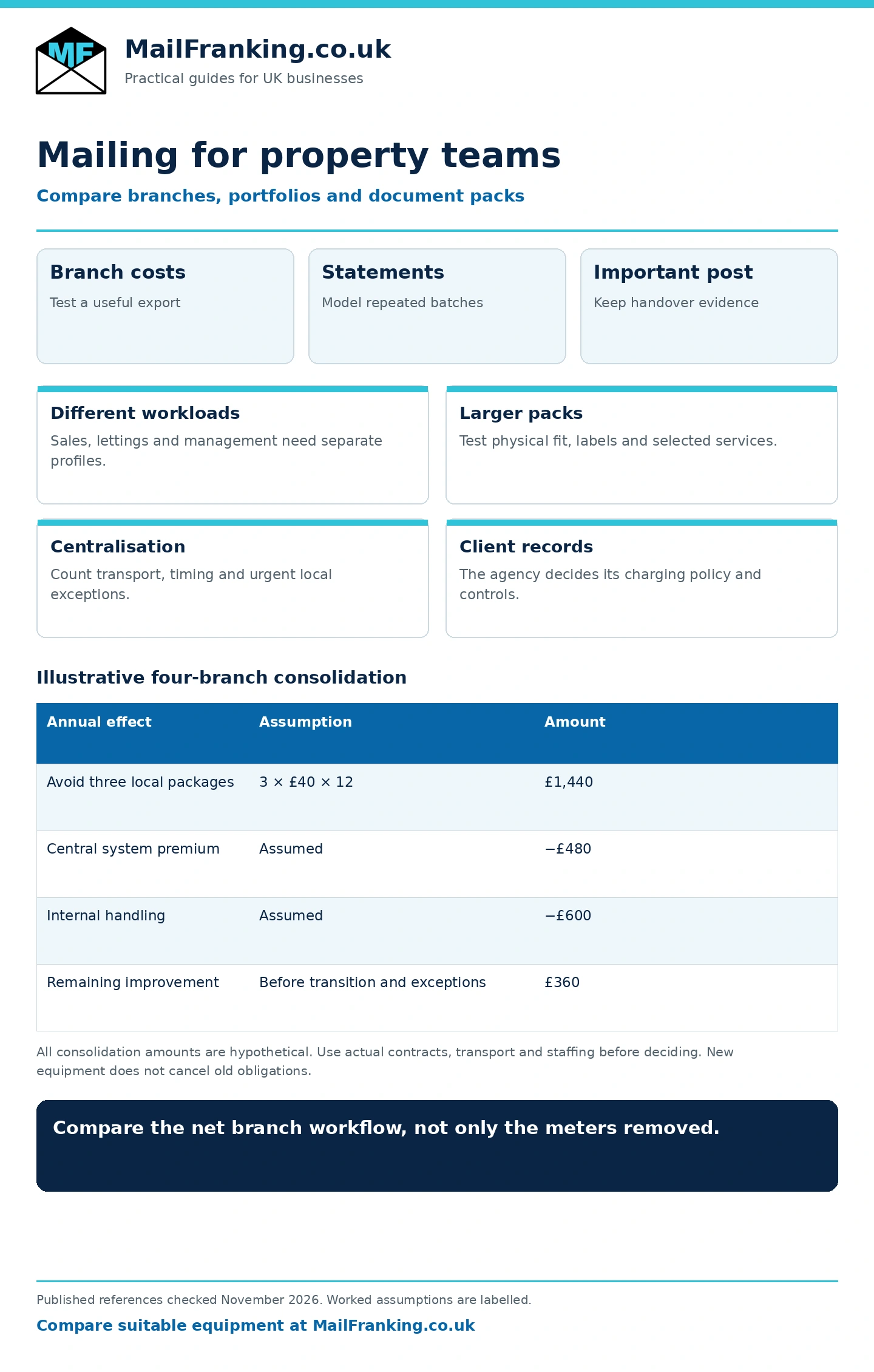
Suppose four branches each have an assumed £40 monthly package. Removing three avoids £1,440 annually. If a larger central arrangement adds £480 annually and internal handling adds £600, the remaining modelled improvement is £360 before transition and exception costs. Present that net figure alongside any reporting benefit.
Measure how documents reach the central office and how urgent local items are handled after the internal cut-off. A branch may still require a supported alternative, even if most work moves centrally. Include staff travel and duplicated supplies where they remain necessary.
Pilot one mailing category before consolidating everything. Compare actual bills, timing and exceptions for a month. Centralisation that saves a modest equipment amount but repeatedly delays correspondence may not serve the agency, particularly if local staff spend time chasing work they previously completed themselves.
Important correspondence and posting evidence
The agency’s responsible team should determine the service and evidence required for each important communication, including where professional advice is needed. A paid impression does not automatically prove Royal Mail accepted the physical item, delivered it or that a notice was validly served.
For the equipment trial, demonstrate the supported services and relevant handover process. Identify who checks selection, prepares paperwork and retains acceptance records. Keep those records distinct from the meter’s usage report. Do not allow a default postage setting to substitute for the agency’s communication procedure.
Test an exception close to collection time: who authorises the route, which workstation can produce the required output and where the item is handed over? A reliable procedure for uncommon but important work can be more valuable than a small speed difference on routine statements.
Marketing mail needs a separate cost model
Property prospecting campaigns can differ from ordinary correspondence in content, preparation and eligible postal products. Obtain confirmation of the exact product and conditions before using a discount in the budget. A PPI or Mailmark reference alone does not demonstrate that the campaign qualifies.
Our PPI comparison explains payment and preparation differences. For a hypothetical 3,000-item campaign, a 4p postage improvement is £120. If extra print preparation and administration cost £95, only £25 remains before other items. Use the agency’s actual content and process for the decision.
Keep campaign permissions and preferences within the agency’s established marketing process. Buying a meter or an account service does not establish permission to send a particular campaign. The equipment guide concerns preparation of authorised mail, not a replacement for the agency’s own legal and compliance decisions.
Personal information and interrupted preparation
Check document matching, address sources, window positions and returned mail. The meter normally acts after those checks and cannot determine that the right client’s information is inside each envelope. Use invented property, landlord and tenant details when suppliers demonstrate equipment or reporting.
The ICO’s guidance on information security provides relevant background. For outsourced preparation, assess data processing and exception handling separately from the unit price. A dashboard or professional imprint does not establish that the full process is appropriately controlled.
Reception and branch staff are often interrupted. Keep unchecked, completed and rejected batches clearly separated and document how another colleague resumes the job. Include an interruption in the acceptance test so the equipment choice reflects normal agency conditions rather than an uninterrupted specialist demonstration.
Supplies, funding and service
Request ink and label part numbers, pack quantities, prices, delivery and realistic yield assumptions. Larger envelope messages or intermittent use may change consumption. A nominally cheaper rental can lose its advantage if it requires costly supplies or a label for work another configuration prints directly.
Ask about the actual provider’s funding method, fees, minimum balance and statements. Separate money loaded for postage from administration charges and postage consumed. Our funding guide explains that distinction and the steps to resolve unused credit when leaving.
Service should identify support hours, diagnosis, attendance, parts, carriage and any replacement provision. Assess restoration against the branch’s dispatch requirements, not only a callback target. Retain a practical fallback and include its staff and travel cost when significant; the maintenance guide provides the questions to ask.
Contract changes, branch moves and renewals
An agency expanding or consolidating branches should consider how the equipment agreement handles location and usage changes. Obtain written relocation and registration instructions. A meter’s previous setup should not be assumed to remain appropriate after an office move or a business-detail change.
Check finance, service and software terms separately, including minimum periods, price reviews, notice and return. If a supplier offers an upgrade contribution, obtain the old settlement and new total cost before deciding. Use the switching guide rather than assuming a new agreement cancels every old obligation.
Recalculate with fewer paper statements and fewer operating branches. Fixed costs can continue even when a portal reduces routine correspondence. Choose the arrangement that remains credible across those scenarios and retain the cost assumptions, anonymised trial results and precise configuration with the approval record.
Frequently asked questions
No. A small branch with limited remaining paper mail should compare a meter’s complete annual cost with its current online or account route. Property-management batches may create a stronger handling requirement. Choose according to actual formats, volume, reporting and dispatch controls rather than the agency’s size or sector alone.
Suitable accounts and exports may support that reporting, depending on the package. Demonstrate the identifier structure and reconciliation before buying. The agency must decide its own charging policy and accounting treatment; a meter’s ability to record a code does not establish whether a particular client charge is permitted.
Compare net savings after central-system cost, internal handling, transport and urgent local exceptions. A shared commercial agreement does not require physical centralisation. Pilot a suitable mailing category and check timing and reports before removing local equipment, particularly where branches have different cut-offs or are geographically dispersed.
Do not treat a payment impression as automatic evidence of acceptance, delivery or valid service. The responsible agency team should determine the required method and records for the communication. Demonstrate the relevant postal workflow and keep handover evidence separate from the meter’s account or usage report.
Assess completed packaging, dimensions, thickness, weight and the selected service. Small objects can need a different process from flat letters, and bulky packs may require labels. Test representative items and platform support. A scale’s maximum capacity does not establish direct-print suitability or the correct Royal Mail format.
Ask the provider for the supported relocation, registration and account-update process before moving equipment. Check installation costs, network requirements and whether commercial terms change. Finance, service and software may have separate obligations, so review them together and keep written confirmation rather than assuming the old setup transfers unchanged.