

A GP surgery or healthcare practice should choose mailing equipment around the correspondence it actually sends and the controls used to prepare it. Routine administration, appointment letters, larger information packs and exceptional items may need different services. A fast meter cannot decide the clinical importance of a communication or check that the right documents are inside an envelope.
The buying aim is a reliable, manageable process with a complete annual cost. This guide compares equipment approaches, models ordinary correspondence and explains the questions to ask about reporting, cover staff, confidentiality and continuity. It concerns equipment procurement and operation, not clinical advice or a recommendation for how a particular patient communication must be sent.
Identify the practice’s remaining paper workload
Review actual correspondence over a representative period and include scheduled batches as well as daily exceptions. Separate administrative letters, patient information, finance documents and larger packs. Record format, weight and delivery requirement using anonymised categories, without including patient details in a supplier brief.
The practice’s authorised team should decide which channel and service is appropriate for each communication. Once that decision is made, assess whether the equipment can support the process accurately. Do not allow a default touchscreen setting or a proposed postage saving to determine the clinical or operational urgency of the item.
- Takes 2 minutes
- Receive quotes to compare
- Easy and no commitment
Measure time spent printing, matching, inserting, weighing, selecting postage and preparing handover. A machine upgrade helps only the stages it changes. If most work lies in personalised preparation, compare that bottleneck separately before paying for a higher maximum envelope-processing speed.
Equipment approaches to shortlist
| Practice requirement | Approach to compare | What should be demonstrated |
|---|---|---|
| Modest mixed correspondence | Compact manual meter or existing online route | Simple selection and reliable cover operation |
| Regular prepared batches | Suitable desktop meter or automatic feeder | Accepted output within the dispatch window |
| Multiple sites or teams | Controlled accounts and useful exports | Site allocation without patient identifiers |
| Large information packs | Supported platform and labels | Physical fit and correct service workflow |
| Exceptional urgent items | Approved separate process where needed | Acceptance evidence and fallback arrangements |
The iX-1 review covers a compact option. For larger desktop systems, use the iX-4 vs SendPro C comparison. A confirmed automatic-feed package belongs on the shortlist only if representative batches justify it; see the iX-6 comparison.
Published postage and the annual equipment budget
The relevant Royal Mail price guides, checked in November 2026, should be used for the actual services selected. Ordinary Mailmark 2nd Class letters up to 100g are 88p under the October reference. That is not a special healthcare price, and it does not establish the appropriate service for every practice communication.
Request a separate equipment quotation identifying hardware, scale, installation, software, supplies and service. There is no single verified price for a GP-practice package. Distinguish a new system from a refurbished offer and ask for the contract’s VAT basis and minimum commitment.
- Give your requirements
- Receive quotes to compare
- Choose a provider or walk away - your choice!
The following complete-system allowances are hypothetical, exclude postage and assume unchanged prices. They provide a simple way to assess the annual commitment before comparing actual quotations. Include additional items if the proposed allowance does not cover them.
| Assumed monthly system allowance | Annual amount | Three-year amount | Five-year amount |
|---|---|---|---|
| £40 | £480 | £1,440 | £2,400 |
| £65 | £780 | £2,340 | £3,900 |
| £100 | £1,200 | £3,600 | £6,000 |
Worked example: 700 routine letters monthly
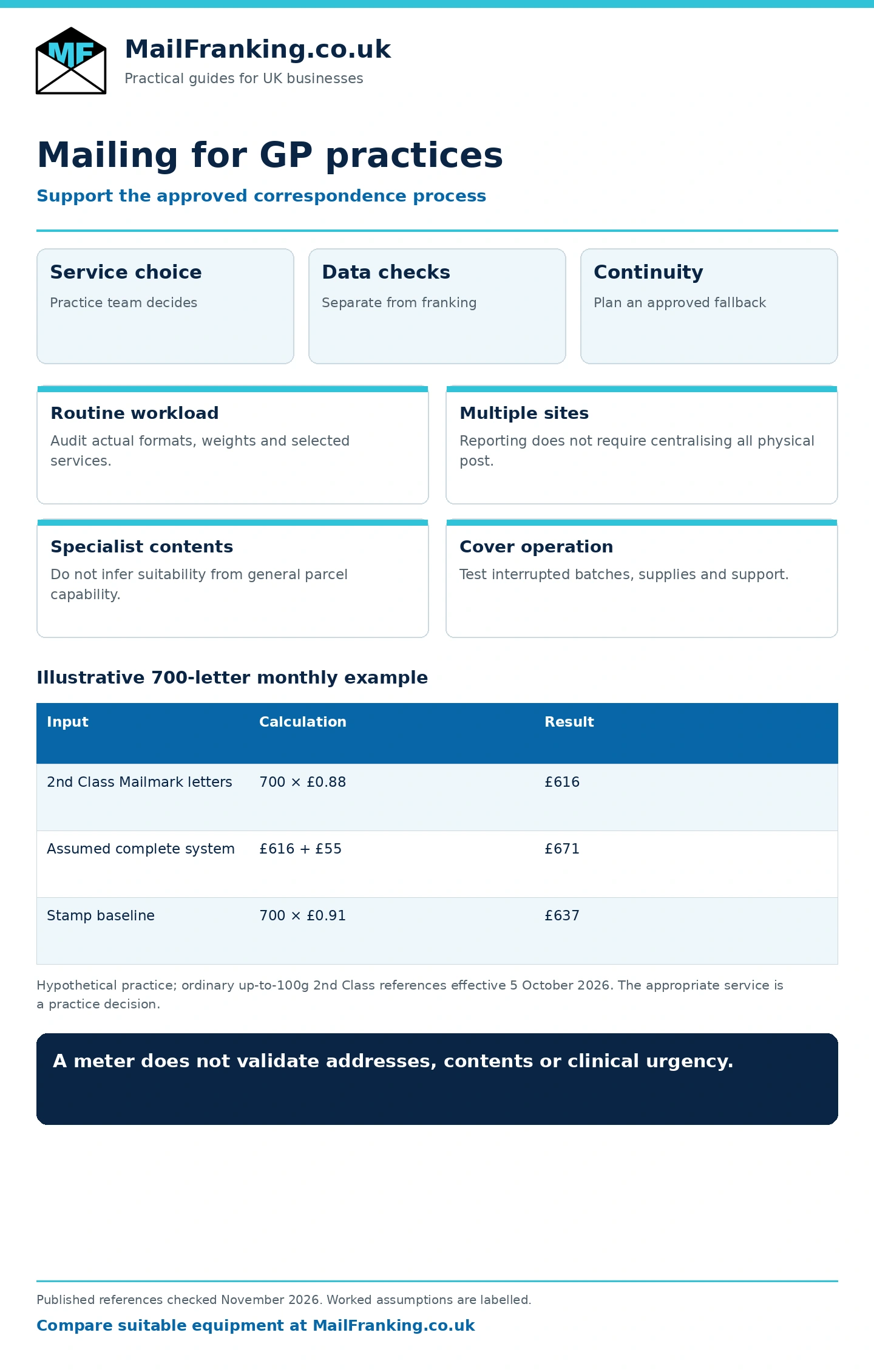
Assume a practice’s authorised process uses ordinary 2nd Class for 700 suitable letters monthly. At 88p, the modelled postage is £616. Add an illustrative £55 complete monthly equipment and running-cost allowance and the total is £671 before collection or other separately charged items.
Against a 91p stamp reference for the same format and class, the postage difference is £21 monthly. After the assumed £55 system cost, the meter requires another £34 of measured benefit to reach the same overall cost. A practice already buying online needs to use that actual baseline instead.
Convenience may still matter. If handling improvements release ten minutes on eighteen posting days monthly, that is three hours. At an assumed loaded administrative cost of £20 per hour, the modelled capacity value is £60. This is not automatically a payroll reduction, and it must be demonstrated without weakening checking or dispatch controls.
Appointment batches and mixed daily post
A repeated batch can use stable job settings, but operators still need to confirm that its contents, class and format match the approved job. An extra insert or a different pack can change the correct postage. Train staff to recognise exceptions instead of treating a saved selection as a complete validation.
Run the demonstration with both a uniform batch and a mixed tray. The latter should include a larger envelope and an item using an exceptional service. Record the whole time, including account changes, weighing and dispatch preparation. A maximum speed measured on identical envelopes does not describe the mixed workflow.
If automatic feeding is proposed, include filled envelopes from the practice’s normal stationery supply. Check seals, print legibility and recovery after an interruption. A small number of rejects can add significant checking work if staff must investigate whether documents or postage have been duplicated.
Address accuracy and document matching
The meter is normally downstream of the most sensitive checks. The practice needs a reliable source address, a controlled way to match personalised contents and a process for returned correspondence. Equipment should support those arrangements rather than be presented as a substitute for them.
The ICO’s subject access guidance highlights appropriate packaging and security when information is sent. A postage mark does not establish that a disclosure was correctly addressed or appropriately authorised. Use invented data in demonstrations and assess the full preparation process with the responsible practice team.
Check whether window envelopes can reveal additional text when contents shift. Keep completed, rejected and unchecked batches physically distinct. Where work is interrupted by reception duties, document how a colleague can identify the current stage without relying on the previous operator’s memory.
Multiple sites and shared administration
A practice group may want one report for several locations while still needing local dispatch capability. Compare central commercial purchasing with physical centralisation: these are different decisions. Moving all mail to one site can create internal transport and timing problems even when equipment costs fall.
Use site and department codes that provide useful totals without storing unnecessary patient identifiers in the meter. Ask for a sample export and test reconciliation with the practice’s financial process. Establish who can change accounts, view reports and authorise postage funding.
For an illustrative three-site group, eliminating two assumed £45 monthly packages avoids £1,080 annually. If internal handling and fallback add £720, the remaining difference is £360 before any central-system premium. Keep that net amount visible when evaluating a consolidated proposal.
Reporting should support a simple audit trail
Reconcile postage used, funding movements, fees and closing balance separately. A top-up is not necessarily the expenditure associated with letters produced during the same reporting period. Ask the provider to explain statements and demonstrate how corrections or spoiled impressions appear.
For ordinary management reporting, a small number of stable categories can be more useful than an elaborate list nobody maintains. Distinguish a local meter total from an online reporting subscription. Request the enabled account count, export format, retention and recurring cost of the actual package.
If a reporting feature claims to save an hour monthly, have the finance or administration team test the export. At an assumed £22 hourly cost, the modelled value is £264 annually. Deduct the software premium and any account-maintenance work before treating that figure as an advantage.
Clinical specimens and specialist dispatch are separate
Do not treat an ordinary office franking machine as evidence that a practice can send every type of healthcare item through the same route. Specimens, medicines, temperature-sensitive goods and restricted contents require their own authorised arrangements and product-specific checks. Keep those tasks outside a routine correspondence comparison unless the responsible team has specified the exact process.
For a procurement brief, describe the service requirement without assuming the meter is the solution. Ask the supplier to state precisely what the hardware and software support and what remains outside scope. Avoid a generic claim that parcel capability establishes suitability for specialist healthcare logistics.
Our parcel guide explains the difference between a scale, a franked label and a separate shipping application. It is a general business guide and should be used alongside the practice’s own specialist dispatch instructions, not instead of them.
Supplies, intermittent use and operator cover
Keep sufficient approved ink, labels and sealing supplies for scheduled work, and assign responsibility for checking stock. Request usable yield assumptions matching actual impressions and usage frequency. A cartridge’s maximum advertised output should not be treated as a guaranteed number of patient letters.
Train a cover operator to load funds through the approved process, check rates, select jobs and manage common exceptions. Store instructions and account access according to the practice’s own security policies. A system that works only when one administrator is present creates an avoidable dependency.
Our supplies guide and postage-credit guide provide the cost and funding questions to ask. Agree the approved response to a spoiled impression or failed print rather than allowing staff to improvise potentially incorrect corrections.
Downtime and dispatch continuity
Specify the required support window, fault-reporting route and restoration arrangements. A callback target is not a guarantee that urgent post can leave on time. Ask about parts, carriage, onsite attendance, software support and any loan or replacement system included in the agreement.
Test the practice’s approved fallback for network failure, lack of credit or equipment breakdown. Identify who can authorise it and whether it changes the handover requirements. A fallback that needs a staff member to leave reception may have a meaningful operational cost even when the postage price is similar.
Use the maintenance guide to compare exclusions. The supplier should explain how a partly working system is supported when, for example, reporting is unavailable but envelope printing remains possible. Agree which failures require stopping the affected workflow and escalating through the practice’s process.
Procurement and contract approval
NHS bodies, GP partnerships, private practices and practice groups can have different purchasing arrangements. Follow the organisation’s own approval process and obtain review of the actual contract. Do not assume a framework, discount or authority applies simply because the equipment will be used in healthcare.
Request separate finance, service and software commitments with renewal, notice, return and unused-credit terms. If replacing equipment, obtain the existing settlement position first. Our rental guide explains why a service-inclusive description still needs an itemised schedule and a clear minimum term.
Forecast remaining paper volume across that term, including planned changes in communication channels. Test lower-volume scenarios and compare the cost per item. Choose a package that remains practical for cover staff and controlled dispatch, with any capacity or convenience benefit recorded honestly alongside cash costs.
Frequently asked questions
A compact supported manual meter may suit modest routine correspondence, but compare it with the current online process. Focus on simple operation, correct services, reliable cover and full annual cost. Larger batches can justify more automation only when the actual preparation and dispatch workflow demonstrates a useful benefit.
The practice’s authorised team should determine the channel and postal service appropriate to the communication. A meter can support the selected process but should not decide clinical urgency or substitute for policy. Train operators to identify exceptions and avoid relying on a default setting for every letter.
Franking pays for a supported postal service; it does not validate addresses, authorise disclosures or match documents to envelopes. Those controls remain part of the practice’s wider process. Demonstrate equipment with invented records and assess window positions, rejected material, report access and interrupted-batch handovers separately.
Potentially, depending on the equipment and software package. Ask for enabled site accounts, user permissions, export formats and recurring charges. A shared report does not require physically centralising all post. Compare the transport, timing and fallback consequences before replacing local equipment with one central machine.
Do not infer suitability from ordinary letter or parcel capability. Specialist contents require the practice’s authorised arrangements and product-specific checks. Define the exact dispatch requirement with the responsible team and establish what the supplier supports. Keep routine office correspondence and specialist healthcare logistics as separate procurement questions.
Request support hours, diagnosis, attendance, parts, carriage, software assistance and any working replacement provision. Assess restoration against actual dispatch requirements rather than only a response target. Train a cover operator and retain an approved fallback for funding, network or equipment failure, including its practical staffing cost.