
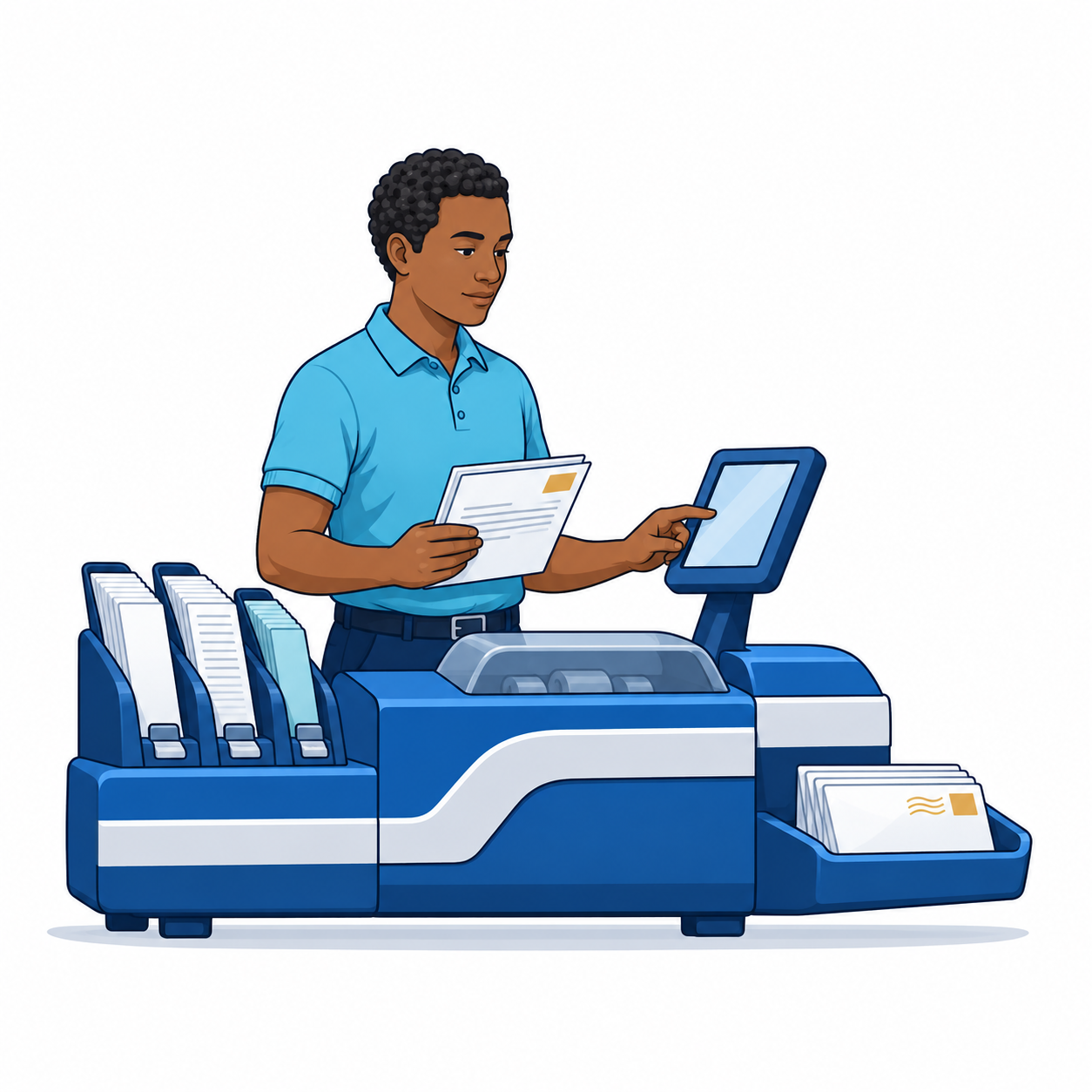
A folder inserter folds documents, places them into envelopes and, where configured, seals the finished mail. It addresses a different task from a franking machine, which applies postage to prepared items. If staff spend more time assembling letters than paying for their dispatch, an inserter may be the more relevant investment.
The buying decision depends on actual document combinations, envelope stock, matching requirements and realistic batch frequency. This guide provides published UK price examples, compares equipment categories and models the labour case. Manufacturer maximums and hypothetical calculations are clearly separated from performance you would need to demonstrate in your own mailroom.
What does a folder inserter do?
The basic sequence is feeding documents, folding them, combining the required sheets or inserts, putting the contents into an envelope and producing output for the next stage. Features vary considerably. Some units suit simple repeated letters, while more capable configurations support variable-page work or reading technology for controlled assembly.
A paper folder alone is not necessarily an inserter, and a franking machine does not normally replace either function. Map the whole process before requesting quotes. If printing, checking or addressing is the real bottleneck, a different investment may be needed even if manual envelope stuffing looks conspicuous.
- Takes 2 minutes
- Receive quotes to compare
- Easy and no commitment
Royal Mail postage remains a separate cost and workflow. After preparation, you may use a meter, an appropriate account process or another supported route. Our PPI comparison and franking equipment guide help assess that later stage without assuming the inserter automatically buys postage.
Published UK folder inserter prices
The following dealer listings were checked in November 2026. They are specific offers, not manufacturer-wide tariffs or guarantees of current stock. Confirm condition, configuration, installation, warranty, service and delivery before ordering, particularly where a listing offers a selectable range.
| Published example | Price excluding VAT | Price including VAT | Important qualification |
|---|---|---|---|
| Quadient DS-40i standard dealer listing | £4,172–£4,805 | £5,006.40–£5,766 | Configuration varies; confirm condition and inclusions |
| Quadient DS-40i two-station refurbished listing | £3,750 | £4,500 | Explicitly refurbished offer |
| Quadient DS-64i manufacturer route | Quote required | Quote required | No fixed complete UK price verified here |
The first two references are the dealer’s own DS-40i listing and refurbished two-station listing. A lower refurbished price is not directly comparable with another package until condition and cover are aligned. The minimum price difference in these examples is £422 excluding VAT, before service and setup differences.
Entry-level and more capable systems
Quadient’s DS-40i product information gives a maximum of 1,350 envelopes per hour. Its DS-64i information gives up to 2,500 and describes barcode-supported capabilities. Treat those as product references, not evidence that every offered configuration includes every reading or integrity feature.
- Give your requirements
- Receive quotes to compare
- Choose a provider or walk away - your choice!
| Requirement | Configuration direction | What to confirm |
|---|---|---|
| Repeated simple letters | Compact office inserter | Sheet count, feeders and envelope fit |
| Additional leaflet or reply envelope | Suitable additional insert station | Material size, thickness and feeding reliability |
| Variable pages by recipient | Appropriate reading and assembly configuration | How groups are identified and exceptions handled |
| Larger regular runs | Higher-capacity system with suitable support | Sustained output and replenishment |
Choose feeder capacity and document handling before chasing maximum speed. A machine that cannot assemble the required combination is not a bargain at any transport rate. Ask for the precise number and type of stations rather than assuming every feeder can handle every size of insert.
Real throughput includes setup and replenishment
An advertised hourly maximum describes suitable operating conditions. Your complete job includes loading stock, selecting the job, checking the first output, replenishing documents, clearing envelopes, dealing with exceptions and reconciling quantities. Short runs can spend more time in setup than in continuous production.
For a hypothetical 1,000-envelope run, a nominal 2,000-per-hour process represents thirty minutes of transport. Add twenty minutes for setup, ten for replenishment and fifteen for checking and exceptions, and the complete job becomes seventy-five minutes. That is an effective 800 envelopes per hour, not 2,000.
Use representative filled output and the intended operator in the trial. Time the complete workflow and record usable envelopes rather than transport passes. Include the awkward stock that causes problems today, so the supplier can show whether it is supported or needs a different configuration.
Worked labour model for 5,000 letters monthly
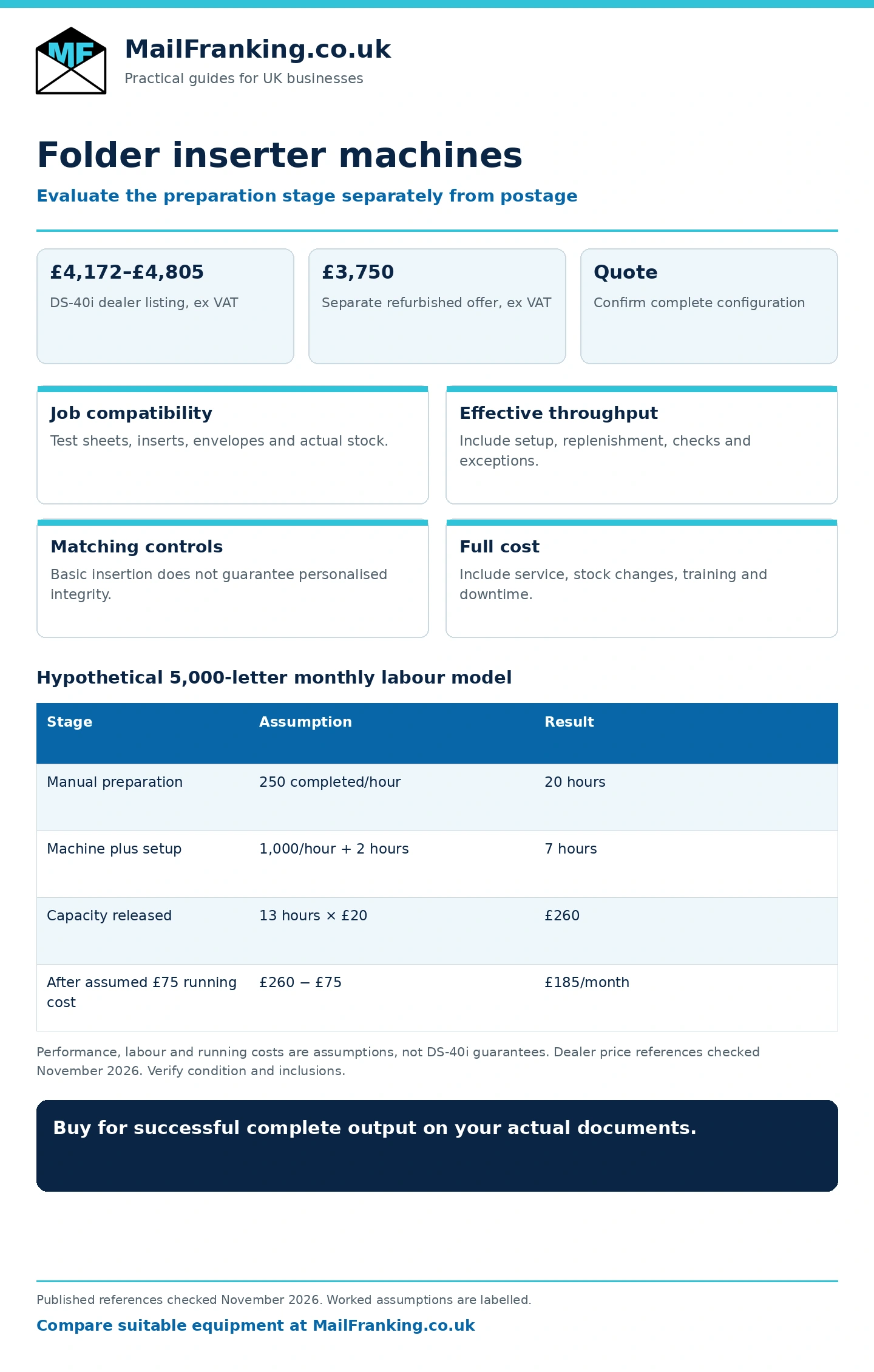
Assume manual preparation achieves 250 completed envelopes per hour, requiring twenty hours for 5,000 letters. Assume the proposed inserter produces an effective 1,000 per hour on the tested job, plus two hours of monthly setup and checks. That is seven hours, releasing thirteen hours of capacity.
At an assumed loaded staff cost of £20 per hour, the modelled benefit is £260 monthly. Deduct an assumed £75 monthly service and incremental running-cost allowance, leaving £185. Against a £4,172 ex-VAT purchase reference, simple payback is approximately 22.6 months before finance, implementation or other excluded costs.
Every performance and running-cost input in that calculation is hypothetical. The purchase reference does not prove that a DS-40i can deliver the assumed effective rate on your documents. Replace those inputs with a trial and a written service quote, and use a consistent VAT basis appropriate to the organisation.
Lower volumes can change the result sharply
At 2,000 letters monthly using the same manual assumption, preparation takes eight hours. If the inserter needs two hours of production and one hour of setup, it releases five hours. At £20 per hour, the £100 benefit falls to £25 after the assumed £75 running allowance.
The same £4,172 reference would then take approximately 167 months to recover through that narrow model. That is not an equipment-life prediction; it illustrates how fixed costs and setup time affect a lower-volume case. Convenience or deadline resilience can still matter, but should be identified separately.
Run a sensitivity table with lower volumes, slower effective output and more exceptions. Our franking savings guide uses the same whole-cost principle for the postage stage. Avoid counting a labour improvement twice when evaluating an inserter and a new meter together.
Documents, paper and envelope compatibility
Bring the actual paper weights, print types, folds, inserts and envelopes to the demonstration. Static, curl, coated stock and variable thickness can affect handling. An insert station suitable for one leaflet may not support a thicker reply envelope or a different dimension without adjustment.
Confirm the exact envelope specification, including flap and window requirements, and test completed filled items. A change in stationery purchasing can undermine a previously successful setup. Retain the approved specification and a sample from acceptance so future reorders can be checked before a major run.
Include the price difference if new stock is needed. If a suitable envelope costs 1.5p more and you use 60,000 annually, that adds £900. A cheaper machine that requires a substantial stationery premium may cost more overall than equipment that handles the organisation’s established stock reliably.
Matching, reading and document integrity
A machine that folds and inserts sheets does not automatically guarantee that each recipient receives the correct documents. Variable-page jobs require an appropriate method of identifying groups, controlling sequence and handling exceptions. Ask suppliers to explain exactly what the quoted reading and assembly configuration detects and what it does not. For housing providers, the housing association mailing guide applies those checks to tenant correspondence and service charge packs, alongside the separate cost of postage and dispatch.
Use fictitious personalised records to test missing sheets, extra sheets, duplicates, a rejected envelope and restart after a jam. Establish the operator’s correction process and whether the system preserves a useful reconciliation record. Do not infer detailed integrity controls from a generic barcode capability description.
The ICO’s information security guidance provides relevant context for personal information. Equipment, software, staff checks and data preparation must work together. A successful demonstration of uniform marketing inserts is not sufficient acceptance for confidential variable-page financial or patient correspondence.
Buying refurbished versus buying another package
For a refurbished unit, request the model, serial identifier, condition report, service history where available and the work completed before resale. Confirm spare parts, software, reading options and ongoing support. A familiar model name does not establish that the exact used configuration can perform the proposed job.
Compare warranty and restoration arrangements with other offers. Ask who pays carriage, whether installation and training are included and what happens if the unit fails the agreed acceptance test. A short warranty with expensive transport can reduce the value of a modest purchase-price saving.
In the published DS-40i examples, the £422 minimum ex-VAT difference is only one input. If another package includes installation or meaningful cover, quantify it before deciding. Conversely, an attractive listing should not be upgraded with assumptions about included options that the seller has not confirmed.
Rental, finance and service costs
Where rental or finance is offered, request the equipment cash price, payment frequency, minimum term, fees and end-of-term position. Keep the service agreement separate enough to understand what is included. No current universal UK monthly rental price was verified for the configurations in this guide.
For an arithmetic illustration, £150 monthly totals £5,400 over 36 months and £9,000 over sixty. Those are assumed payments, not inserter rental offers. Compare them with purchase plus actual service, support and financing on the same period, including any expected residual or return obligation only where contractually supported.
Ask about covered parts, labour, call-outs, cleaning, consumables, software and accidental damage. Response is not restoration. If a scheduled statement run cannot wait several days, a loan unit, alternative production route or stronger service arrangement may be worth more than a low headline payment.
Integrating preparation with franking and collection
After insertion, output still needs the correct postage and handover preparation. Arrange the workstation so completed envelopes do not mix with unchecked or rejected work. Agree who reconciles print quantity, inserted output, spoiled items and dispatched items, especially across separate operators.
Do not assume the inserter is physically integrated with the meter merely because they appear in the same sales proposal. Ask whether output is transferred manually, what space and trays are needed and whether the two stages have compatible throughput. A very fast inserter can simply move the queue to postage preparation.
Use the automatic franking comparison where a matched envelope workflow is needed, and the high-volume guide for larger operations. Assess collection cut-offs and exceptions as part of the same dispatch plan rather than a later detail.
When outsourcing may be more suitable
Compare outsourcing where batches are infrequent, personalised assembly is complex or the organisation lacks operators and space. Obtain a complete price including print preparation, proofs, stationery, postage, data handling and exceptions. The mailing supplier’s unit charge should be compared with the full in-house workflow, not just machine payments.
If regular confidential or original documents must remain in-house, assess those separately rather than moving every job to one route. A mixed arrangement may let the organisation retain controlled specialist work while avoiding a permanent equipment commitment for an occasional large campaign.
Our hybrid mail guide explains the practical distinction. Whichever route is chosen, keep a clear owner for approvals, quantity checks and dispatch evidence. The equipment’s productivity does not remove the need to know what was prepared and handed over.
Acceptance checklist before purchase
Agree a written test using the normal documents, envelope stock, largest sheet group and required inserts. Include setup, an interrupted run, recovery, count reconciliation and output inspection. Ask the intended operator to repeat the task after training and record the supported settings.
Retain the quote, exact configuration, agreed material specification and acceptance result together. Base the investment case on successful complete output and realistic annual volume. A published price is a useful starting point, but the best purchase is the package that reliably prepares your actual mail at a justifiable whole cost.
For school offices, include term-time peaks and the annual commitment in the same review. For charities, distinguish routine correspondence from infrequent appeals. Both can have substantial individual batches without enough continuing work to justify the same permanent equipment arrangement as a production mailroom.
Frequently asked questions
The checked dealer examples list a DS-40i at £4,172–£4,805 excluding VAT and a separate refurbished two-station offer at £3,750 excluding VAT. These are specific listings, not universal prices. Confirm condition, configuration, installation, training, delivery and support, and obtain a complete quotation before comparing them.
No. A folder inserter prepares envelopes by folding and inserting documents and, where configured, sealing them. A franking machine applies postage to prepared items. The two can form part of one mailroom process, but their functions, costs and benefits should be evaluated separately before combining the investment case.
There is no universal volume threshold. The result depends on manual preparation speed, effective machine output, setup, complexity, running cost and the value of released capacity. Test your actual job and model lower volumes. An occasional large batch can have a different case from the same annual quantity spread across many small runs.
Only the specific quoted controls and wider process can be assessed. Basic folding and insertion do not automatically establish correct personalised matching. Demonstrate the required reading, grouping, exception and reconciliation functions with fictitious records, including missing or duplicate sheets and recovery after an interruption.
It can be, provided the exact unit has suitable condition, options, materials compatibility and continuing support. Request a condition report, configuration and acceptance test, then compare warranty, carriage, installation and service. A lower purchase price is less useful if essential reading functions or reliable restoration are missing.
Use your real stationery and representative documents, with invented personal details where appropriate. Include setup, replenishment, multiple inserts, the largest supported group, jams, restart, sealing and count reconciliation. Measure usable output ready for the next stage and retain the agreed specification and results with the complete quotation.