

The Quadient iX-1 is an entry-level franking machine for businesses that want a compact, manually fed system. It is designed to weigh items, select postage and print an eligible paid impression without the size or handling equipment of a larger mailroom machine.
Its value depends on the proposed UK configuration, complete running cost and your actual postal mix. This review uses the UK brochure for specifications, distinguishes quote-only equipment from illustrative budgets, and shows why small offices should calculate savings by format rather than rely on a broad discount claim.
Quadient iX-1 specifications
| Feature | UK brochure information |
|---|---|
| Maximum processing rate | Up to 18 letters per minute |
| Feeding | Manual, with envelopes presented individually |
| Weighing platform | 5kg integrated removable platform in the cited UK brochure |
| Rate shortcuts | Six |
| Job memories | Nine |
| Accounts | One standard; additional account options available |
| Printed messages | Eight advertisements and ten custom messages listed |
| Connectivity | LAN standard; wireless option available |
| Physical thickness | 5/16 inch, approximately 7.9mm |
The official UK iX-1 brochure is the basis for this table. Online descriptions and older offers may describe different scale capacities or market configurations. Request the exact UK specification in the quote rather than combining details from several versions into an imaginary package.
The iX-1 is a compact office machine, not a stack-fed production system. Its advertised speed measures the printing stage under suitable conditions. It does not include document preparation, inserting, format checks, addressing or the time needed to change products between items.
- Takes 2 minutes
- Receive quotes to compare
- Easy and no commitment
How much does the Quadient iX-1 cost?
The current official UK product information directs buyers towards a quotation rather than providing a fixed public purchase or rental tariff. We therefore cannot present a verified manufacturer price for a new iX-1. An online headline from another source may describe an old offer, a different package or refurbished equipment.
Obtain separate purchase, rental and finance proposals where available. Each should identify the equipment condition, exact scale, software access, service, installation, rate updates and contract length. A weekly equipment-only price is not directly comparable with a monthly service-inclusive package.
The following figures are illustrative complete monthly allowances, not Quadient prices or quotations. They show how apparently small monthly differences accumulate over a long term and affect the postage volume needed to cover the system.
| Assumed complete monthly cost | Annual cost | Five-year arithmetic total | Ordinary letters at 3p saving to cover each month |
|---|---|---|---|
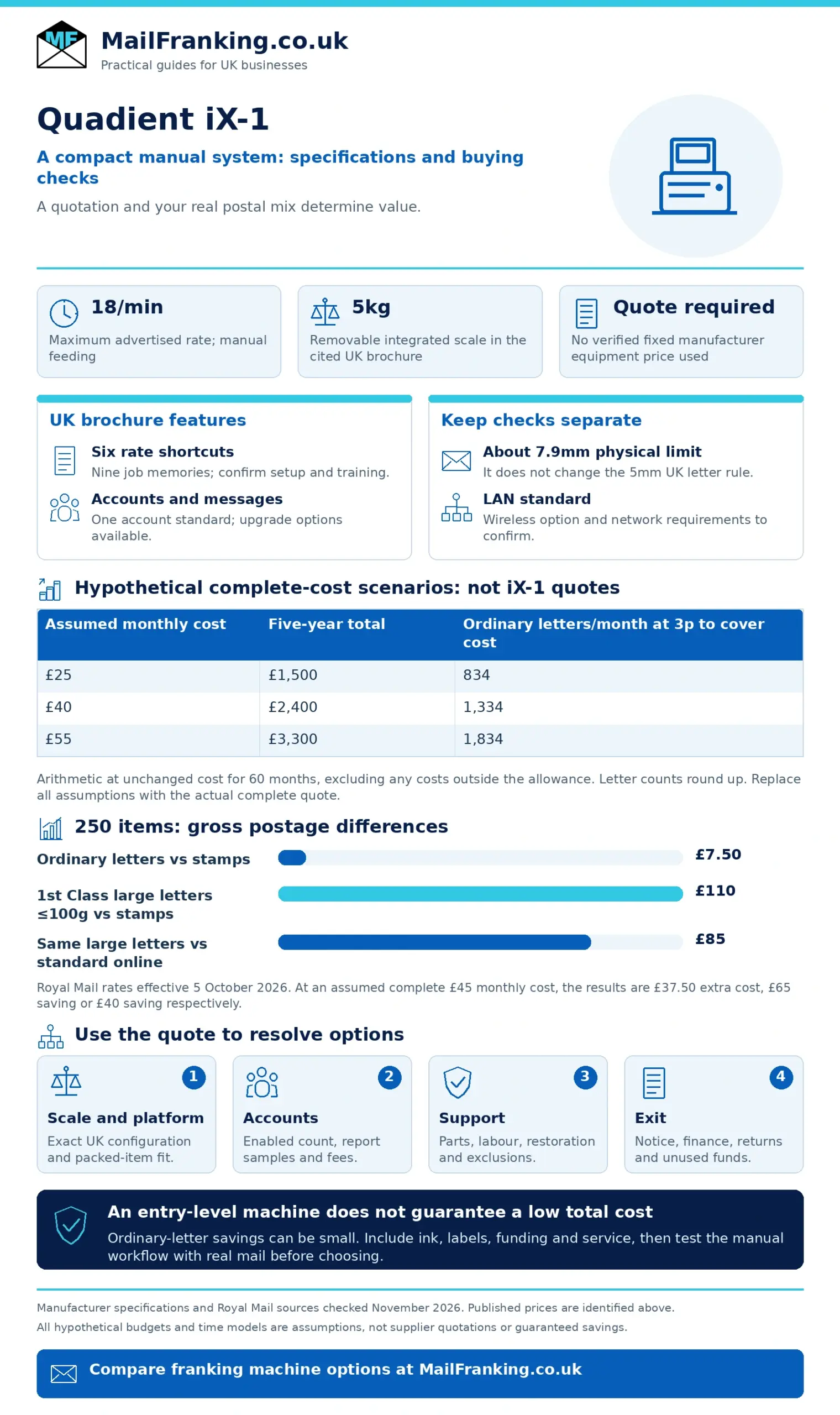
| £25 | £300 | £1,500 | 834 |
| £40 | £480 | £2,400 | 1,334 |
| £55 | £660 | £3,300 | 1,834 |
The final column rounds up to a whole letter and excludes any additional cost outside the assumed allowance. Replace every allowance with your actual quote. Check whether prices can increase, whether VAT is additional and whether finance continues independently from the service agreement.
- Give your requirements
- Receive quotes to compare
- Choose a provider or walk away - your choice!
If one offer is £8 a month cheaper over 60 months, its headline difference is £480. That can disappear if it excludes installation, consumables or a service item included elsewhere. Compare a written schedule of costs, not the first figure displayed beside the machine photograph.
Will an iX-1 reduce your postage bill?
An eligible Mailmark impression gives access to the applicable Mailmark postal prices, but equipment discounts and postage discounts are separate matters. Current savings vary sharply between ordinary letters and certain large letters. Start with the products your business already purchases.
The Royal Mail tariff effective 5 October 2026 lists ordinary 1st Class letters up to 100g at £1.77 and 2nd Class at 88p. The corresponding stamp prices are £1.80 and 91p. Both differences are 3p per item, which generates only £7.50 on 250 ordinary letters.
For a 1st Class large letter up to 100g, Mailmark is £2.86 against £3.30 by stamp, producing 44p gross saving. Against the standard online price of £3.20, the difference is 34p. The online comparison is more relevant if you already buy postage digitally.
| Worked monthly mail mix | Gross saving against the stated baseline | After assumed £45 complete cost |
|---|---|---|
| 250 ordinary letters against stamps | £7.50 | £37.50 additional cost |
| 250 qualifying 1st Class large letters against stamps | £110 | £65 remaining saving |
| 250 of those large letters against standard online postage | £85 | £40 remaining saving |
At the illustrative £45 allowance, covering the system requires 1,500 ordinary letters at 3p each, 103 qualifying large letters at 44p, or 133 at 34p. That is why a suggested daily volume cannot establish whether the machine pays for itself.
Include consumables, applicable funding charges, staff handling and any collection differences before treating a remaining balance as a final saving. Our franking savings calculator sets out the same method for a mixed mailing profile.
Manual feeding and real batch times
At the advertised maximum of 18 letters per minute, 180 envelopes represent ten minutes of continuous printing. In practice, someone still needs to prepare and present them. Mixed weights, different services and interruptions can make the end-to-end job substantially longer.
Use a representative test rather than a stack of perfectly identical demonstration envelopes. Include short invoice letters, thicker document packs and any awkward items you regularly send. Check whether the feeding position is comfortable and whether the output remains tidy enough for the next stage.
A machine that saves a few minutes once a week may still provide convenience, but it is unlikely to justify a large cost premium through labour alone. If staff regularly spend long sessions presenting individual envelopes, compare a different feed system rather than simply a higher printing-speed number.
Our guide to manual versus automatic franking explains the distinction between individual presentation, assisted transport and automatic stack feeding. The Quadient iX-4 also needs careful interpretation: its higher stated speed does not make it a stack-fed machine under the cited UK specification.
The scale does not decide the postal format
The cited UK brochure specifies a removable integrated 5kg weighing platform. Confirm that this is the platform supplied in your offer and that its physical size accommodates your work. A heavy parcel touching the desk or a wall can prevent an accurate reading.
Weight is only one part of selecting postage. UK letter and large-letter services also have dimensional and thickness limits. The meter’s approximately 7.9mm physical envelope allowance does not mean an envelope thicker than 5mm qualifies for ordinary letter postage.
Measure the completed item, including all inserts, and use a format guide. A wide, light envelope can be a large letter despite weighing very little. Conversely, buying a large-letter service unnecessarily can cost more than the saving achieved by franking.
For boxes or bulky items that cannot be printed directly, ask about compatible labels and the associated parcel process. A scale’s capacity does not prove that the meter provides every tracked service, customs function or online-shop integration you need. Compare the complete parcel-postage workflow.
Accounts, job memories and printed messages
The UK brochure lists one standard account with additional account options. If several departments need separate budgets, request the number of enabled accounts, any upgrade price and the report format. Do not assume that a feature described as available is included in the entry quotation.
Nine job memories and six rate shortcuts can simplify repeated tasks. Configure them around real jobs, such as a particular class and format, and train staff to confirm the selection. A shortcut does not detect that today’s envelope contains extra pages or requires a different service.
Printed advertisements and custom messages are listed, but the supplier should demonstrate the exact artwork or text you want. Ask about setup charges, file preparation and whether the message remains legible with your chosen envelopes. Never treat a supplier’s logo library as permission to use another organisation’s branding.
For reporting, distinguish a local meter total from a software dashboard or downloadable file. Request a sample report and reconcile it with a small batch. Useful reporting depends on staff selecting the correct account consistently, as well as the machine supporting the feature.
Connectivity, installation and support
LAN is listed as standard, with wireless connectivity available. Check whether the quoted equipment needs an optional adapter and whether your office network permits its connection. Obtain the technical requirements before signing rather than finding an incompatible network policy on installation day.
Agree who installs the machine, configures rates and accounts, trains staff and verifies a successful postage download. Keep a basic operating guide accessible to cover staff. A simple device can still disrupt a small office if only one person understands its account and funding process.
Ask what happens when internet access, software or the meter fails. Confirm the difference between a support callback and a working replacement. Service cover should specify applicable parts, labour, travel and exclusions, with a practical route for sending urgent post during an outage.
Read our franking maintenance guide before comparing service-inclusive offers. Routine maintenance, regulatory inspection provisions and breakdown repair are different matters. Avoid paying twice for an item already included in the equipment agreement or assuming every advertised guarantee includes accidental damage.
Ink, labels and postage credit
Ask for current genuine compatible ink prices, expected usage and delivery charges. An advertised yield is an estimate under particular conditions, not an invoice-level guarantee. A cost-per-letter model should reflect your mixture of plain postage impressions, additional messages and cleaning activity.
For label users, calculate the unit cost from the pack price and quantity. Add a modest allowance for reprints where justified by your own experience. Direct envelope printing and labelling every item produce different consumables budgets, even at the same mailing volume.
Funding fees need to be established for the actual supplier account; another manufacturer’s refill charge is not evidence of an iX-1 fee. Ask how credit is loaded, whether an administration charge applies, what cash is held and how unused funds are recovered when leaving.
Keep meter credit separate from equipment payments and account fees in your records. Our postage-credit guide explains the reconciliation principles. When comparing VAT, use a consistent basis: ordinary exempt postage and taxable equipment charges should not be blended into one misleading percentage saving.
Contract checks before choosing
Ask for the minimum term, notice deadline, cancellation process, automatic renewal terms and end-of-term ownership position. Identify any separate finance provider. Returning the device or stopping postage downloads may not cancel all the related contractual obligations.
If the offer covers refurbished equipment, check the refurbishment standard, warranty, support period and licensing arrangements for that serial number. Confirm who will maintain it and whether current rates and software remain available. An older model at a low upfront price can carry additional transition work.
Arrange a Royal Mail franking licence through the appropriate authorised provider before use. A previous user’s licence does not automatically transfer with a second-hand machine. Keep the registered legal name and operating address correct, including when the business moves.
Our assessment
The iX-1 is worth considering for a small business that values a compact manual system, useful presets and the confirmed UK weighing configuration. It is particularly important to compare the full quote where usage is low, because ordinary-letter postage savings alone can be modest.
Shortlist it alongside the SendPro Mailstation and PostBase Mini using identical mail samples and cost categories. This review is based on published UK specifications and tariff calculations, rather than hands-on testing or an undisclosed supplier quote. The best choice is the demonstrated workflow that fits your mail at a sustainable complete cost.
Frequently asked questions
The current official UK information uses a quotation route rather than a fixed public purchase or rental price. Ask for an itemised offer covering the exact machine, scale, condition, software, service and term. The monthly amounts in this guide are calculation examples, not manufacturer prices or advertised deals.
No. The cited UK brochure describes manual feeding, with a maximum advertised rate of 18 letters per minute. An operator presents the envelopes individually. If your main goal is unattended stack handling, compare equipment with a confirmed automatic feeder and test the entire job using your actual mail.
The cited UK brochure specifies a removable integrated 5kg platform. Other descriptions may relate to different versions or packages, so confirm the exact scale in writing. Capacity alone does not establish parcel-service compatibility, and the packed item must be supported correctly without touching nearby surfaces during weighing.
The UK brochure lists one standard account and additional account options. Ask how many are enabled in your quote, whether an upgrade or software subscription is required and which reports are available. Request a sample export and check that staff can reliably choose the correct department before printing.
Current ordinary Mailmark 1st and 2nd Class letters up to 100g are 3p below corresponding stamp prices. Some large-letter comparisons offer larger differences. Calculate your own mix and deduct equipment, consumables and applicable account fees before deciding whether the business saves money overall.
Potentially, but confirm current support, condition, compatible supplies and licensing before paying. A previous owner’s franking licence does not transfer automatically. Obtain the serial number and written confirmation from an appropriate authorised provider that the unit can be registered, maintained and used with the services your business requires.