

The Quadient iX-4 and Pitney Bowes SendPro C are desktop franking systems for offices that want to prepare routine correspondence in-house. The most useful comparison is between the exact UK packages offered to your business: feeding method, weighing, reporting, postal services and the complete cost over the agreement.
The headline speed is different, but neither number tells you how quickly staff can finish a mixed batch. This guide compares the published specifications, explains where quotations are still required and provides calculations you can adapt using your own mail. Generic illustrations on this page represent mailing equipment rather than exact product photographs.
The main differences at a glance
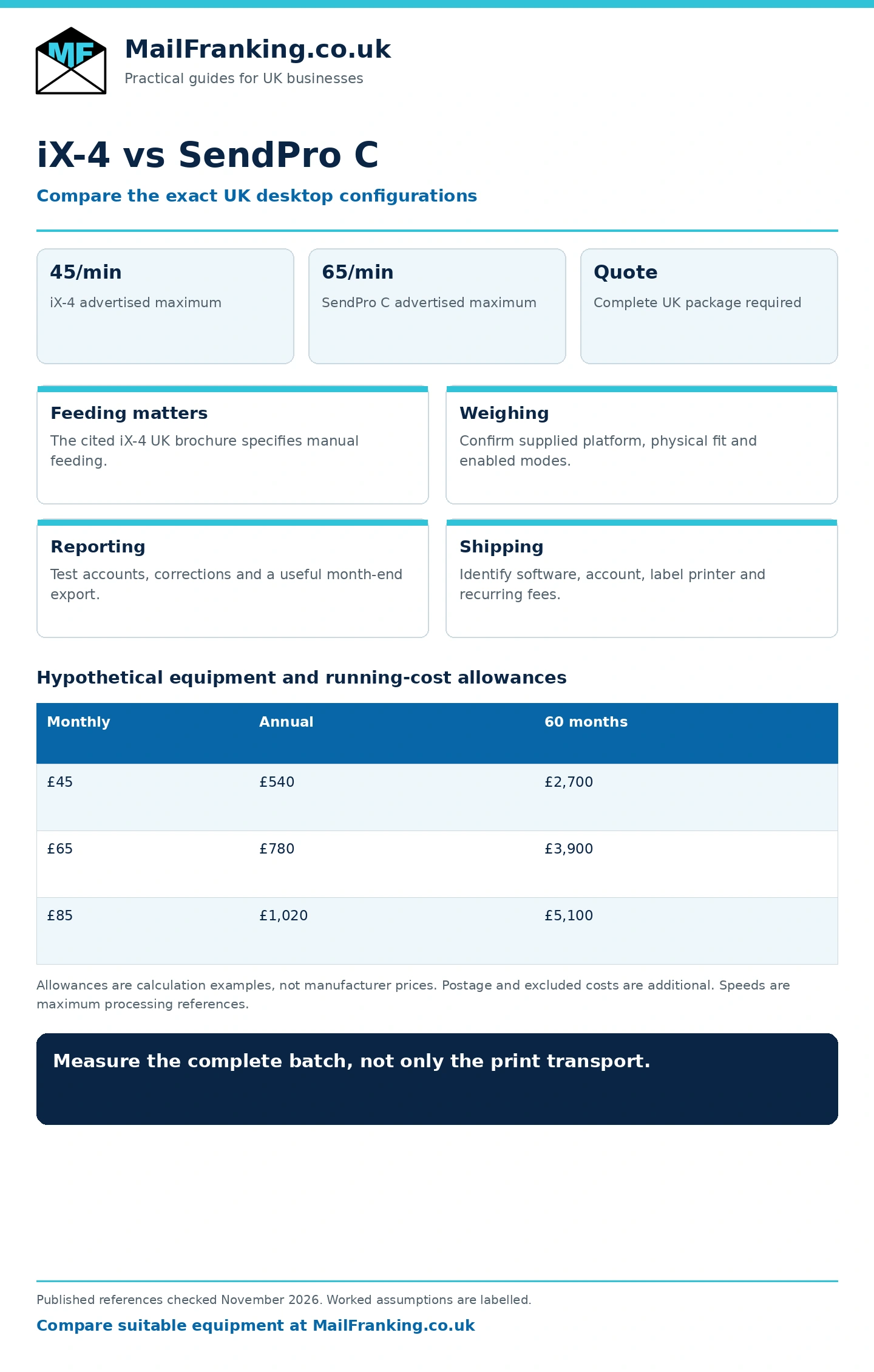
The official UK iX-4 brochure and Pitney Bowes UK specifications are the principal technical references. The iX-4 brochure explicitly describes manual letter feeding. Do not confuse a motorised envelope transport or a high print rate with an automatic stack feeder.
| Feature | Quadient iX-4 | Pitney Bowes SendPro C |
|---|---|---|
| Published maximum speed | Up to 45 letters/minute | Up to 65 letters/minute |
| Screen | 5-inch vertical colour touchscreen | 7-inch tablet display |
| Feed comparison | Manual in cited UK brochure | Operator-fed desktop system; distinguish C Auto |
| Scale | 3kg integrated in cited brochure | Confirm supplied platform and capacity |
| Reporting | S.M.A.R.T. Online; account options | Confirm enabled accounting and reporting package |
| Fixed current new-machine price | Itemised quote required | Itemised quote required |
Pitney Bowes’ SendPro C and SendPro+ share some support documentation, but they are not interchangeable commercial bundles. Our SendPro C vs SendPro+ guide addresses that choice. Keep the proposed C model code and any shipping accessories visible on the quotation.
- Takes 2 minutes
- Receive quotes to compare
- Easy and no commitment
Feeding and actual batch times
At continuous advertised maximum rates, 450 letters would represent ten minutes on a 45-per-minute system and roughly six minutes fifty-five seconds on a 65-per-minute system. The theoretical difference is about three minutes five seconds. That calculation excludes weighing, changing services, preparing envelopes and dealing with interruptions.
If a supplier asks £20 more each month for the faster package, the difference is £240 annually. To recover that through labour at an assumed £18 per hour, you would need to release about thirteen hours twenty minutes annually. Whether the speed difference produces that benefit depends on batch frequency and operator handling.
Use the same completed envelopes in both demonstrations. Start timing before selecting the first account and stop after the accepted output is ready for dispatch. Count misprints and any items that need labels. Our manual versus automatic guide explains why operator effort deserves its own comparison.
How much do the machines cost?
The official product and support references checked for this comparison do not establish a fixed current UK new-machine price for either complete package. Obtain purchase and rental proposals with the condition, platform, installation, service, software and term itemised. Avoid presenting an older dealer advertisement as a current manufacturer tariff.
- Give your requirements
- Receive quotes to compare
- Choose a provider or walk away - your choice!
The table below is a budgeting illustration, not a quote for either model. It shows the effect of a small recurring difference and makes the contract calculation easy to repeat. Postage is additional, as are any charges excluded from your chosen allowance.
| Assumed complete monthly allowance | Annual amount | 36-month total | 60-month total |
|---|---|---|---|
| £45 | £540 | £1,620 | £2,700 |
| £65 | £780 | £2,340 | £3,900 |
| £85 | £1,020 | £3,060 | £5,100 |
A £45 package can cost more overall than a £65 package if the first excludes substantial service or supplies. Conversely, paying for software nobody uses creates a recurring premium without a benefit. Our hidden costs guide provides the fee categories to request.
Postal savings are not brand-specific discounts
For the same eligible ordinary Mailmark service, switching machine brands does not create a separate Royal Mail tariff. The financial comparison between these machines is therefore mainly about equipment cost, preparation, functionality and support, unless the proposals genuinely use different postal products.
At the October 2026 Mailmark tariff, an ordinary 1st Class letter up to 100g costs £1.77. Against the £1.80 stamp reference, 600 such letters generate £18 gross monthly saving. An illustrative £60 system allowance would leave £42 additional cost before any other benefit or charge.
Different formats can change the result substantially. Audit three months of actual mail and compare each product with the alternative you already buy, including online postage. Do not justify either package using a maximum percentage saving from a service your business rarely sends. Use our savings calculator guide to structure the calculation.
Weighing and envelope handling
The iX-4 brochure lists a standard 3kg integrated scale, with external platforms available. Its 10mm physical envelope thickness limit is an equipment specification, not a postal-format entitlement. A letter must still meet Royal Mail’s own dimensions and weight conditions even if it fits through the machine.
For the SendPro C proposal, request the exact scale included and demonstrate the largest packed items you send. A higher capacity is only helpful if the platform physically supports the item without contact elsewhere. For bulky packs, compare compatible labels and the steps needed to apply them accurately.
Differential weighing can be useful for mixed envelopes when available in the chosen package. Ask the operator to show the full sequence and identify which manual choices remain. A weighing feature does not guarantee that every destination, optional service and format decision is automatically correct.
Accounting, accounts and report exports
The iX-4 brochure lists up to 100 accounts, but the supplier should confirm the number enabled in your offer and any software conditions. For either machine, explain whether you need departmental budgets, individual user access, client charging or simple monthly totals. These are related but different requirements.
Ask for an anonymised sample export and try importing it into the spreadsheet or accounting process used by finance. Check date ranges, product descriptions, account identifiers and correction entries. A dashboard that looks attractive during a demonstration may still leave someone manually rebuilding the information needed for monthly reconciliation.
Calculate the value of reduced administration separately. If better reporting removes forty minutes monthly at an assumed £24 per hour, its estimated value is £16. That might justify a small software premium, but only if the export actually replaces work and the feature remains included throughout the agreement.
Parcel labels and optional software
Both proposals should explain how ordinary envelope franking differs from a separate parcel-label workflow. Identify the software, carrier account, printer, label stock and recurring subscription needed for your actual services. A machine’s built-in scale is not proof that it provides every tracked parcel product.
The iX-4 brochure includes S.M.A.R.T. Online and identifies optional accessories and software separately. On the Pitney Bowes side, distinguish SendPro C from a SendPro+ bundle and any separate shipping application. Ask suppliers to demonstrate the same representative parcel rather than relying on a broad promise of parcel capability.
If your operation mainly dispatches online orders, compare the complete alternative in our Click & Drop comparison. The right office meter is not automatically the right fulfilment platform. A mixed arrangement can be sensible where letter correspondence and warehouse shipping have different needs.
Consumables and funding costs
Request the ink part number, pack price, delivery charge and realistic yield for each quoted device. The published SendPro C support specification gives an estimated cartridge yield under particular conditions; actual results change with usage and graphics. Compare the cost of producing your own imprint, not a yield borrowed from another market.
For a simple sensitivity test, an extra 1p per item is £10 on 1,000 items and £120 annually. Over sixty months, that becomes £600 at unchanged volume. Labels can add a separate cost if your envelopes or parcels cannot be printed directly. Include waste and test impressions based on observed usage.
Funding charges belong to the actual provider account. Ask about refill fees, minimum balances, invoicing and unused-credit recovery, rather than assuming the two brands use identical terms. Our postage credit guide sets out the distinctions between postage principal and administration charges.
Installation, network and downtime
Before accepting either offer, give the supplier your network requirements and identify who approves connected equipment. Confirm whether Wi-Fi requires an option, whether Ethernet is available at the chosen workstation and who is responsible for setup. Ask for a successful funding and rate-update test at installation.
Define service in operational terms: reporting hours, response, diagnosis, parts, carriage and a working replacement where included. A same-day callback does not mean same-day restoration. Compare the support commitment with the last collection time and the importance of the correspondence you send.
Train at least one cover operator and retain an approved fallback for urgent work. Include the cost of that fallback in the evaluation if outages are material. Our maintenance guide explains the exclusions and restoration questions that a short service promise can hide.
Which package is the better choice?
Choose the iX-4 if its demonstrated handling, enabled reporting and complete quote suit your office better. Choose the SendPro C if its particular configuration offers a measurable benefit at an acceptable total cost. A screen preference or nominal speed difference is useful only when it improves the work people actually do.
For frequent large batches, ask whether comparing two operator-fed devices addresses the real bottleneck. An automatic feeder may change handling more than a higher transport speed. The iX-6 vs SendPro C Auto comparison examines that different requirement.
Our comparison is based on published specifications and cost modelling, not a claim that we have physically tested the two machines. The final shortlist should use a controlled demonstration, an itemised quote and your actual monthly profile. Keep price increases, contract exit and any existing finance obligation in the final approval.
A shortlist for professional practices
For solicitors, test matter allocation and bulky document packs before assigning value to extra speed. For accountants, use a full seasonal year and a sample reconciliation export. These needs can make the preferred package different even where two offices post similar annual quantities.
Keep a simple acceptance record with the tested material, enabled accounts, supplied platform and software. Ask the supplier to confirm that the delivered unit matches it. If a proposed option changes after the demonstration, identify which results need checking again instead of assuming the original trial applies to a different package.
At renewal, compare the original benefit assumptions with actual use. Reporting software that was essential during purchase may be little used, while a growing pack workload may make labels or feeding more important. A documented review supports a better next agreement and prevents unnecessary features becoming permanent overheads.
Frequently asked questions
The published maximums are up to 45 letters per minute for the iX-4 and 65 for the cited SendPro C configuration. These are processing figures, not complete job times. Measure the same batch including account selection, weighing, service changes, labels and interruptions before assigning a financial value to the difference.
The cited UK brochure specifies manual letter feeding. Motorised transport does not mean the machine automatically takes envelopes from a stack. Ask the supplier to demonstrate the exact unit. If unattended stack feeding is essential, compare a confirmed automatic model and include its larger footprint and full service cost.
The same eligible ordinary Mailmark service uses the relevant Royal Mail tariff whichever machine produces the impression. Differences in your total bill arise from the chosen services, qualification schemes and equipment arrangements. Compare identical formats, weights and delivery requirements, then add each package’s consumables, service and funding costs.
Ask suppliers to demonstrate the exact products and label process you need. A weighing platform or a generic parcel claim does not establish tracked-service access, a shipping account, label printer or included software. Keep envelope franking and separate shipping applications clearly identified in the written quotation.
A current itemised UK quotation is required for the complete configuration. The monthly allowances shown in this comparison are hypothetical budgeting examples, not advertised prices for either model. Obtain the condition, scale, software, installation, service, supplies, VAT basis and contract length before comparing purchase and rental totals.
Use your own completed envelopes, mixed weights, departments and required postal services. Time the whole batch, inspect print and sealing quality, export a report and test a bulky item requiring a label. Have the intended operator perform the work so the result reflects normal office use rather than a specialist demonstration.