

The Pitney Bowes SendPro Mailstation, Quadient iX-1 and FP PostBase Mini are natural shortlist options for a small UK office considering franking. All need to be judged against the same mail samples, current postal products and complete contract costs, rather than compared through isolated promotional claims.
This guide separates verified UK specifications from details that need confirmation. It also explains why the cheapest weekly equipment figure, fastest advertised rate or largest percentage discount may not identify the best choice for your business.
The three-machine comparison
| Buying point | SendPro Mailstation | Quadient iX-1 | PostBase Mini |
|---|---|---|---|
| Feed category | Manual | Manual | Confirm exact UK configuration and demonstration |
| Advertised speed used here | Up to 16 letters/minute | Up to 18 letters/minute | Obtain a consistent written UK specification |
| Weighing reference | 2.5kg UK brochure | 5kg cited UK brochure | Current UK page headline lists 2kg; confirm supplied platform |
| Public manufacturer equipment price | Specified refurbished references available | Quote required in official UK information reviewed | Quote required in official UK information reviewed |
| Key check | Included service, software and logo requirements | Scale, accounts and options | Resolve conflicting specifications before comparing |
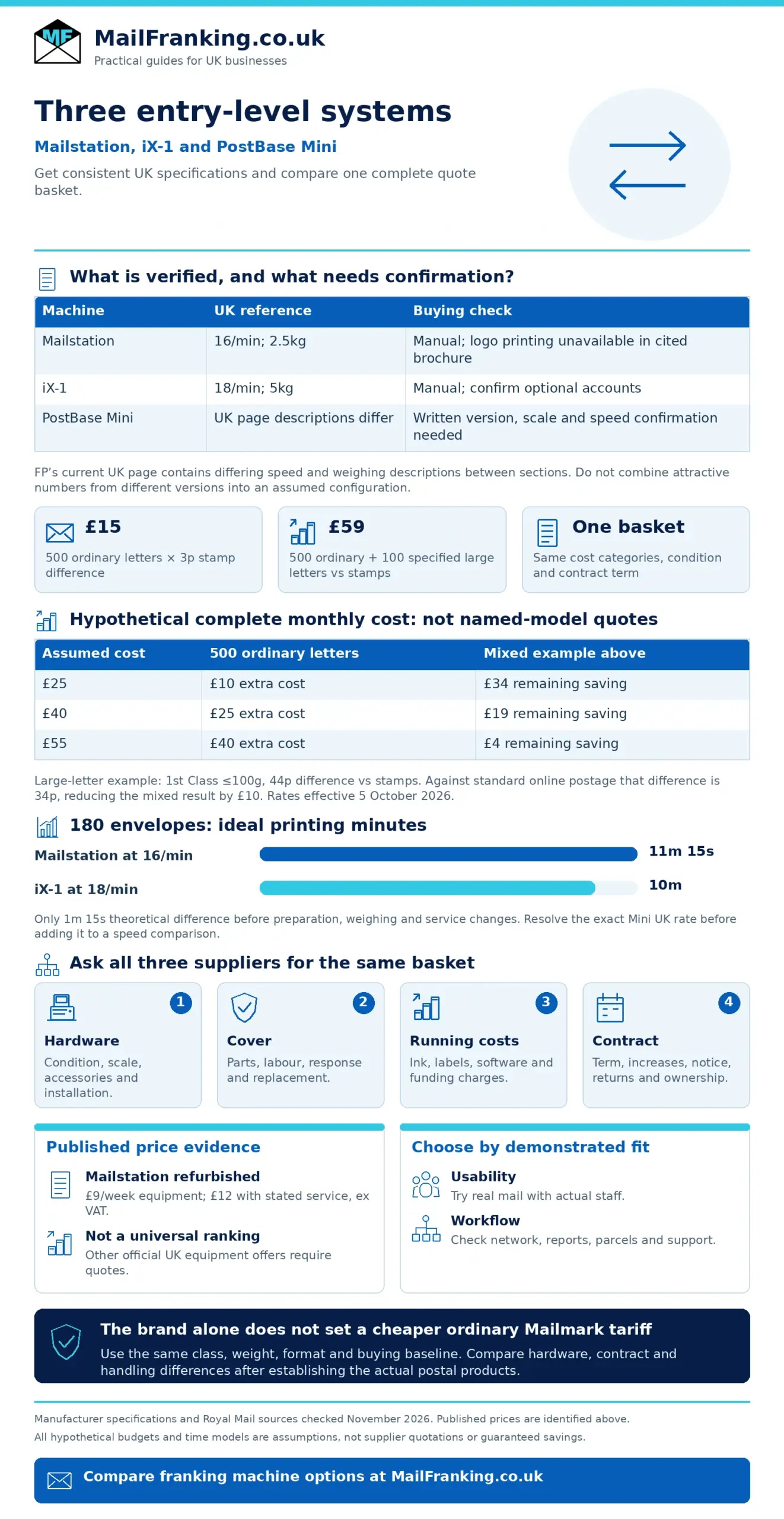
The Mailstation UK brochure and iX-1 UK brochure support the first two columns. The current FP UK PostBase Mini page contains differing speed and scale descriptions between sections. We have therefore not selected the most attractive number and presented it as a settled specification.
Ask FP or the supplying dealer to identify the exact UK version, scale, processing rate and included accessories in writing. This is especially important for used or refurbished equipment, where the model name can cover different generations or packages. A clear quote is more useful than apparent precision assembled from inconsistent descriptions.
- Takes 2 minutes
- Receive quotes to compare
- Easy and no commitment
Which is cheapest to buy or rent?
Only Mailstation has a directly comparable manufacturer equipment-price reference in the sources used here. The Pitney Bowes 2026 list covers specified refurbished equipment, not a universal new-machine offer. iX-1 and PostBase Mini require current itemised quotes before a fair price ranking is possible.
| Published Mailstation Refurbished reference | Excluding VAT |
|---|---|
| Weekly equipment lease | £9 |
| Weekly lease with stated Inclusive Service | £12 |
| Purchase | £1,715 |
| Annual Inclusive Service | £122 |
The Pitney Bowes price brochure describes five-year leases and relevant conditions. £12 a week converts to £52 per average calendar month using 52 ÷ 12. An illustrative 260-payment total is £3,120, excluding VAT, postage and other applicable charges; confirm the actual schedule and terms.
That reference is useful evidence, but it does not establish Mailstation as the cheapest of the three. A competing quote may include different service, consumables, installation or software. Compare the same condition and term, and obtain total payable for every proposal.
If one package is £25 a month and another £40, the apparent gap is £180 a year or £900 over five years. Those figures are hypothetical arithmetic, not prices for a particular machine. An excluded £200 installation item or recurring account charge can change the result materially.
- Give your requirements
- Receive quotes to compare
- Choose a provider or walk away - your choice!
Build one complete quote basket
Send every supplier the same information: monthly item count, largest batch, postal classes, format and weight mix, parcel requirements and available workspace. Ask for a response against identical cost categories so the comparison does not depend on which supplier includes the longest list of extras in a headline.
| Cost category | Question to resolve |
|---|---|
| Equipment | New or refurbished, exact model, scale and accessories? |
| Finance or rental | Minimum term, payment schedule, total payable and ownership? |
| Service | Parts, labour, travel, response and replacement arrangements? |
| Ink and labels | Current pack prices, expected usage and delivery? |
| Funding | Download, payment-method, invoice or account fees? |
| Software | Included functions, users, reporting and renewal charges? |
| Setup and exit | Installation, training, registration, returns and cancellation? |
Use a consistent VAT basis. Ordinary eligible letter postage is generally exempt, while equipment and many supplier charges are taxable. A business unable to reclaim VAT should not compare an excluding-VAT machine price with another gross amount and call the difference a saving.
Record any assumptions separately from confirmed quote items. If an ink allowance is estimated because the supplier has not provided a useful yield, make that visible. A complete comparison with one explicit uncertainty is better than a tidy table built from invented precision.
The same Mailmark tariff can apply to all three
For the same eligible ordinary Mailmark product, format, class and weight, the basic postal price is not normally lower simply because you choose one of these machine brands. Different separately qualifying products or account arrangements need their own comparison; they should not be confused with the basic meter choice.
The Mailmark tariff effective 5 October 2026 lists ordinary letters up to 100g at £1.77 for 1st Class and 88p for 2nd Class. Corresponding stamps are £1.80 and 91p, giving 3p gross saving per item. Five hundred ordinary letters therefore save £15 before equipment and other costs.
For a 1st Class large letter up to 100g, the Mailmark price is £2.86 versus £3.30 by stamp, or 44p less. Against the standard online price of £3.20, the difference is 34p. Compare with the online tariff if that is what your office already uses.
A realistic small-office savings model
The following table uses illustrative complete monthly costs of £25, £40 and £55. None is a quotation for a named machine. It shows why the final quote and the mail mix matter more than a brand-level savings claim.
| Assumed monthly cost | 500 ordinary letters: £15 gross saving | 500 ordinary plus 100 qualifying large letters: £59 gross saving |
|---|---|---|
| £25 | £10 additional cost | £34 remaining saving |
| £40 | £25 additional cost | £19 remaining saving |
| £55 | £40 additional cost | £4 remaining saving |
The mixed example uses 3p for ordinary letters and 44p for the specified large letters against stamps. If the large-letter baseline is standard online postage, gross saving falls to £49, reducing every mixed-mail result by £10. Different weights and services need their own rows.
If consumables, funding fees or staff time sit outside the assumed monthly cost, deduct them as well. An office sending low volumes mainly in ordinary letter format may prefer online postage, even if a dedicated meter offers convenience. Use our franking savings calculator with your own records.
Does 16 versus 18 letters per minute matter?
At the maximum continuous rates, 180 envelopes take 11 minutes 15 seconds at 16 per minute and ten minutes at 18. That ideal printing-stage difference is one minute 15 seconds. It does not include preparation, individual weighing, product changes or interruptions.
For a small weekly batch, interface clarity and comfortable handling can matter more than that nominal difference. Test whether staff can select the correct product, see the price and avoid misfeeds. A modest speed advantage can disappear if one system creates extra corrections or awkward reaching.
For PostBase Mini, settle the exact UK rate in the quote before calculating comparative timings. Do not combine a speed from one page section with a scale from another and assume both describe the same supplied device. Ask for a demonstration using the actual proposed unit or an equivalent confirmed configuration.
If you regularly process substantial batches, consider whether manual feeding itself is the constraint. Moving from 16 to 18 per minute is a different decision from buying confirmed stack feeding. Our manual-versus-automatic guide explains how to measure the operator time that remains.
Weighing capacity and physical formats
The Mailstation’s cited UK scale is 2.5kg and the iX-1’s cited UK brochure specifies 5kg. For Mini, obtain confirmation of the platform supplied. A higher capacity is only useful if the platform fits the finished item and the system supports the required postage process.
A box resting against a nearby wall or partly on the desk may not weigh correctly. Test bulky items as well as flat envelopes. If your work is mainly parcels, an external platform and dedicated label workflow may be more useful than a compact meter’s integrated arrangement.
Machine thickness limits and postal format limits are separate. A meter capable of physically accepting an envelope thicker than 5mm does not make it an ordinary UK letter. Use a format guide, measure the packed item and select the actual class, format and weight band.
For tracked parcels or overseas goods, establish the supported software, label hardware and electronic data process. Do not infer complete shipping functionality from an integrated scale. Compare parcel franking and online shipping as workflows, with the required products and tracking features included.
Logos, accounts and everyday usability
The cited Mailstation UK brochure says logo printing is unavailable. If a branded postage-area impression is essential, that requirement needs checking before shortlisting. Do not assume that every franking machine has the same advertising features simply because the general technology can support them.
The iX-1 brochure lists advertisements, custom messages and optional additional accounts. Confirm what is enabled and whether artwork setup or account upgrades cost extra. Ask the Mini supplier for the equivalent exact feature list rather than comparing a standard package with another machine’s optional maximum.
Request sample departmental reports and a demonstration of common jobs. A useful preset saves repeated selections, but staff must still notice when an envelope’s weight or format changes. Check how the system handles a mistake, an empty balance, a low-ink warning and a second operator signing in.
Use at least one person who will actually operate the machine during the demonstration. A quick routine for an experienced representative may be confusing for occasional office users. Include training and backup cover in the decision, especially where the mail normally depends on one staff member.
Service, connectivity and long-term flexibility
Ask each supplier for current network requirements and whether wireless equipment is included or optional. Confirm who handles installation, router changes and office moves. A connected machine needs a workable support route when postage downloads or rate updates fail.
Compare service outcomes, not just response slogans. Find out whether the agreement covers diagnosis, attendance, parts, labour and a replacement machine. Read exclusions and establish how urgent post will be sent during an outage. A lower premium with weak restoration support may be poor value for time-sensitive mail.
For second-hand equipment, obtain the serial number and confirmation of current support and registration arrangements. The previous owner’s licence does not automatically transfer. Our franking licence guide explains the difference between owning a machine and being authorised to use it for your business.
Finally, check notice deadlines, automatic renewals, price increases, return conditions and unused-postage recovery. A long commitment can outlast the workload if correspondence moves online. Compare a smaller or more flexible arrangement where future volume is uncertain rather than paying for capacity that is unlikely to be used.
Which should you shortlist?
Mailstation offers a useful published refurbished price reference and a straightforward low-volume proposition, subject to its exact feature limits. iX-1 deserves consideration where the confirmed UK scale, messages or account options match the requirement. PostBase Mini should remain a quote-led comparison with its exact UK specification resolved first.
This is a desk-researched comparison of manufacturer information and Royal Mail tariffs, not a hands-on award or an undisclosed commercial ranking. Read the separate Mailstation review and iX-1 review, then choose using real samples and a complete written quote. None can be named the universal cheapest without that evidence.
Frequently asked questions
A fair ranking requires matching current quotes for condition, scale, service, software and term. Pitney Bowes publishes specified refurbished Mailstation references, while the official iX-1 and Mini information reviewed uses quotations. A public figure for one model does not prove it is cheaper than every comparable offer for the others.
For the same eligible ordinary Mailmark class, format and weight, the basic postal tariff is not normally determined by the machine brand. Separately qualifying services and account arrangements need checking. Compare the same product and VAT treatment, then assess equipment, handling, consumables and funding charges independently.
The current FP UK product page contains differing speed and scale descriptions across sections. We have avoided selecting a favourable number as definitive. Ask the supplier to identify the exact UK version, supplied scale and supported rate in writing, then demonstrate that configuration using your actual mail.
The cited UK Mailstation brochure lists 2.5kg, while the cited iX-1 UK brochure specifies 5kg. Mini’s supplied capacity needs confirming because current descriptions differ. Check platform size, supported postal products and your heaviest packed items: a larger weighing capacity alone does not establish a better shipping workflow.
It depends on the complete cost and mail mix. Five hundred ordinary letters at a 3p stamp difference produce only £15 gross savings. Some large-letter comparisons save more. Deduct equipment, consumables, funding fees and other differences before deciding, using your actual online or stamp baseline rather than an advertised maximum.
Confirm the precise printing feature rather than assuming it is standard. The cited Mailstation brochure says logo printing is unavailable; iX-1 lists messages and advertisements with configuration checks needed. Ask each supplier to produce a sample of your desired artwork and identify setup charges, software requirements and supported envelope stock.