

The Quadient iX-8 is a high-volume franking system intended for organisations with substantial envelope-processing work. Its automatic feeding, sealing and weighing options make it a different purchase from a compact office meter. The question is whether those functions remove enough work from your mailroom to justify the complete equipment and support cost.
There is also an important specification issue: the public product page and UK brochure present different speed figures. This review identifies that discrepancy rather than treating one headline as a guaranteed result. It uses published UK information and cost modelling; we have not carried out a hands-on product test.
What the iX-8 is designed to do
Quadient’s UK product page presents the iX-8 as an automatic mixed-mail system. The practical purpose is to reduce repeated envelope presentation and combine stages that would otherwise require more handling. It can make sense for regular batches, provided preparation and dispatch do not remain the dominant bottlenecks.
A high-volume meter is not an envelope-stuffing machine. Documents still need to be printed, matched, folded and inserted before franking. If staff spend most of their time preparing the contents, compare a folder inserter or an outsourced print-and-mail proposal alongside the meter upgrade.
- Takes 2 minutes
- Receive quotes to compare
- Easy and no commitment
UK specifications and the speed discrepancy
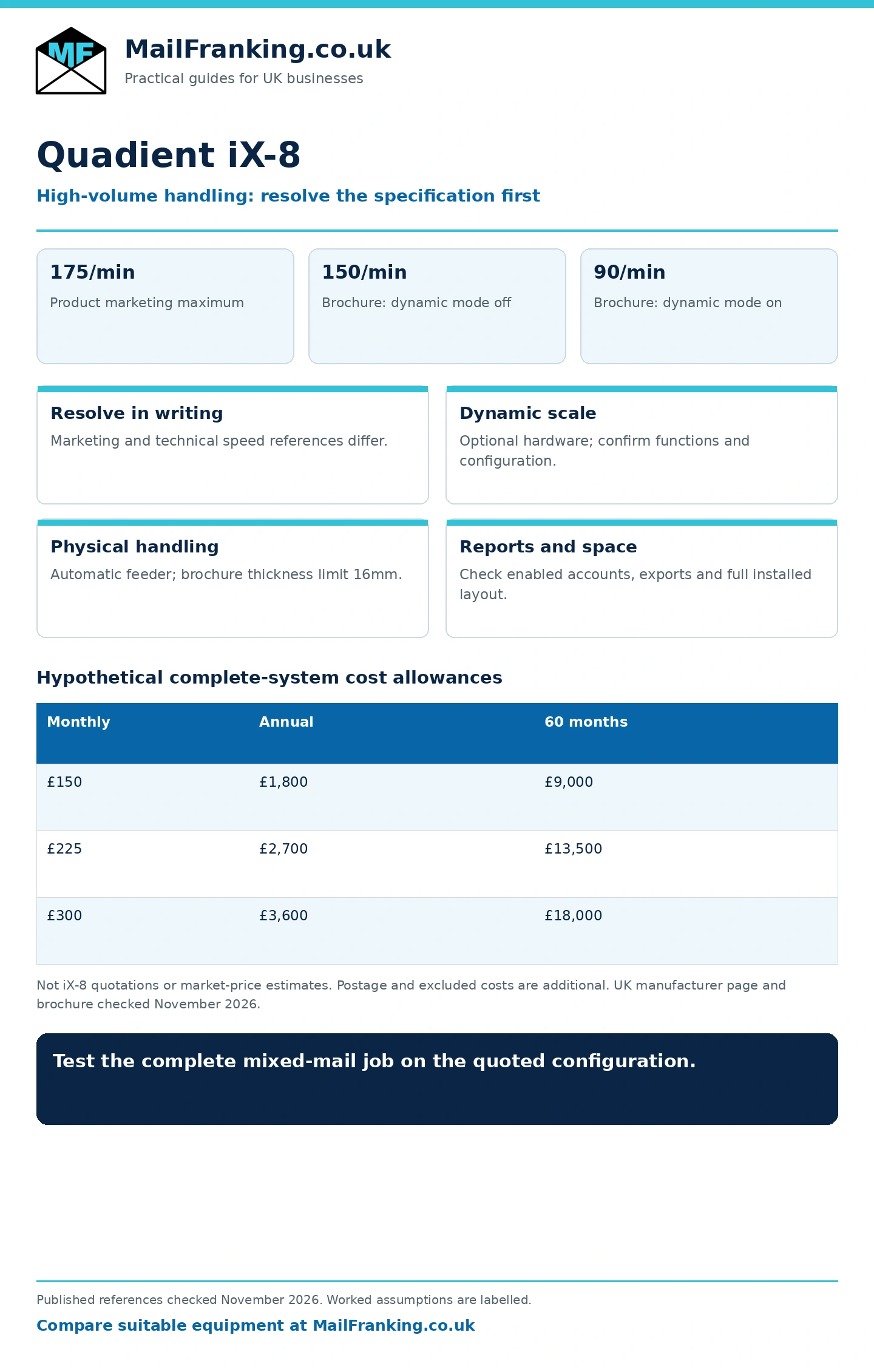
The official UK iX-8 brochure includes a detailed specification table. Its technical speed entries differ from the up-to-175 figure used in product marketing and elsewhere within the brochure. The quotation should resolve which configuration, mode and performance commitment apply to your installation.
| Item | Published information to verify |
|---|---|
| Product-page maximum | Up to 175 letters/minute |
| Brochure technical table, dynamic mode off | Up to 150 letters/minute |
| Brochure technical table, dynamic mode on | Up to 90 letters/minute |
| Feeding | Fully automatic |
| Maximum physical envelope thickness | 16mm in brochure |
| Touchscreen | 7.5-inch vertical colour display |
| Accounting | Up to 500 accounts; confirm enabled package |
| Network | LAN standard; Wi-Fi optional |
Do not use the highest number in a return-on-investment model unless the supplier demonstrates it on the actual job. Differences between marketing, options and technical modes deserve written clarification. A general daily-volume recommendation is also not a guarantee that your particular mixed batch will finish within a given time.
What does a Quadient iX-8 cost?
The current official UK information checked directs buyers towards a quotation rather than a fixed public complete-system price. Ask for separate equipment, dynamic-scale, external-platform, installation, software and service figures. Identify whether the offer is new, refurbished or another condition, and which accessories are included.
Use purchase and rental comparisons over the same period. A cash purchase may leave maintenance and software outside the headline, while a recurring agreement may include some services. Request the total commitment, price-review provisions and end-of-term obligations; an equipment payment alone is not the annual cost of operating a mailroom.
- Give your requirements
- Receive quotes to compare
- Choose a provider or walk away - your choice!
The following amounts are illustrative system allowances, not iX-8 prices or market estimates. They show how to translate a proposed monthly amount into a decision that finance can assess. Postage, VAT and excluded charges must be handled consistently with the actual quotation.
| Assumed monthly system allowance | Annual total | Five-year arithmetic total |
|---|---|---|
| £150 | £1,800 | £9,000 |
| £225 | £2,700 | £13,500 |
| £300 | £3,600 | £18,000 |
A £75 monthly premium is £900 annually and £4,500 over sixty months at unchanged prices. The extra capability needs to release useful time, reduce errors or provide another measurable operational improvement. Use our franking machine prices guide to capture the full cost categories before comparing offers.
Dynamic weighing and the value of fewer stops
The dynamic scale is optional in the brochure, and some weighing functions depend on it. Establish whether it is physically included and enabled. A quotation describing the iX-8 family is insufficient if the desired mixed-mail feature requires an additional module or a different operating mode.
Consider a hypothetical batch of 900 completed envelopes. At the brochure’s 150-per-minute technical reference without dynamic weighing, continuous processing would take six minutes. At 90 with dynamic weighing, it would take ten. Yet the slower transport mode could still finish the overall mixed job sooner if it removes more than four minutes of separate weighing and handling.
That is the useful comparison: total elapsed work under the appropriate mode. Ask for three trials covering uniform envelopes, mixed weights and exceptions. Record what is sorted first, what is detected and which choices remain manual. Do not infer universal format detection or every postal-service decision from the presence of a scale.
Feeding, sealing and material limits
The automatic feeder and sealer should be demonstrated with your stock, filled as it would be on a normal posting day. Include windows, different flap designs and packs near the quoted material limits. Test the quality of the accepted output rather than counting envelopes that merely pass through the transport.
The 16mm physical thickness entry does not mean every item qualifies for ordinary letter postage. Postal format, size and weight rules remain separate. Staff must have a controlled method for selecting services, and bulky items outside direct-print capability need the appropriate label or alternative workflow.
Inspect a sample across the batch for open flaps, creasing, unclear impressions and envelope damage. Record the supplier’s instructions for unsuitable materials and jam recovery. A machine that runs quickly with one envelope brand may need adjustments when a purchasing change introduces another stock.
Space and workstation requirements
The brochure gives a base footprint of 1,154 by 448 by 379mm and a larger configuration with dynamic scale at 1,595 by 451 by 379mm. Confirm orientation and the installed layout with the supplier. Leave additional operating space for loading, clearing output and accessing service areas.
Measure the full route through the mailroom, including the arrival of prepared envelopes and storage before collection. An operator should not need to carry batches repeatedly across the room simply because the machine fits a convenient gap. Check bench suitability, power, network and the position of external scales or a label printer.
For shared premises, establish access and noise expectations with the people working nearby. Ask who moves equipment if the room changes and whether relocation affects installation or registration arrangements. Our licence guide covers the details to resolve when moving a meter.
Accounts, reporting and software scope
Up to 500 accounts can support a structured operation, but more accounts are not automatically better. Decide whether you need department, branch, client or project totals and how those identifiers will be maintained. Request the number enabled in the offer rather than assuming the maximum is included without conditions.
Quadient presents S.M.A.R.T. Online alongside the system, while the brochure identifies additional software options separately. Ask for an entitlement schedule covering users, sites, reports, exports and shipping functions. A platform’s wider feature list is not evidence that every component is supplied under the equipment agreement.
Test a month-end export using your intended account hierarchy. Check that finance can reconcile usage, corrections and funding movements without rebuilding the data manually. If improved reporting saves two hours monthly at an assumed £25 hourly staff cost, its annual modelled value is £600; verify that the saving is achievable.
Ink, labels and consumables budgets
Ask for the ink part number, current supply price, delivery charges and a yield estimate matching your imprint and usage. Cleaning, test prints and additional advertisements can affect the number of usable impressions. Build a sensitivity allowance rather than treating a laboratory or marketing yield as a guaranteed invoice quantity.
An extra half-penny per impression amounts to £100 on 20,000 items monthly and £1,200 annually. That simple calculation demonstrates why consumables deserve attention on a production system. Label stock, sealing fluid and replacements outside the service agreement should each appear on the cost schedule.
Check whether any automatic ink arrangement changes pricing, order control or stock levels. Identify who can authorise replenishment and what happens before a large scheduled run if supplies are low. Our ink and labels guide explains how to compare usable quantities and compatibility.
Postage, qualification and batch administration
The iX-8 does not create its own brand-specific Royal Mail discount on ordinary postage. Use the tariff for the actual supported product, format and weight. If the proposed case relies on a qualifying bulk arrangement, obtain the conditions and calculations separately from the equipment proposal.
High monthly volume is not enough to establish that every item qualifies for a given batch price. The way post is grouped, prepared and declared matters. Our Business Mail Advanced guide and PPI comparison address different account and preparation choices without assuming one mark fits every mailing.
Include postage funding, account administration and unused credit in the project budget. Maintain a reconciliation process that separates cash loaded from postage consumed. Ask for the supported procedure for spoiled impressions and corrections so that a production interruption does not become a recurring accounting discrepancy.
Service, backup and a realistic labour model
At larger volumes, restoration matters more than a support callback. Specify hours of cover, parts, travel, onsite attendance, remote diagnosis and any replacement provision. Ask how a dynamic-scale or software fault is handled when the rest of the machine still works but your intended workflow does not.
Suppose a demonstrated upgrade reduces operator work by twenty-five minutes on eighteen posting days monthly. That releases 7.5 hours. At an assumed loaded cost of £22 per hour, the modelled value is £165 monthly or £1,980 annually. It is capacity released, not automatically a cash saving or a reduction in staffing.
Compare that benefit with the premium over the current system, not only the total new bill. Deduct extra service, consumables, financing and transition costs. Run the same calculation at lower volume and with a realistic rework allowance before deciding the investment remains worthwhile.
Who should shortlist the iX-8?
Shortlist it where automatic mixed-mail preparation addresses a persistent bottleneck and where a controlled trial shows a useful improvement over smaller systems. A shared mailroom with regular completed-envelope batches may value it more than an office whose main delay is printing or inserting documents.
Compare the iX-6 and SendPro C Auto if your workload can be handled with a smaller automatic system. For wider alternatives, use the high-volume buying guide. An oversized machine can add cost without shortening the stage that actually delays dispatch.
Before signing, resolve the conflicting speed references in writing, agree the precise modules and test the full job. Keep your acceptance results, service commitments and cost assumptions with the contract. That produces a stronger buying decision than relying on the largest letters-per-minute figure in a brochure.
Frequently asked questions
The product marketing states up to 175 letters per minute, while the cited UK brochure’s technical table lists up to 150 with dynamic weighing off and 90 with it on. Ask Quadient to clarify the applicable configuration and mode in writing, then test your actual mailing before modelling productivity.
A current itemised UK quotation is needed. Confirm equipment condition, scale modules, external platforms, software, installation, service and term. The monthly amounts in this review are hypothetical budgeting allowances, not advertised iX-8 prices. Compare complete purchase and rental costs over the same period with postage shown separately.
The cited brochure identifies the dynamic scale as optional, with particular modes dependent on that hardware. Ask for the exact supplied configuration and enabled functions. Request a demonstration using mixed weights and record the complete job time, because a lower transport speed can still produce a faster overall workflow.
The iX-8 is a franking system, not a replacement for document printing, matching, folding and inserting equipment. It works on prepared envelopes. If preparation consumes most of the time, compare a suitable folder inserter or outsourced print-and-mail service before assuming a faster meter will solve the bottleneck.
The same eligible ordinary Mailmark product uses the relevant Royal Mail tariff regardless of meter size. Additional equipment can improve handling and control, but separate discount schemes have their own qualification conditions. Calculate postage by actual product and assess productivity independently before combining the two benefits.
Include uniform envelopes, mixed weights, different stock, account changes, sealing, exceptions and report exports. Have normal operators run the work and measure successful output ready for dispatch. Clarify network, service and fallback arrangements, and retain written results against the exact equipment configuration and software package being quoted.