

The Quadient iX-6 and Pitney Bowes SendPro C Auto are options for organisations processing regular batches of office post. The central buying issue is feeding: the iX-6 is available in different versions, while the SendPro C Auto is specifically an automatic-feed system. Comparing the names without identifying the supplied configuration can produce a misleading shortlist.
For a busy mailroom, dependable handling, mixed-weight processing and recovery from interruptions may matter more than a small difference in maximum speed. This comparison explains the published UK information, the cost questions to resolve and a practical demonstration method. Prices used in worked examples are labelled assumptions rather than supplier quotations.
Compare the iX-6 AF with the correct alternative
Quadient’s UK iX-6 product page identifies power-assisted hand-feed HF and auto-feed AF versions. If your objective is processing a stack without presenting every envelope, specify AF in the quotation. A lower HF equipment price is not a like-for-like automatic-feed offer.
Pitney Bowes’ UK SendPro C Auto information describes an automatic feeder. Keep SendPro C Auto and C Auto+ separate where their shipping packages differ. Ask for the model identifier, enabled options and every accessory in writing before comparing totals.
- Takes 2 minutes
- Receive quotes to compare
- Easy and no commitment
| Comparison point | Quadient iX-6 | SendPro C Auto |
|---|---|---|
| Feeding choice | HF hand-feed or AF automatic | Automatic feeder |
| Advertised maximum | Up to 110 letters/minute | Up to 120 letters/minute |
| Touch display | 7.5-inch vertical | 7-inch tablet |
| Mixed-mail handling | Confirm AF setup and weighing options | Demonstrate actual material and scale setup |
| Software | S.M.A.R.T. Online; confirm entitlements | Confirm included reporting and shipping software |
| Current complete equipment price | Itemised UK quote | Itemised UK quote |
How much does ten letters per minute matter?
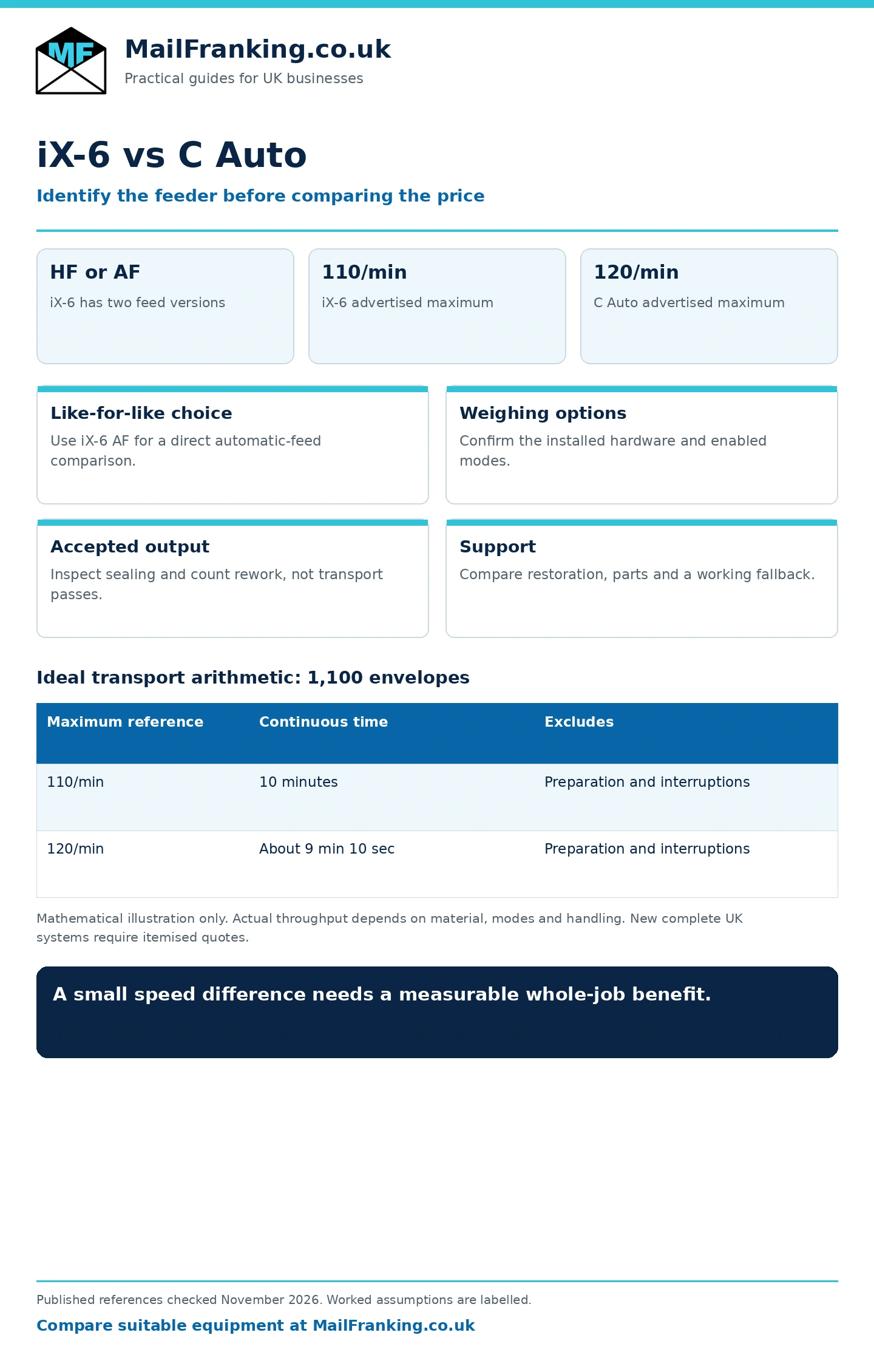
At ideal continuous rates, 1,100 envelopes take ten minutes at 110 per minute and approximately nine minutes ten seconds at 120. The difference is around fifty seconds. This is a mathematical illustration, not a prediction of either machine’s complete batch time.
For twenty such batches monthly, that theoretical difference totals approximately sixteen minutes forty seconds. At an assumed loaded labour cost of £20 an hour, its value is about £5.56. A larger recurring price premium therefore needs justification from other benefits, such as less preparation, fewer interruptions or better reporting.
Weighing and sealing can change processing speed, and operator replenishment still takes time. Ask suppliers to state the mode associated with any performance claim. Use our manual and automatic feeding guide to distinguish the feeder from the print transport and the complete job.
Purchase, rental and complete contract costs
The manufacturer references checked do not provide a fixed current public price for each complete new UK configuration. Request an itemised purchase offer and a separately itemised rental or finance offer. Identify equipment condition and do not mix a refurbished dealer package with a new service-inclusive proposal.
- Give your requirements
- Receive quotes to compare
- Choose a provider or walk away - your choice!
The following allowances illustrate contract arithmetic only. They are not iX-6 or SendPro C Auto market prices. Replace them with offers that include the same service coverage, software and supply assumptions, then add postage and any excluded charges.
| Assumed monthly system allowance | Annual cost | 60-month amount |
|---|---|---|
| £90 | £1,080 | £5,400 |
| £120 | £1,440 | £7,200 |
| £150 | £1,800 | £9,000 |
A £30 monthly difference becomes £1,800 over five years before changes in price or usage. If one package includes a useful service provision worth £180 annually, that offsets £900 of the difference over the same period. Verify the contractual inclusion rather than assigning value to an undefined support promise.
Build the comparison around your envelope mix
Bring completed examples of every common job: thin invoices, multiple-page letters, window envelopes, document packs and any awkward sizes. Include the envelope stock you actually buy. Do not allow the whole evaluation to use uniform demonstration envelopes if your usual batches contain different weights and flap styles.
Ask the operator to show how envelopes should be sorted before feeding. Some preparation can make an advertised mixed-mail capability more effective, but it also consumes time. Record the work before loading the feeder, how often it is replenished and whether staff need to change settings between groups.
Material limits are not postal-format limits. An envelope can fit the equipment while requiring a different Royal Mail format or service. For items outside the direct-print capability, compare the label workflow and whether that work interrupts the main batch. Our usage guide covers the underlying checks.
Weighing options and operator involvement
Quadient describes piece-by-piece and stack weighing for the iX-6 family. Ask which modes are enabled in the offered unit and whether an external platform or software option is required. A description of the family does not establish that every capability is included in its lowest-priced configuration.
For the SendPro C Auto, establish the supplied scale capacity and usable platform size. An allowance for a larger platform should correspond to an actual requirement, such as thick document packs or boxes. Keep the scale and any shipping printer clear of surrounding surfaces so items can be weighed correctly.
Evaluate a mixed-weight batch separately from a uniform batch. If all items share a weight band, a repeated job may be straightforward. If every item needs an individual reading or different service, weighing and selection may dominate the elapsed time, making maximum transport speeds less relevant.
Sealing quality, jams and rework
Automatic processing is only valuable if the output is ready for dispatch. Check the seal across your envelope sizes, including filled envelopes near the relevant equipment limits. Inspect window positioning, print legibility and any creasing. A batch that needs manual inspection and resealing can erase the expected labour benefit.
Record the rate of exceptions in a trial. At 5,000 items monthly, a 1% rework rate means fifty envelopes. If each takes two minutes to investigate and correct, that is one hour forty minutes. At an assumed £20 hourly labour cost, the monthly consequence is £33.33 before replacement stationery and postage adjustments.
Ask how staff recover from a feed interruption without printing twice or losing the account allocation. Request the approved process for spoiled impressions rather than making informal corrections. Keep maintenance responsibilities clear, including operator cleaning, moistener care and faults requiring authorised service.
Reporting for several departments or clients
Explain whether you need broad department totals or detailed charging by client and project. A small number of cost centres may be enough for a reception desk, while a shared mailroom can need substantially more structure. Do not purchase complexity simply because a specification lists a large account limit.
Ask both providers to export a sample report with dates, products, amounts and account identifiers. Check that totals can be reconciled to usage and funding statements. If staff must rekey information, record that time and consider whether a simpler report would serve the same budget-control purpose.
The SendPro C Auto product information lists account and reporting capabilities, but enabled limits and services should remain contractual. For Quadient, distinguish the bundled online functions from optional software tiers. Request the recurring price and what access remains if the software agreement ends.
Postal prices and funding arrangements
Both machines can be used within eligible Mailmark arrangements, but a brand change does not automatically reduce the tariff for an identical ordinary service. Compare your actual postal mix using the Mailmark guide and treat any qualifying discount scheme as a separate decision.
Funding differences can still affect administration and cash flow. Ask for the fee schedule, funding frequency, minimum balances and invoicing arrangements. A charge associated with one provider’s account should not be assumed to apply to the other. Separate money loaded for postage from a fee charged for loading it.
For example, an assumed £6 administration fee repeated twelve times costs £72 annually; repeated weekly, it would cost £312 over fifty-two transactions. Those are hypothetical arithmetic examples, not charges attributed to either provider. Your real schedule and transaction pattern belong in the postage-credit comparison.
Shipping software and labels need their own test
Do not assume that automatic envelope feeding proves compatibility with every parcel service. If you need tracked labels, international goods documentation or marketplace imports, list those requirements separately. Ask for the exact application, account, printer and stock included in the proposal, with a live demonstration of each required step.
The ordinary C Auto and a C Auto+ offer may package shipping differently. Likewise, access to Quadient online software does not establish that every optional service is included without additional cost. Record which workstation and user licences are needed and who supports the full chain when something fails.
If parcel dispatch dominates, compare specialist shipping options alongside the meter. Our parcel guide explains why weighing a parcel, printing an impression and producing an eligible carrier label are separate capabilities. Keep that decision distinct from the choice of envelope feeder.
Space, installation and continuity
Measure the complete workstation, including open trays, scales, label printer, supply storage and room for an operator. A nominal chassis dimension can omit the area needed to feed and clear envelopes comfortably. Check access to power and the supported network connection before delivery.
Agree an installation acceptance checklist: registration, postage funding, current rates, accounts, sample prints, sealing and report exports. Have the normal operator and a cover colleague participate. A supplier demonstration is much more useful when the staff who will use the equipment can repeat the task without prompting.
Match service cover to your dispatch deadlines. Ask about diagnosis, travel, parts, replacement equipment and restoration, not only response time. A functioning backup route may be worth more than an attractive maximum speed if an outage would delay essential correspondence. Compare terms using our maintenance guide.
A practical decision and demonstration scorecard
Give each supplier the same mail profile and a fixed demonstration batch. Score feeding effort, successful output, exception recovery, report usefulness and full annual cost. Use your own importance weights rather than assigning every feature equal value. Record any promised capability against the exact configuration offered.
For an automatic-feed requirement, make the iX-6 AF the direct comparison. Include HF only as a separate lower-automation alternative if the operator considers it acceptable. If both automatic systems meet the requirement, choose on demonstrated handling, service and complete cost rather than a ten-per-minute headline difference.
This is a specification-based assessment, not a claim of hands-on testing. If your batch includes larger production runs, compare the iX-8 review and high-volume guide before choosing. The larger system still needs to justify its additional cost against the actual bottleneck.
Frequently asked questions
No. Quadient identifies HF hand-feed and AF automatic-feed versions. Specify the required version in the quotation and demonstration. A price for an HF unit cannot be treated as the price of an equivalent automatic configuration. Confirm all weighing, sealing and software options as well as the model family name.
The cited UK information gives up to 110 letters per minute for the iX-6 and 120 for SendPro C Auto. Actual performance depends on material, weighing, sealing and handling. For purchasing, compare a complete representative batch and its accepted output rather than treating maximum transport speed as guaranteed productivity.
The official references checked do not establish one fixed current price for each complete new configuration. Obtain itemised offers and identify condition, options, term, software, supplies and service. The monthly amounts in this guide are hypothetical cost allowances used to explain contract arithmetic, not advertised manufacturer deals.
Faster feeding can reduce handling time but does not automatically change the Royal Mail price of the same postal service. Any separate discount scheme needs its own qualification checks. Compare equipment productivity and postage eligibility independently, then combine the actual charges and measured labour effect in the overall calculation.
No. Material dimensions, thickness, flap design and condition matter. Test your completed envelopes and establish the approved preparation and exception process. Items outside direct-print limits may need labels or another route. An equipment limit also does not replace Royal Mail’s format and service rules for the physical item.
Time the complete job and count output accepted without rework. Include sorting, account selection, weighing, replenishment, sealing, interruptions and reporting. Ask your normal operator to run the same batch on both systems, then compare results alongside service commitments and the full agreement cost rather than an isolated speed claim.