
A franking machine can be cheaper than Royal Mail Click & Drop for some letters, but it is not automatically the cheapest way to post everything. Your result depends on the exact service, envelope size, weight, equipment costs and how much time each method takes.
For UK businesses, the useful question is how much the complete mailing operation costs. A small discount per letter can disappear into rental and ink, while a busy office sending large letters may have a stronger case for franking. Parcel sellers should also compare online tracked services rather than relying on a stamp-versus-franking percentage.
The quick comparison
| Question | Franking machine | Royal Mail Click & Drop |
|---|---|---|
| How is postage produced? | A licensed meter prints an impression on an envelope or compatible label | Software produces the postage label or another supported printing workflow |
| Equipment commitment | Buy, rent or lease an eligible machine | Use a suitable printer or a supported label-printing option |
| Recurring equipment costs | Rental or finance, service and consumables depend on the agreement | No franking-machine lease; printer, label and any optional integration costs remain |
| Routine letters | Direct envelope printing can simplify repeated batches | Assess the actual label workflow and handling time |
| Online orders | Check the exact machine and shipping software combination | Marketplace and order-import functions can suit online selling |
| Price comparison | Use the Mailmark tariff for the selected service | Use the online tariff or your actual account prices |
Royal Mail describes Click & Drop as a shipping solution for buying and preparing postage. Its platform overview lists marketplace integrations, spreadsheet imports and automation features. Using it does not require buying a franking meter, although preparing and dispatching an order still involves equipment and labour.
Franking is a different payment and preparation method. The machine must be eligible for the services you intend to use, connected as required and registered through the provider. For an overview of that arrangement, see Mailmark franking explained.
- Takes 2 minutes
- Receive quotes to compare
- Easy and no commitment
Compare the same postal product first
The table below compares standard domestic services from Royal Mail’s October 2026 guides. These are published tariff references, not negotiated account quotations. They exclude machine costs, print supplies and collection charges. Standard First and Second Class services in this table are VAT exempt.
| Service and packed weight | Stamps or counter | Online postage | Mailmark franking | Franking saving against online |
|---|---|---|---|---|
| 1st Class letter up to 100g | £1.80 | £1.80 | £1.77 | 3p |
| 2nd Class letter up to 100g | £0.91 | £0.91 | £0.88 | 3p |
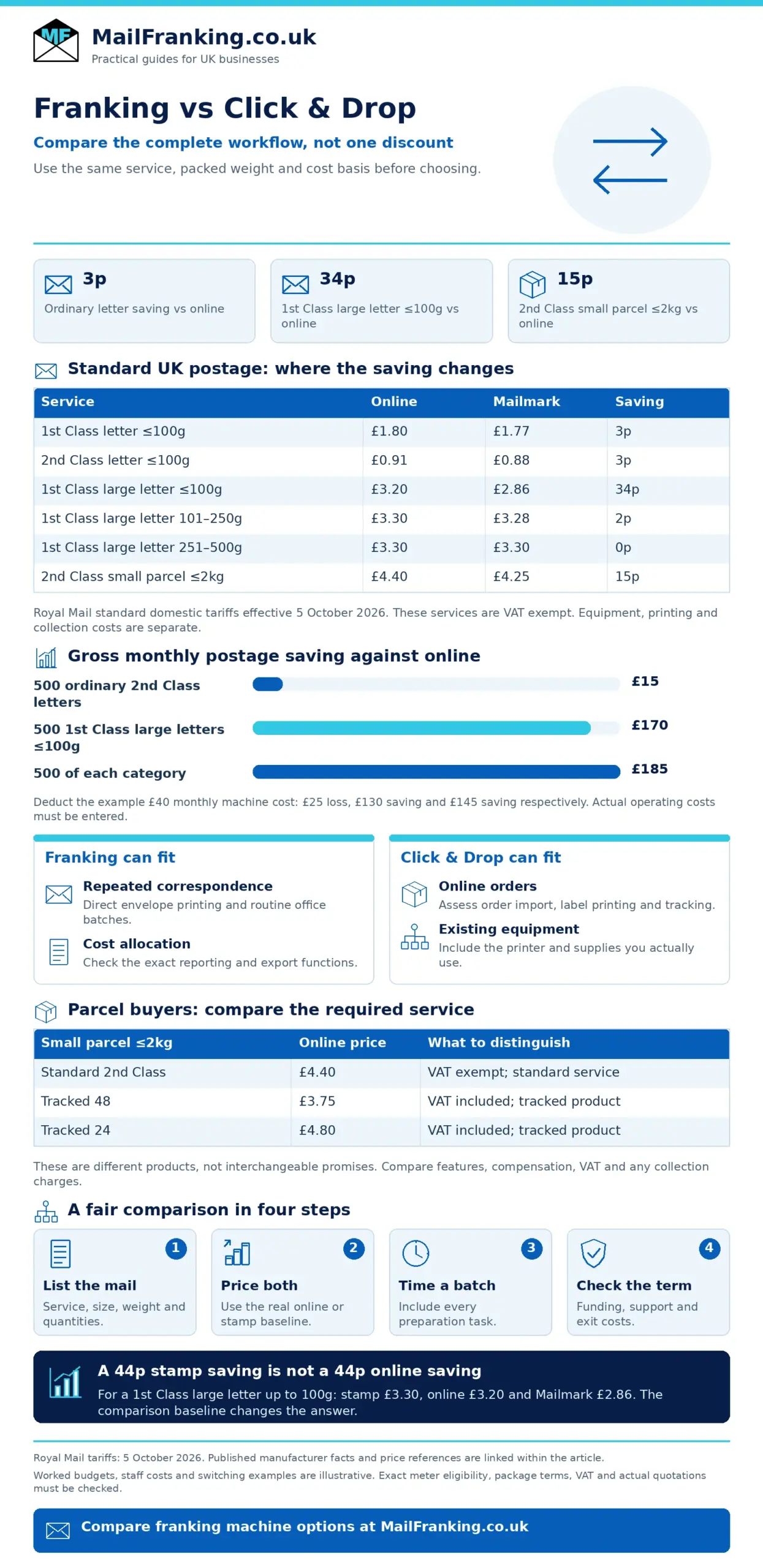
| 1st Class large letter up to 100g | £3.30 | £3.20 | £2.86 | 34p |
| 1st Class large letter 101–250g | £3.60 | £3.30 | £3.28 | 2p |
| 1st Class large letter 251–500g | £3.60 | £3.30 | £3.30 | 0p |
| 2nd Class large letter up to 100g | £1.55 | £1.55 | £1.52 | 3p |
| 2nd Class large letter 101–250g | £1.90 | £1.90 | £1.81 | 9p |
| 1st Class small parcel up to 2kg | £5.90 | £5.70 | £5.45 | 25p |
| 2nd Class small parcel up to 2kg | £4.60 | £4.40 | £4.25 | 15p |
The references are Royal Mail’s online price guide, Mailmark wallchart and counter price guide, all effective from 5 October 2026. Keep the baseline consistent: the 44p saving often quoted for a First Class large letter up to 100g is against a £3.30 stamp. Against the £3.20 online price, the difference is 34p.
The heavier First Class large-letter rows show why one headline percentage is unhelpful. At 251–500g, online and Mailmark prices are both £3.30. The financial case for a machine then depends on processing, accounting and the rest of your post, rather than a postage discount on those particular items.
Three worked monthly examples
These calculations assume a total £40 monthly machine-related cost, including equipment and the consumables or service allowance chosen for the example. They do not establish what a supplier will charge. Online printing supplies are left out initially so the postage and equipment effects are visible.
- Give your requirements
- Receive quotes to compare
- Choose a provider or walk away - your choice!
| Monthly workload | Online postage | Mailmark postage | Gross postage saving | Franking total including £40 | Difference against online |
|---|---|---|---|---|---|
| 500 standard 2nd Class letters | £455 | £440 | £15 | £480 | £25 more |
| 500 1st Class large letters up to 100g | £1,600 | £1,430 | £170 | £1,470 | £130 less |
| 500 standard letters plus 500 qualifying 1st Class large letters | £2,055 | £1,870 | £185 | £1,910 | £145 less |
The first office should not buy a machine solely because 88p is below 91p. Its £15 gross postage saving does not cover the assumed £40 operating cost. The second office has a stronger postage case because its mail attracts a larger discount against the actual online alternative.
For the mixed workload, the saving is £15 on standard letters plus £170 on large letters. The £185 total becomes £145 after the assumed equipment and supplies cost. If the real quote is £70 monthly, the comparable result is £115. If the monthly large-letter volume halves, recalculate instead of carrying the original saving forward.
Use our franking savings calculator to enter your own volumes and choose the correct comparison baseline. It also separates postage savings from the time saving you may achieve.
Online tracked parcels can change the decision
A business shipping goods needs more than the lowest price for an untracked parcel. Royal Mail’s October online guide lists Tracked 48 at £3.75 and Tracked 24 at £4.80 for a small parcel up to 2kg. Those services have different features and VAT treatment from standard First and Second Class postage.
For example, 200 small parcels sent Second Class would cost £880 online at £4.40 each, or £850 in Mailmark postage at £4.25 each. The gross £30 difference does not cover the assumed £40 machine cost. Online Tracked 48 would be £750 at its published £3.75 price, before any collection and printing costs.
This is a service comparison, not a claim that Second Class and Tracked 48 are identical. Check delivery aims, compensation, tracking, permitted contents and the customer’s expectations. The tracked tariff includes VAT; compare the appropriate cash or recoverable-VAT cost for your business, with your accountant if necessary.
Do not assume every franking machine can produce every shipping product. Ask for a demonstration of the exact parcel-label process, account connection and software entitlement. An envelope feeder’s speed tells you little about how quickly staff can enter parcel dimensions and dispatch an online order.
For a dispatch-focused comparison, our guide to franking machines for parcels and online sellers covers current prices, tracking, label equipment, account quotations and worked monthly budgets.
What equipment and consumables will cost
Franking equipment prices vary with condition, configuration and contract. As a concrete published reference, Pitney Bowes’ 2026 price list lists a refurbished SendPro Mailstation at £1,715 to purchase, or £9 per week on a five-year lease excluding its inclusive service option. Its weekly figure including that service is £12. Prices are before VAT and subject to the document’s conditions and subsequent changes.
The conversion matters. £12 per week is £624 across 52 weeks, equivalent to £52 per calendar month for budgeting. It is not £48 per calendar month. Over 260 assumed weekly payments, it totals £3,120 before postage and any extras. A current written quote may differ and must specify what the service includes.
For Click & Drop, cost the equipment you will actually use. A printer already owned by the business has no new purchase outlay for this decision, but toner, labels, maintenance and staff time still have a cost. A dedicated label printer needs its own purchase and supply budget.
A useful planning example is a £150 printer spread over 36 months, plus labels at 3p per order. At 500 orders monthly, that is £4.17 in allocated printer cost and £15 in labels, before ink or other applicable supplies. These are explicit assumptions, not advertised Royal Mail prices. Do not charge the same printer purchase both upfront and again as depreciation in a cash-total comparison. Use the entry-level model comparison for a compact meter quote, and C vs Plus where the shipping software and label-printer bundle may change the workflow.
Which method takes less staff time?
Time the complete process with real items. For letters, include weighing, choosing the product, applying postage, sealing and separating the batch. For orders, include importing addresses, checking customer details, printing labels, matching them to parcels and producing any required handover paperwork.
Suppose franking saves ten minutes per working day over 22 days. At an assumed loaded staff cost of £18 per hour, that is 220 minutes, or £66 of staff capacity monthly. This can be commercially valuable even where the postage saving is modest. It is not automatically a £66 reduction in payroll: the benefit depends on whether the released time can be used productively.
An online shop may see the opposite result if order import removes repeated address entry. Test both methods on the same 50-order batch, including mistakes and reprints. A fast impression print is not a complete measure of dispatch productivity.
If the correspondence starts as a digital document, also compare hybrid mail with in-house franking. Outsourcing print and post changes the handling work as well as the postage bill.
Collections, drop-off and proof of posting
Buying postage does not itself arrange the correct handover. Check where the selected service can be posted, which paperwork or scans are required and whether your collection agreement covers it. Do not use a general letter-posting instruction for a tracked parcel without checking that product’s conditions.
The October online guide identifies an additional 50p per item for collection. If applicable to 200 items, that adds £100 to the comparison. Business collection arrangements and product-specific offers can differ, so use your actual arrangement rather than treating that figure as a universal franking collection charge.
Proof of posting and tracking are also separate questions. An accounting record showing that a meter printed an impression does not automatically prove Royal Mail accepted the physical item. Establish the handover evidence required for the contents, service and any later claim.
When each option is likely to fit
An office sending repeat batches of qualifying large letters may benefit from direct envelope printing and the relevant Mailmark discount. An online seller may value imported orders, parcel tracking and label-based dispatch more highly. A low-volume business may find that existing printing equipment avoids a machine commitment its postage savings cannot support.
Mixed operations can use both methods. An accounts department might frank routine correspondence while the warehouse prints online parcel labels. Compare the combined cost, including any duplicated subscriptions or funding accounts, rather than forcing all items into one workflow.
Before committing, compare your machine rental options, read the hidden-cost checklist and request itemised proposals from franking suppliers. Give each supplier the same service and volume breakdown so the resulting quotes are comparable.
How to make the final decision
Collect a representative month’s actual posting data, then identify the service, size and weight for each category. Price the same workload using online and Mailmark tariffs, add operating costs and test a realistic batch. Repeat the calculation for lower volume and for your busiest month.
The best choice is the workflow that meets your delivery needs at the lowest justified total cost. A machine can be worthwhile without winning on every individual item; Click & Drop can be worthwhile without eliminating every manual task. The calculation should show which advantages matter to your particular business.
Frequently asked questions
Sometimes. Compare the exact service and weight, then add equipment and printing costs. At October 2026 standard tariffs, franking saves 3p on an ordinary letter against online postage, but 34p on a First Class large letter up to 100g. Other weights produce different results.
Royal Mail offers Click & Drop without a franking-machine subscription. You still pay for postage and any printing, labels, collections or optional services you use. Business-account tariffs, third-party tools and integrations should be checked separately rather than assumed to have the same costs as basic online postage.
Yes. A business can compare using a machine for suitable correspondence and online labels for parcel orders. Check each service’s preparation and handover rules. Include the cost of maintaining both workflows, any software subscriptions and the staff time needed to reconcile separate postage accounts.
Not automatically. Tracking depends on the postal product selected and the supported equipment or shipping workflow. Ordinary Mailmark First or Second Class post is not the same as a fully tracked parcel service. Ask the supplier to demonstrate the precise service you intend to buy.
At very low volumes, a machine’s recurring costs can exceed its postage savings. Calculate the saving against the method you would actually use, including online postage where relevant. Existing office printing equipment or stamps may be more economical unless franking provides enough additional handling or accounting benefits.
Use a consistent basis appropriate to your business. The standard domestic services compared here are VAT exempt, while the online tracked examples include VAT. Equipment and service quotes may be before VAT. If VAT is recoverable, compare the relevant net cost as well as the cash paid.