

Franking machines for insurance brokers and financial advisers should be assessed against renewal correspondence, client document packs and the work shared between offices. A machine can simplify physical dispatch, but the financial case depends on the postal service, envelope format and continuing volume of paper communication.
For a small advice practice, ease of use and reliable cover may matter more than processing speed. A broker with concentrated renewal runs may need batch handling or outsourced production. This guide sets out how to compare equipment, costs and records without confusing postage payment with client communication controls.
Map the correspondence before choosing equipment
Separate renewal invitations, policy documentation, client reports, onboarding packs and general office post. For each category, establish whether paper is required by your approved process, requested by the client or simply inherited from an older workflow. Equipment should follow that decision rather than determine the communication channel.
Record the selected service and the person responsible for approving it. A franking supplier is not deciding whether a particular client communication meets your firm’s obligations. A postage impression also does not establish that the correct version was enclosed, that an address was current or that the recipient received the item.
- Takes 2 minutes
- Receive quotes to compare
- Easy and no commitment
Audit twelve months where possible. Renewals may be distributed across the year, concentrated around particular schemes or influenced by acquisitions. Financial advisers may have fewer postal items but larger packs. Treat those as different workloads even if their monthly postage bills look similar.
Measure the finished client pack
Weigh the actual sealed envelope with its booklet, report, return stationery and covering letter. Record dimensions and thickness too. A pack’s postal format depends on more than the weight of its main document, and a last-minute insert can move a repeated mailing into a different band.
| Correspondence | Useful measurement | Question for the supplier |
|---|---|---|
| Short renewal letters | Daily and peak envelope count | Can cover staff repeat the job easily? |
| Policy or advice packs | Finished weight and thickness | Which items need labels or separate handling? |
| Branch correspondence | Location and local cut-off | What reporting and continuity are included? |
| Reply stationery | Distribution and response numbers | Which separate reply product is suitable? |
| Exceptional dispatches | Approved service and evidence | How does the process handle these items? |
Use a representative range rather than the lightest envelope. Ask the supplier to demonstrate ten different packs and a realistic renewal batch. Our postage meter guide explains the equipment category, while the small business guide covers lower-volume office requirements.
Published postage references for the calculation
Checked in November 2026, the Royal Mail current prices show £1.77 for a 1st Class Mailmark letter up to 100g against a £1.80 stamp. For a 2nd Class ordinary letter, the corresponding figures are £0.88 and £0.91. Each comparison produces a 3p gross difference per item.
- Give your requirements
- Receive quotes to compare
- Choose a provider or walk away - your choice!
A qualifying 1st Class large letter up to 100g is different: £2.86 Mailmark against a £3.30 stamp, or 44p gross. At up to 250g, the 1st Class large-letter comparison is £3.28 against £3.60, a 32p difference. Use the correct band for each completed pack rather than applying the largest saving to all correspondence.
The existing baseline matters as much as the proposed tariff. A broker already using a print-and-post service should compare its complete invoiced cost with the proposed complete in-house process. A stamp saving is not evidence that a meter beats an existing account agreement, and no equipment price includes unlimited postage.
Worked example for a renewal mailing practice
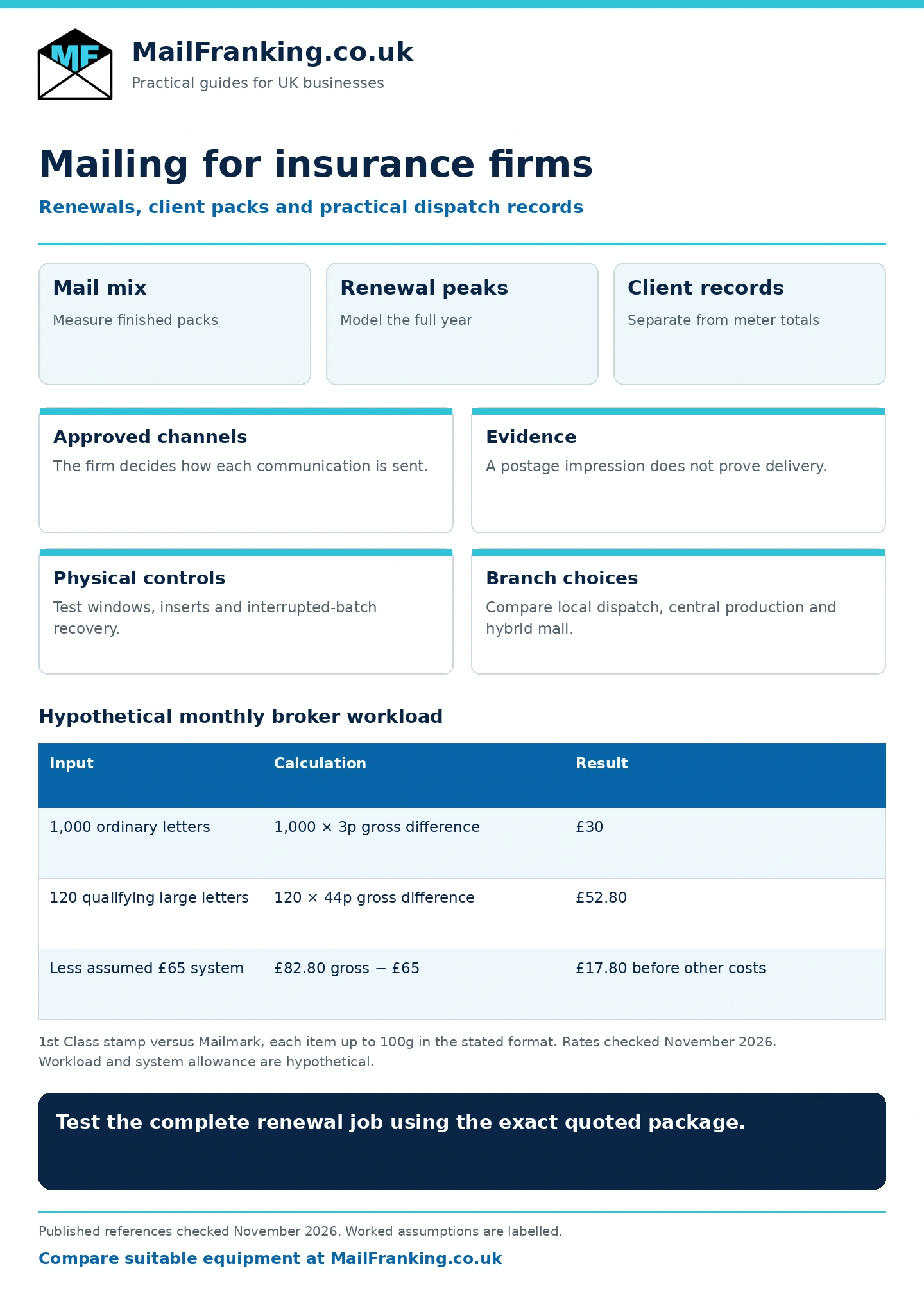
Consider a hypothetical firm sending 1,000 ordinary 1st Class letters and 120 qualifying 1st Class large letters up to 100g each month. The firm currently buys stamps for those same services. The assumed system cost below is a calculation allowance, not a live quotation or a claim about typical broker volumes.
| Monthly comparison | Calculation | Result |
|---|---|---|
| Ordinary-letter gross difference | 1,000 × £0.03 | £30 |
| Large-letter gross difference | 120 × £0.44 | £52.80 |
| Total gross postage difference | £30 + £52.80 | £82.80 |
| Assumed complete equipment allowance | Per month | £65 |
| Difference after that allowance | £82.80 − £65 | £17.80 |
The stamp baseline is £2,196. Mailmark postage is £2,113.20, or £2,178.20 after the assumed £65 allowance. The remaining £17.80 monthly improvement is £213.60 over twelve identical months, before additional costs or operational benefits. Preparation, rework and any excluded charges still need to be considered.
If the 120 large letters instead fall in the up-to-250g band, their gross difference becomes £38.40. The overall gross benefit falls to £68.40, leaving £3.40 after the same equipment allowance. This sensitivity explains why accurate pack measurements are more useful than a headline percentage saving.
Equipment prices and the complete commitment
Pitney Bowes’ general UK pricing guidance puts entry-level purchase around £500–£1,000 and leasing around £15–£100 or more monthly, depending on features. These are broad references, not model-specific offers or complete broker packages. Ask suppliers to state VAT, inclusions and the exact term.
Compare installation, training, maintenance, consumables, funding charges, reporting software and postage arrangements separately. An assumed £65 monthly commitment totals £3,900 over five years before increases and excluded costs. A low first-year promotion can be less useful than a transparent whole-term price with appropriate support.
The selected standard letter postage references are VAT-exempt services; equipment, supplies and other postal products can have different VAT treatment. Financial services firms should use the VAT recovery treatment applicable to their own business rather than assuming every quoted input is fully recoverable. Have finance confirm a consistent comparison basis.
Choose for routine output and renewal peaks
For modest daily volumes, start with compact equipment such as the SendPro Mailstation or Quadient iX-1. Check reporting, scale capacity, label handling, connectivity and support on the current UK package. Simplicity can be valuable when several administrators share dispatch duties.
For larger recurring batches, compare mid-range desktop and automatic-feed configurations. The Quadient iX-4 review and iX-6 review explain why feeding arrangements and installed options matter. Do not treat every model in a range as having identical automation or usable throughput.
Time the complete task from approved print output to ready-to-hand-over mail. Include sorting formats, checking enclosures, filling supplies and dealing with errors. If folding and matching consume most of the time, compare preparation changes before buying a faster franking transport. The folder inserter guide provides a separate cost framework.
Cost peaks across the year
A renewal peak does not automatically justify a large permanent machine. Model the quiet months and the cost of serving the peak separately. A firm can keep a compact office meter for exceptions while using a specialist production service for a larger, predictable run, provided responsibilities and records remain clear.
For example, assume four months at 1,500 ordinary letters and eight months at 300. That is 8,400 letters annually. At a 3p stamp difference the gross annual postage benefit is £252. An assumed £50 monthly equipment package costs £600 annually, leaving £348 to justify through other measurable benefits or a different mail mix.
This example does not value the time saved handling postage. Measure that separately. Reducing administration by three hours per month at an assumed loaded staff cost of £22 per hour creates £66 of monthly capacity, but it becomes a cash saving only where expenditure actually falls. Avoid counting the same time improvement twice.
Client records and evidence of dispatch
Define what the firm needs to retain: the approved document, address used, correspondence date, selected postal service and any relevant handover evidence. A meter usage total is primarily an equipment and postage record. It should not be represented as a complete client communication archive.
Test how operators allocate cost centres and correct mistakes. A department code may be enough for branches or teams, whereas matter-level or client-level allocation requires a more detailed process. The accountants’ guide discusses similar reporting and reconciliation questions without assuming that a franking platform replaces practice software.
Where the firm’s process calls for tracking or another specific form of evidence, confirm the exact service and any separate label or software requirements. Demonstrate the handover procedure as well as printing. Do not infer delivery evidence or suitability for a deadline merely from the appearance of a franked envelope.
Protect confidentiality during physical preparation
Use fictional client data in demonstrations. For live batches, establish document-to-envelope checks, clear desks, controlled access and a defined way to restart after an interruption. Window alignment and enclosure counts should be tested with the actual stationery and folded pack, including items of different lengths.
Separate machine access from access to client documents. Operator controls can help manage postage spending, but they do not prevent a printed report being left in a shared tray. Review your physical process against relevant ICO security guidance and the firm’s own information governance arrangements.
If personalised packs contain different inserts, ask how missing pages and double feeds are detected in the preparation stage. Basic folder insertion should not be described as guaranteed client matching. Agree which team resolves an exception and how the affected item is held until the correct pack can be confirmed.
Branches, home working and outsourced production
A central meter can serve several teams, but home-based advisers may not be able to route late documents through the central office before dispatch. Compare approved local dispatch, centrally printed templates and hybrid mail for the relevant workload. Include staff access, file approval and local exceptions in the design.
Ask outsourced providers to price the actual number of sheets, print specification, envelope and postal service. Separate upload acceptance, production confirmation and postal handover in the reporting. Agree how rejected files, duplicates and returned mail are handled. A low per-letter figure may exclude setup or minimum monthly commitments.
For acquisitions or office closures, check contract flexibility before ordering replacement equipment. A new group-wide deal does not remove obligations under existing leases. Our supplier switching guide explains practical handover questions, including funding balances, equipment return and continuity between arrangements.
Reply envelopes need their own decision
If clients return signed forms, measure the response rate and completed return format. Paying postage on every enclosed reply envelope can produce a different cost from using a licensed response service that charges for replies received. Artwork, service compatibility, licence fees and VAT treatment all affect the comparison.
Use the prepaid reply versus Freepost guide to compare those alternatives separately from outward franking. Confirm the exact product with the supplier before printing stationery. Do not assume an outward meter impression can simply be copied onto return envelopes or that ordinary postage funding includes a reply licence.
Request a comparable demonstration and quotation
Give each supplier the same twelve-month profile and a fictional renewal pack. Test the person who normally posts mail and a colleague covering absence. Record time, interventions, accurate reports and the cost of a complete set of replacement consumables. Check what happens if connectivity or the usual operator is unavailable.
Request itemised figures for purchase and rental over the same period, including increases, support, exit arrangements and the supplied configuration. Then test a lower postal-volume forecast as more clients choose digital delivery. Select equipment only when its full cost and measured workflow benefits fit the firm’s approved correspondence process.
Frequently asked questions
It depends on their physical correspondence. A machine can simplify routine post and renewal batches, but ordinary-letter savings may be too small to cover fixed costs alone. Audit the actual annual mail mix and compare the complete in-house process with existing account mail and outsourced production.
That depends on the completed envelope and the quoted configuration. Test finished weight, dimensions, thickness, feeding and label handling using representative packs. Larger documents may require separate processing. Equipment capacity does not establish the appropriate postal service or the firm’s requirements for client communication evidence.
An ordinary postage impression does not by itself provide proof of delivery. The selected service and handover process determine what evidence is available. Specify the firm’s record requirements separately, then confirm any tracking, label, software and acceptance arrangements needed for the relevant class of correspondence.
Many machines support accounting codes, but included capacity and reporting vary. Ask for the actual export from the quoted configuration, including adjustments and corrections. Branch totals are different from individual client records. Confirm who reconciles usage and how postage funding movements appear in finance records.
Compare the complete commitment over the same period. Include maintenance, supplies, software, funding fees, installation and exit costs, with consistent VAT treatment. Leasing spreads payments but can create a longer fixed obligation. Buying also needs a suitable ongoing support and meter arrangement, particularly as postal volumes change.
Hybrid mail is worth comparing for repeatable approved documents and dispersed staff. Request a complete price for the actual pages, envelope, service and expected volume. Trial reporting and exception handling before switching. A local meter can still serve unusual packs or late items that do not suit the outsourced workflow.