

An accountancy practice should choose a franking machine around its remaining paper workflows, rather than the assumption that every professional office needs one. Client correspondence, accounts packs, payroll-related documents and occasional original paperwork can create very different demands. Seasonal peaks also make an average daily volume a poor starting point for equipment selection.
The right package should make busy periods manageable while remaining economical during quieter months. This guide explains how to build that comparison, evaluate account allocation and reporting, and distinguish useful automation from a long agreement for capacity the practice rarely needs. All practice scenarios and equipment allowances below are illustrative.
Map the paper work that remains
Separate routine letters, larger document packs and exceptional services. Record what was actually posted in the last twelve months, including the busiest weeks and the months with little activity. A successful digital-document project may have changed the mail mix even if the practice’s historic annual postage budget looks familiar. Insurance renewals and advice packs create a related but distinct workload, examined in our guide to franking machines for insurance brokers and financial advisers.
Break the preparation process into printing, checking, inserting, weighing, postage selection and handover. If accountants or administrators spend most of the time checking personalised packs, a faster meter will not remove that stage. Keep the benefit model tied to the work the proposed machine can actually change.
- Takes 2 minutes
- Receive quotes to compare
- Easy and no commitment
Use our small-business guide for modest workloads and the automatic-feed comparison where completed batches are substantial. The choice should follow the actual bottleneck rather than the status of the firm or its number of fee earners.
A shortlist by accountancy workflow
| Mailing pattern | Candidate approach | What to test |
|---|---|---|
| Occasional mixed client letters | Compact manual meter or online postage | Easy service selection and total annual cost |
| Repeated statement or invoice batches | Desktop meter; automatic feeding if justified | Time on a complete prepared batch |
| Frequent client-coded post | Suitable accounts and export package | Client identifiers, corrections and reconciliation |
| Large packs and originals | Supported scale, labels and appropriate service | Physical fit and handover evidence |
| Mainly digitally generated bulk letters | Compare in-house with hybrid mail | Data controls, exceptions and complete price |
For a compact option, assess the iX-1. For a larger desktop arrangement, compare iX-4 and SendPro C. These are starting points for a requirements-led demonstration, not a claim that the same shortlist suits every practice.
Account allocation and client charging
Decide whether you need records by department, office, service line or individual client. A few broad accounts may be sufficient for management reporting. A client-charging process can require more detailed identifiers, controlled corrections and a reliable way to distinguish postage usage from other mailing costs.
Ask the supplier to create an anonymised test structure with active, closed and newly added clients. Process several items under different accounts and request an export. Check identifier length, date range, descriptions and how allocation errors are corrected. Avoid relying on a screenshot that conceals the work required at month end.
- Give your requirements
- Receive quotes to compare
- Choose a provider or walk away - your choice!
The practice should decide its charging policy and accounting treatment using its own professional processes. A meter report does not determine whether an amount is a disbursement, a recharge or another category. The equipment buying decision is whether the records support the policy accurately and efficiently.
What does a suitable system cost?
Request itemised UK proposals for equipment, scale, enabled accounts, software, installation, service and consumables. Do not assume there is a special accountant price or that a broad manufacturer entry range applies to a particular machine. For each proposal, identify condition and the precise agreement term.
These hypothetical complete monthly allowances show how a recurring commitment should be considered across the full year. They exclude postage and any item outside the allowance, and assume unchanged prices. Replace them with actual quotations before making a purchase decision.
| Assumed monthly allowance | Annual amount | Cost per active month if used for eight months | Five-year amount |
|---|---|---|---|
| £40 | £480 | £60 | £2,400 |
| £70 | £840 | £105 | £4,200 |
| £110 | £1,320 | £165 | £6,600 |
The active-month column does not mean payments stop during quiet periods. It allocates the full annual commitment across eight assumed months of material use. A seasonal practice should also test six or ten active months and compare the result with pay-as-you-go online postage or outsourcing particular batches.
Worked example: seasonal postage savings
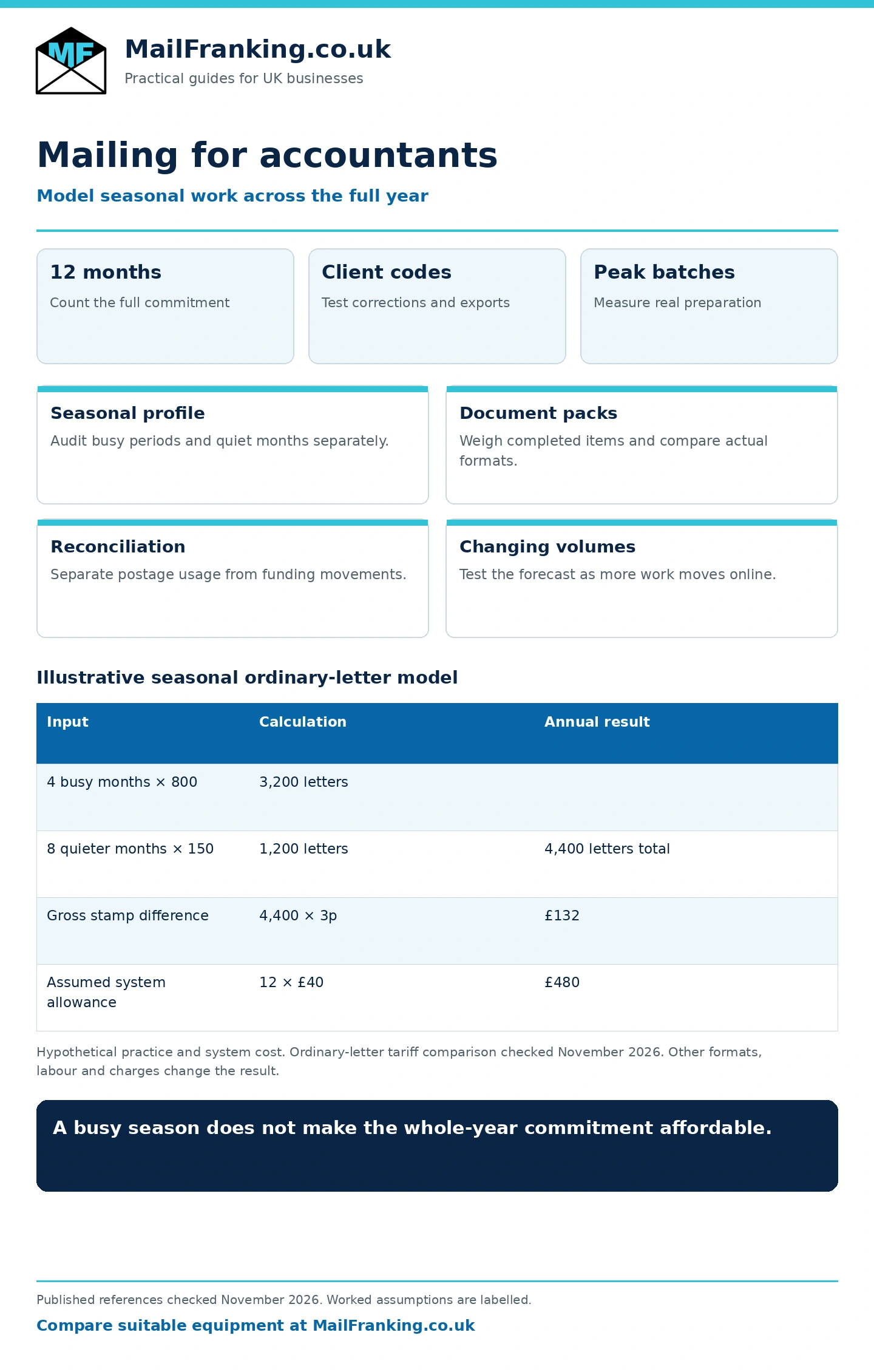
Assume the practice sends 800 ordinary letters in each of four busy months and 150 in each of eight quieter months: 4,400 annually. At a 3p gross saving per ordinary letter against the corresponding stamp reference, the annual postage improvement is £132. An assumed £40 monthly system allowance is £480 annually, leaving £348 to justify through other measured benefits.
The 3p comparison follows the Royal Mail October 2026 tariffs, checked in November. It concerns the relevant ordinary letter comparison and excludes running costs. A practice sending larger packs may have a different result; an office already buying online should use its actual alternative prices.
Suppose improved handling and reporting release thirty minutes on each of twenty busy posting days. That is ten hours annually. At an assumed £25 loaded administrative cost, the modelled capacity value is £250. Combined with £132 gross postage improvement, that still does not fully cover £480 before any additional charges.
Build a separate case for document packs
Measure completed accounts packs and other larger correspondence, not only their sheets. Envelopes, covers and inserts can move items into another weight or format. A pack may require a label even when the scale can weigh it, so demonstrate both the physical support and the complete printing process.
Calculate each common pack type against the method currently used. If a hypothetical pack saves 30p and you send 900 annually, its gross contribution is £270. If compatible labels and other incremental supplies cost 4p each, £36 of that contribution is consumed before equipment and administration.
Avoid counting the same labour saving twice. If an inserting system already removes most envelope preparation, the meter’s contribution is the remaining weighing and postage stage. Our folder inserter guide explains the separate investment, and the savings calculator guide provides a whole-cost structure.
Reports should reduce reconciliation work
Ask finance to work with a real sample export before signing. It should be possible to understand the relationship between usage, postage funds loaded, fees and closing credit. A funding payment is not automatically the same as postage consumed during that month, particularly when balances span reporting periods.
For internal reporting, agree a stable hierarchy and a way to resolve unallocated entries. Too many rarely used accounts can make operator selection slower and less accurate. Consider whether fewer controlled accounts plus a separate job reference would produce more reliable results than a large unmanaged list.
Measure the administrative benefit. If an export reduces manual reconciliation by forty-five minutes monthly at an assumed £28 hourly cost, the annual modelled value is £252. Deduct any software premium and allow for account maintenance. A feature deserves credit only when it replaces identifiable work.
Personalised documents and security
A postage meter does not check that every client received the correct contents. Keep print batches, matching, insertion and address validation under the practice’s existing information-handling controls. For demonstrations, use invented client details and representative pack sizes rather than real financial records.
The ICO’s guidance on supplying information securely provides relevant context for postal disclosures. Equipment should support the controlled process, not be presented as a substitute for it. Include rejected prints, returned mail and report access in the assessment.
If the practice considers hybrid mail, examine data processing, approvals and exception handling alongside cost. Determine which originals or sensitive communications remain in-house. Our hybrid mail comparison helps evaluate the practical difference without assuming that every pack can use the same route.
Busy periods, cover staff and repeat jobs
Configure repeat jobs around stable, well-defined mailings, and train operators to confirm the contents before using a shortcut. A familiar preset can be wrong when a pack contains an extra attachment or a different delivery requirement. Keep clear responsibility for changing settings when rates or workflows change.
Choose a trial date that resembles a busy day. Include interruptions, a colleague covering reception and a mixture of client accounts. Measure total accepted output ready for collection. An expert demonstrating identical envelopes in ideal conditions may not reveal the problems that appear when administrative staff are juggling other duties.
Record recovery steps for a jam, a spoiled impression, a low postage balance and a failed report export. The useful system is one the practice can operate consistently during a peak, including when the usual administrator is absent. A simple cover guide and a trained second operator can be valuable.
Service and consumables through the full year
Ask for ink and label prices, delivery, usable yield assumptions and any restrictions on compatible stock. Low-volume users should discuss storage and intermittent use rather than modelling every cartridge at its maximum advertised yield. A supply contract should match the practice’s real annual pattern.
Service cover should identify remote support, attendance, parts, carriage and any replacement provision. Check whether software assistance and network diagnosis are included or handled separately. A repair promise matters most when the practice has a large scheduled batch and limited time before the agreed handover.
Our maintenance guide and ink guide provide the detailed questions. Keep a fallback for exceptional items and outages, and include its incremental cost where significant. Do not assume the meter is the only route the office will ever need.
Contract length and declining paper volumes
Forecast the remaining paper workload across the proposed term, including planned changes to client portals or electronic approvals. Recalculate the case at 25% and 50% lower volume. Fixed payments can remain substantial even when postage savings shrink, so a long term deserves scrutiny.
Ask separately about finance, service, software, renewal, notice and equipment return. A supplier’s upgrade offer should not conceal continuing old payments. Use our cancellation guide before treating a replacement as a clean start, and obtain the existing settlement position in writing.
If buying outright, include the service and software needed to keep the machine usable over the planned period. If renting, compare equivalent inclusions and the total minimum commitment. The cheapest monthly headline can be poor value when it adds years of payments beyond the practice’s credible mailing forecast.
How to choose the final package
Give suppliers an annual profile with peak batches, client-account requirements, pack samples and a sample report specification. Ask them to demonstrate the same work and return an identical cost schedule. That creates a comparison the practice can review with the same discipline it applies to other recurring overheads.
The final decision should show annual cash cost, expected postage differences, usable capacity released and implementation work separately. Keep assumptions visible, particularly where a benefit is time saved rather than money leaving the bank. A practice may reasonably value convenience, but it should know what it is paying for.
This shortlist follows published capabilities and accountancy workflows, not a physical comparative test. Start with the simplest supported arrangement that meets the demonstrated need. If client allocation or seasonal economics remain uncertain, resolve those points before committing to a higher-capacity machine or a longer software agreement.
Frequently asked questions
They can be where remaining paper volumes, larger packs or measurable administrative benefits support the full annual cost. Seasonal use makes the calculation especially important. Compare actual products and current alternatives, then include equipment, software, supplies and service rather than assuming every professional practice saves money by owning a meter.
Some packages support suitable account allocation and exports, but limits and workflows vary. Demonstrate your identifier structure and reconciliation process before buying. A departmental dashboard is not automatically client-level billing data, and the practice must determine its own charging policy and accounting treatment independently from the equipment supplier.
A compact supported manual system may be sufficient, but compare it with the current online route. Consider annual cost, intermittent use, easy cover operation and the size of document packs. There is little value in paying for automatic feeding or complex software if the remaining work rarely uses those features.
Assess the full annual commitment and expected paper workload throughout the term. Payments usually continue during quiet periods under the agreed contract. Test lower-volume forecasts, identify renewal and exit obligations, and compare purchase or shorter commitments where offered. A long term needs benefits that remain credible beyond the next busy season.
No. A meter generally operates on already prepared mail and does not establish that the right documents are inside each envelope. Printing, matching, inserting, address checks and exception handling need their own controls. If considering an inserter or outsourced process, evaluate those capabilities separately using representative anonymised work.
They were selected against published capabilities and practical accountancy requirements: seasonal batches, client allocation, document packs and reconciliation. We have not physically compared the equipment. Final selection should use actual quotations, a representative trial and a finance-approved report export, with all cost assumptions and software entitlements recorded.