
Franking machines can pay for parcel postage, but an online seller should compare the complete dispatch system before choosing one. A machine that is useful for office letters may offer little advantage when most orders need tracked labels, marketplace imports and automatic customer notifications.
The best choice depends on the parcels you actually send: their packed size and weight, the delivery service customers expect, your weekly volume and the equipment you already own. Start with the service and workflow, then decide whether franking, online postage or a business parcel account delivers the lowest practical cost.
This guide compares published UK prices checked in November 2026, explains the equipment involved and provides worked budgets. For the broader office-mail comparison, see franking machines vs Click & Drop.
Can you send parcels with a franking machine?
Yes. Instead of feeding a box through the machine, you normally print the paid impression on a compatible franking label and attach it securely to the parcel. The address still needs to be clear, and you must select the correct format, weight and postal product. Royal Mail’s franking guidance describes franking as an option for both envelopes and parcel labels.
- Takes 2 minutes
- Receive quotes to compare
- Easy and no commitment
A paid franking impression is not automatically a fully tracked shipping label. Check whether the proposed system merely prints postage or also supports the specific tracked products, address labels and reporting you require. Some equipment combines mailing and shipping functions, but the supplier should demonstrate the actual UK configuration rather than describe the whole product family.
For example, an accounts office sending occasional documents and one parcel a day has different needs from a retailer dispatching 100 online orders before a collection. The retailer may gain more from order import, reliable tracking updates and fast label printing than from direct envelope printing.
What does parcel postage cost?
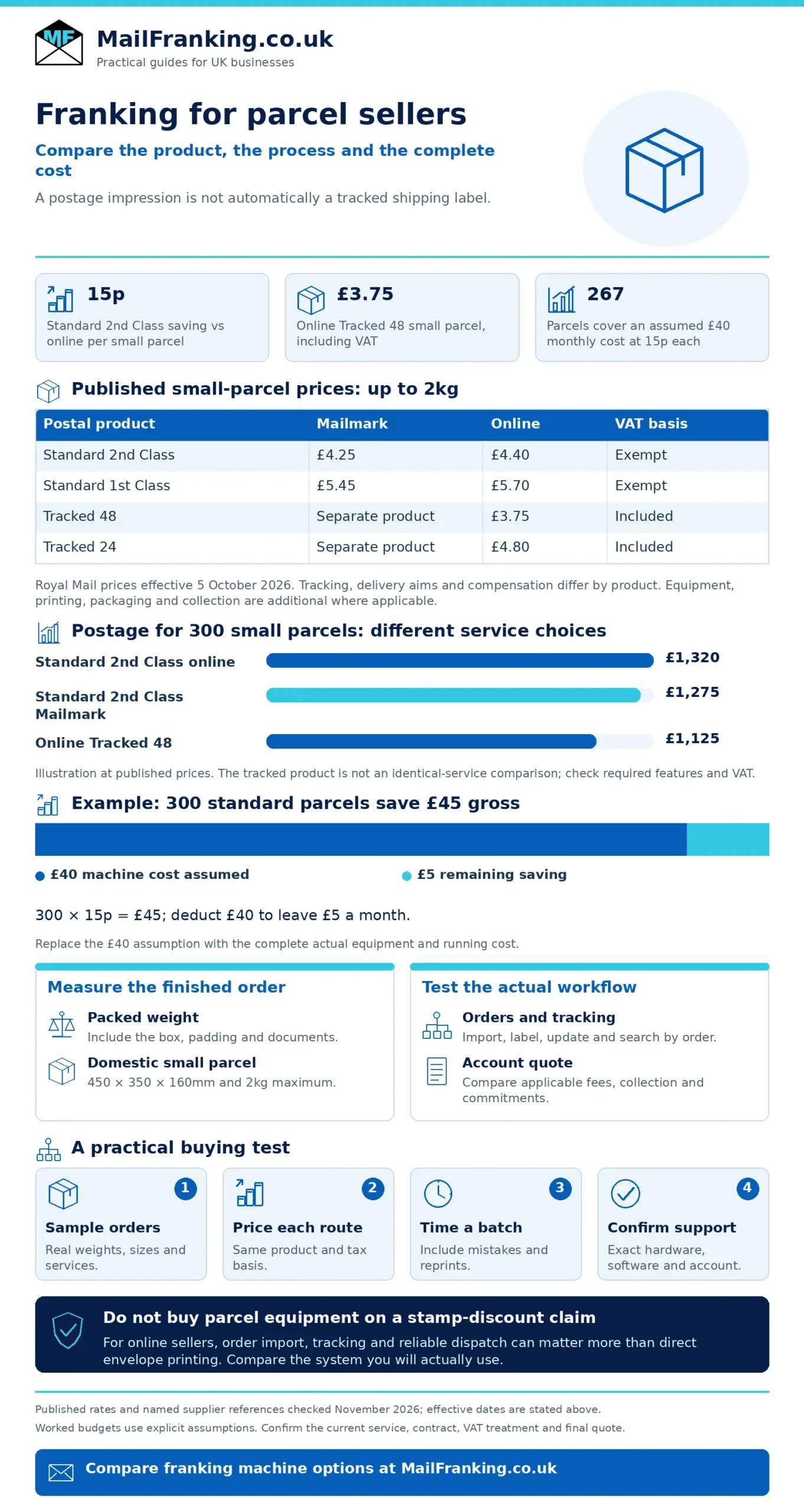
The following figures are published prices for a small parcel weighing up to 2kg. They show why the word “cheapest” needs a clearly defined service. Standard 2nd Class, Tracked 48 and Tracked 24 are different products, with different features and VAT treatment.
| Postal product | Payment route | Published price | VAT basis |
|---|---|---|---|
| Standard 2nd Class small parcel | Mailmark franking | £4.25 | Exempt |
| Standard 2nd Class small parcel | Online | £4.40 | Exempt |
| Standard 1st Class small parcel | Mailmark franking | £5.45 | Exempt |
| Standard 1st Class small parcel | Online | £5.70 | Exempt |
| Tracked 48 small parcel | Online | £3.75 | Includes VAT |
| Tracked 24 small parcel | Online | £4.80 | Includes VAT |
Sources: Royal Mail’s Mailmark wallchart and online price guide, effective from 5 October 2026. Equipment, printing materials, packaging and collection are additional where applicable. A contract parcel quotation can use different prices and conditions.
- Give your requirements
- Receive quotes to compare
- Choose a provider or walk away - your choice!
For standard 2nd Class small parcels, the direct online-to-Mailmark difference is 15p. For standard 1st Class it is 25p. That is the gross postage difference before operating the machine. Comparing £4.25 standard postage with £3.75 tracked postage answers a different question: which product and dispatch route suits the order?
Do not assume a tracked service is guaranteed to arrive on a particular date. Tracked 48 has a delivery aim, subject to postcode exceptions, and includes tracking and compensation subject to conditions. If a guaranteed delivery commitment is needed, compare an appropriate guaranteed service separately.
Check the packed parcel before buying equipment
Measure the finished package, including padding, seams and any bulge. Royal Mail’s standard domestic small-parcel limits are 450 × 350 × 160mm and 2kg; medium parcels have different limits. A small lightweight product in an oversized box can be charged as a larger format.
Use a scale with enough capacity for your heaviest packed order and a platform large enough to support it. A 7kg platform may be adequate for your routine parcels but does not cover a 15kg carton. Ask whether a separate larger platform integrates with the system or whether the weight has to be entered manually.
Also examine the label process. A franking label, an A4 address sheet and a thermal shipping label are different consumables. Confirm the dimensions, compatible stock, adhesive and printer needed for each selected service. Our ink and labels guide explains the supplies costs to include.
Worked example: 300 standard parcels a month
Suppose a business sends 300 small parcels up to 2kg using standard 2nd Class. Its online postage bill is £1,320; Mailmark postage is £1,275. The gross monthly difference is £45. This example compares the same postal product, not a tracked substitute.
Assume the quoted machine package costs £40 a month including the particular service and supplies allowance needed. The remaining saving is £5 a month before any other differences in labels, funding, collection or staff time. Over 12 months that is £60, provided the volumes and costs remain unchanged.
| Monthly standard 2nd Class parcels | Gross saving at 15p each | Assumed monthly machine cost | Net result |
|---|---|---|---|
| 100 | £15 | £40 | £25 additional cost |
| 300 | £45 | £40 | £5 saving |
| 500 | £75 | £40 | £35 saving |
| 1,000 | £150 | £40 | £110 saving |
The £40 figure is an explicit modelling assumption, not a supplier offer. At that fixed cost, at least 267 such parcels are needed to cover the machine payment from postage savings alone. If labels and funding add another £15 monthly, the break-even volume becomes 367 parcels. Enter your actual mix in our franking savings calculator.
What if your orders need tracking?
Build a separate tracked-service comparison. At the published online Tracked 48 price, 300 small parcels cost £1,125 including VAT, before printing, packaging and any collection charge. The corresponding standard Mailmark calculation above is £1,275 plus machine costs. That does not establish universal superiority; it shows why an online seller should price the required product rather than buy on a stamp-discount claim.
If you can recover input VAT, compare recoverable amounts consistently. The net price within £3.75 including 20% VAT is £3.125 before invoice-level rounding. The £4.25 standard Mailmark product is VAT exempt, so there is no VAT within it to recover. Confirm eligibility and invoice evidence with your accounts team.
Tracking also has an operational value. Can the system return the tracking number to the marketplace? Can staff search by order number? Does a customer receive notifications? A lower postage price can be undermined if every dispatch then requires manual copying between systems.
Online postage, a franking machine or a parcel account?
| Route | Often useful for | Main buying check |
|---|---|---|
| Mailmark franking | Mixed office correspondence and occasional parcels | Same-service savings after the full equipment cost |
| Online postage | Sellers needing shipping labels and flexible volumes | Integrations, tracking workflow and printing costs |
| Business parcel account | Regular dispatch with a defined service profile | Contract rates, surcharges, collection and commitments |
| Combined mailing and shipping system | Businesses with substantial letters and parcels | Exact supported products and total package charges |
Royal Mail invites businesses sending more than 20 parcels a week to discuss a business parcel account. That is a route to a quotation, not a promise that every sender receives the same discount or qualifies for every service. Ask for prices based on your weights, destinations and delivery requirements.
For a contract offer, check the effective date, minimum spend, volume expectations, collection arrangements and all applicable surcharges. Royal Mail’s 2026 price-change information identifies a business-account peak surcharge period from 2 November 2026 to 10 January 2027. Establish whether your proposed products are affected instead of adding a blanket percentage to every postal service.
Equipment and software costs to include
The dispatch budget should include the machine rental or purchase allocation, service cover, tariff updates, ink, labels, postage funding fees, shipping software and any additional printer. Avoid counting an included item twice, but do not treat “all inclusive” as proof that every optional shipping application is covered.
For an existing office machine, distinguish additional costs from costs you will pay anyway. If the meter is already needed for 2,000 letters a month, the parcel decision may concern only extra labels and shipping software. If you are acquiring equipment solely for parcels, the entire new commitment belongs in the comparison.
Our franking machine prices guide and hidden fees guide cover the wider cost categories. Request the complete payment schedule over the proposed term, including installation and cancellation conditions, before accepting a promotional monthly price. The SendPro C vs Plus guide is a practical example of why an envelope meter and a parcel-label package must be compared at the exact bundle level. Confirm supported products rather than inferring them from the machine name.
Test marketplace imports and address handling
Ask for a demonstration using a realistic batch from your own order process. Import orders, amend an address, split a multi-item order, choose a service and produce the labels. Then cancel a label and check how the order and postage records change.
Pay particular attention to duplicate prevention. Staff should be able to distinguish an imported order, an approved shipment, a printed label and an item physically handed over. A reprinted label should not silently create a second paid shipment. Decide who can override service rules or change a dispatch address.
Test your actual computer, browser and network arrangements too. A demonstration on a supplier’s laptop does not prove that the printer driver, USB connection or cloud application will work with your managed office devices. Include IT approval and staff training in the implementation plan.
Collections, handover and returns
Collection arrangements can change the economics more than a small postage discount. Confirm whether collection is included, charged per item, charged per visit or conditional on account volume. Record the latest ready-for-collection time and the separate posting or manifest requirements for each route.
Allow for returns rather than budgeting only for successful outward deliveries. Check whether return labels can be generated, how you pay for their use and how returned items are matched to orders. Compensation conditions, restricted contents and proof-of-posting requirements also need to fit the products you sell.
For overseas orders, use the international franking guide before promising a delivery price. Customs data, destination restrictions, duties and the selected international service require a separate process. Printing a paid impression alone does not complete an export shipment.
Run a pilot before signing a long contract
Choose a normal dispatch week and one representative peak batch. Record the total minutes spent importing orders, checking weights, producing labels, fixing exceptions and reconciling the postage account. Include the time spent walking items to the handover point.
Suppose a new workflow saves 30 minutes per working day. At an assumed loaded staff cost of £18 an hour and 20 working days, that represents £180 of monthly staff capacity. It becomes a cash saving only if paid hours or another real expense falls; otherwise describe it as time available for other work.
Keep quality measures alongside the stopwatch: labels reprinted, parcels sent on the wrong service, address corrections and customer tracking queries. A workflow that is 10 minutes faster but produces avoidable mistakes is unlikely to be the better operating choice.
How to choose a suitable supplier
Shortlist suppliers that can support the exact UK meter and shipping setup. Ask each one for a written statement of supported services, label hardware, account requirements, reporting exports, funding charges and support response. Our supplier comparison and the Pitney Bowes, Quadient and FP Mailing guides provide starting points.
Give every bidder the same parcel profile and compare the same contract term. The useful outcome is a complete cost and a tested dispatch process. For an online seller, the deciding question is whether the system sends the right parcels reliably at the lowest overall cost for that business.
Frequently asked questions
Yes. You generally print the paid impression onto a compatible franking label and attach it to the parcel. Select the correct service, packed weight and format. A franking impression does not automatically provide a complete tracked shipping label, so check the workflow for the product you need.
Sometimes for the same standard service, but not automatically across different products. Published standard 2nd Class small-parcel prices are £4.25 with Mailmark and £4.40 online. Online Tracked 48 is a separate product at £3.75 including VAT. Add equipment, printing and collection costs before choosing.
It depends on your chosen shipping platform and label format. Some workflows support A4 printing; others work best with a dedicated thermal printer. Ask the supplier to demonstrate the supported setup, including label sizes, driver compatibility, reprints and tracking updates on the computers your business actually uses.
Royal Mail invites businesses sending more than 20 parcels weekly to discuss a business account. Request a quote using your actual weights, destinations and service mix. Compare the complete contract, including volume expectations, surcharges and collection, against the online prices and equipment costs you would otherwise pay.
Some systems combine envelope franking and shipping applications, but capabilities vary by model and package. Verify the exact UK services, marketplace integrations, printers and fees. Test a complete batch from order import through label creation, handover and account reconciliation before committing to the equipment.
Measure it separately from postage and equipment costs. Time released has operational value, but it is a cash saving only when a real expense falls. Use an explicit hourly-cost assumption, include exception handling and check dispatch accuracy alongside speed when comparing two systems.