

A school should choose a franking arrangement around the post it still sends, the staff available to prepare it and the full annual cost. Term-time peaks can make a machine look busy while holiday periods leave it largely unused. For an academy trust, central purchasing also needs to work for the individual school offices that handle correspondence.
The buying decision is therefore broader than the cheapest monthly rental. This guide compares equipment approaches, models annual costs and explains the operational questions to put into a specification. The scenarios are illustrative and do not represent published prices offered specifically to schools or guaranteed savings.
Count post across the whole school year
Review a complete year of actual postage, including admissions correspondence, parent letters, finance documents, staff administration and exceptional packs. Record the format and delivery requirement rather than counting envelopes alone. A school increasingly using electronic communication may have a smaller but more varied remaining workload.
Identify the busiest batches and the time available to complete them. A few large runs do not necessarily justify a permanently larger machine if the preparation bottleneck is printing or inserting. Compare occasional outsourcing or a separate batch arrangement before sizing equipment for the most demanding day of the year.
- Takes 2 minutes
- Receive quotes to compare
- Easy and no commitment
Ask office staff to record preparation and dispatch time for a representative fortnight. Include interruptions at reception and the need for cover. A simple device that two colleagues can operate reliably may provide more value than faster equipment that requires one specialist to remain available.
Equipment options by school requirement
| Requirement | Approach to compare | Main acceptance check |
|---|---|---|
| Small amount of varied correspondence | Compact manual meter or online postage | Simple selection and complete annual cost |
| Regular prepared envelope batches | Desktop system with suitable handling | Full batch completed within office staffing time |
| Larger trust mailroom | Confirmed automatic-feed system | Consistent output and cost-centre reporting |
| Thick documents or bulky packs | Suitable platform and compatible labels | Accurate support, format and service selection |
| Occasional large campaigns | In-house versus outsourced batch | Printing, preparation, data controls and handover |
The small-business guide covers compact systems. The iX-4 vs SendPro C comparison is useful for desktop proposals, while the high-volume guide applies to genuinely centralised operations. Use the demonstrated requirement to choose the category first.
Annual costs matter more than term-time headlines
Request equipment, service, software and supplies separately, with the VAT basis and minimum term. There is no universal school-specific franking tariff. A proposal needs to identify the exact meter, platform, condition and enabled features, rather than simply describing a school package.
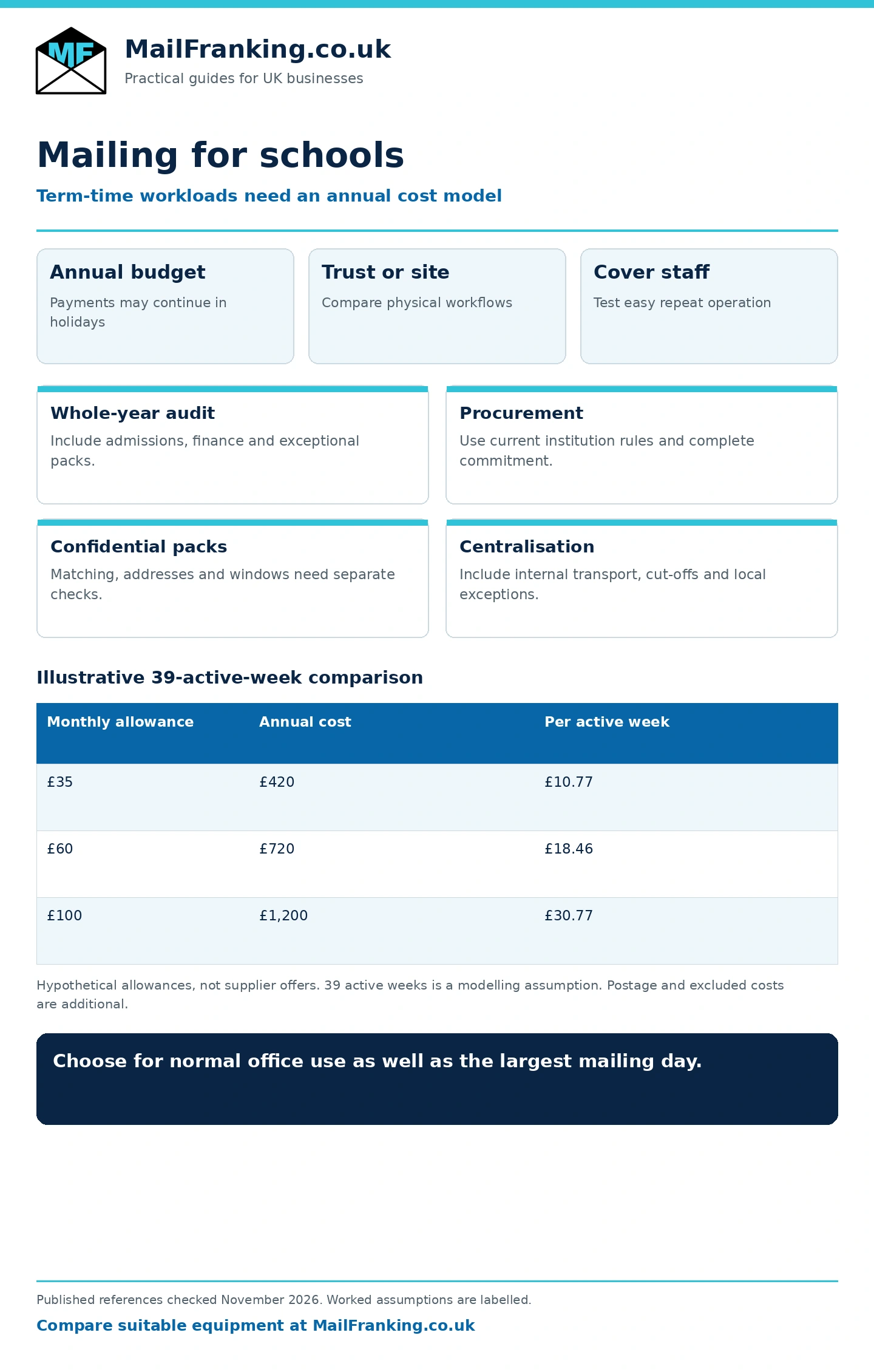
The table allocates hypothetical annual equipment and running-cost allowances across 39 active weeks. That is an illustration, not a statement about every school’s working calendar or a supplier price. Contractual payments may continue throughout all twelve months regardless of use.
- Give your requirements
- Receive quotes to compare
- Choose a provider or walk away - your choice!
| Assumed monthly system allowance | Annual amount | Cost per active week over 39 weeks | Five-year total |
|---|---|---|---|
| £35 | £420 | £10.77 | £2,100 |
| £60 | £720 | £18.46 | £3,600 |
| £100 | £1,200 | £30.77 | £6,000 |
Use the school’s own VAT treatment consistently when budgeting. Do not assume all schools or academy trusts have identical recovery arrangements. Finance should check the cash and economic cost of the exact offer, including service fees that might be quoted on a different basis from postage.
Worked example: 3,900 ordinary letters annually
Assume a school sends 100 ordinary letters in each of 39 active weeks, giving 3,900 items. At a 3p gross saving against the relevant stamp reference, the annual postage improvement is £117. Against an assumed £420 annual system allowance, that leaves £303 to justify through other measurable benefits before additional charges.
The reference follows Royal Mail’s current price guides, checked in November 2026. It does not describe a special education discount. Schools sending larger packs or already using online postage should build a different product-by-product baseline rather than apply the ordinary-letter comparison universally.
Now suppose reliable in-office processing saves fifteen minutes on each of thirty busy dispatch days. That releases 7.5 hours annually. At an assumed £20 loaded staff cost, the modelled value is £150. The combined £267 remains below the £420 allowance, so convenience alone should not be presented as a guaranteed financial saving.
Buying and leasing need a clear specification
The Department for Education’s school buying guidance explains that purchasing routes depend on the value and applicable procurement rules. Use your school’s or trust’s current approval process and assess the complete commitment, including related service and software, rather than only the first monthly instalment.
State the required envelope mix, active-year volume, peak batch, accounts, installation location and support hours in the specification. Ask bidders to return the same cost schedule. Request the contract documents before the decision so the finance and procurement teams can assess them together.
Do not assume a supplier’s use of the word rental determines the agreement’s legal or accounting classification. Have the relevant school or trust team review the actual terms and any required approvals. Keep the article’s equipment comparison separate from professional advice about the institution’s borrowing or leasing position.
Whole-trust purchasing versus local school needs
A trust may negotiate one commercial arrangement while retaining equipment at several sites. Compare that with centralising physical preparation. Removing local meters can create transport, urgent-post and collection problems, especially where schools are spread across a large area or have different working patterns. Local authority offices face similar transport and reporting questions; the council franking machine guide examines department budgets, multi-site dispatch and the wider postal requirement.
For an illustrative trust with five sites, avoiding £40 monthly at each would remove £2,400 annually. If central handling adds £1,500 in transport and staff work, the remaining improvement is £900 before the central machine premium and transition costs. The relevant saving is the net result, not the equipment subtotal alone.
Agree account identifiers by school and function, and test whether local teams can select them accurately. Ask for a sample trust report that finance can reconcile. A single dashboard is useful only if it distinguishes the costs and exceptions that the trust actually needs to manage.
Confidential correspondence and address checks
School post can contain sensitive information. The franking stage does not confirm that the correct documents are inside the envelope or that an address is current. Use the school’s established controls for data accuracy, document matching, authorisation and handling of returns.
For a demonstration, use invented pupil, parent and staff details. Check window positions and whether an insert can move to reveal information unintended for display. Keep rejected and completed items separate, particularly when reception staff are interrupted and another colleague takes over the work.
The ICO’s security advice for smaller organisations provides relevant background. A supplier should explain any access to device or reporting data, but a franking contract should not be described as automatically establishing the school’s wider data-protection compliance.
Report letters and seasonal batch preparation
Time a full batch from the point completed documents are ready. If folding and inserting consume most of the work, compare a folder inserter or a controlled outsourced process. A faster print transport cannot remove the need to match personalised contents.
Before seasonal use, check rates, available credit, supplies and the operator cover plan. Make a small test batch early enough to resolve a problem before the deadline. Avoid discovering on the last dispatch afternoon that a seldom-used account is inaccessible or a supply order has not arrived.
If outsourcing a large run, include artwork preparation, approvals, data handling, exception packs and acceptance evidence in the comparison. Our hybrid mail guide explains the different workflow. The cheapest unit rate may exclude work that remains with school staff.
Holiday periods and intermittent operation
Ask the provider how to leave and restart the exact equipment during periods of low use. Follow its supported instructions for supplies, connectivity and updates. Do not assume a machine can be disconnected indefinitely without affecting its ability to load funds or exchange required information.
Plan who receives service or funding notices when the main administrator is absent. A school email address that nobody checks during a closure can leave an avoidable problem until term begins. Store account access and the operating guide according to the school’s own security arrangements.
Include the restart routine in staff training. Check a print, scale reading and selected product before resuming a batch after a long gap. For equipment used infrequently, reliability and a straightforward support route can matter more than a large nominal throughput figure.
Service, supplies and a posting fallback
Ask whether service includes parts, labour, carriage, onsite attendance, software help and a replacement unit where needed. Compare restoration arrangements with the school’s real dispatch deadlines. An engineer response target is different from having a usable system before the last collection.
Request ink and label prices and realistic yield assumptions for intermittent use. Compare the correct part numbers and quantities, and identify delivery charges. Our supplies guide and maintenance guide explain the cost categories that should appear in the proposal.
Keep an approved fallback for urgent items and confirm who can use it. The fallback may involve another site, online postage or a different supported service, depending on the school. Include any extra travel or preparation in the annual model instead of treating backup as cost-free.
Contract review and changing communication volumes
Forecast paper volume over the actual term. If a trust is introducing digital communications, test scenarios with fewer routine letters but a continuing need for occasional physical packs. The annual fixed cost per remaining item can rise even while the total postage bill falls.
For example, a £600 annual system allowance is 10p per item at 6,000 letters but 30p at 2,000, before postage. That sensitivity may favour a different agreement or workflow. It does not automatically rule out a meter, but it makes the operational benefit easier to assess honestly.
Check renewal, notice, return and unused-credit arrangements before approval. Keep finance, service and software obligations distinct, particularly if replacing existing equipment. Use the rental guide and cancellation guide alongside the school’s current procurement process.
How to select the final shortlist
Give suppliers the same anonymised mail samples and cost template. Ask the intended school operator to run a representative batch, including an interruption and a larger item. Check account selection, print quality, weighing, report exports and the actual handover preparation.
Evaluate the result across the whole year and the trust structure where applicable. A modest system that staff use accurately can be preferable to paying for capacity that only appears attractive on a peak-day forecast. Keep the assumptions and acceptance results with the purchase approval.
This guide uses published equipment categories and practical school workflows, not a hands-on ranking of every machine. Obtain the exact UK configuration and verify support through a suitable authorised supplier. The final choice should be demonstrably affordable, usable by cover staff and compatible with the institution’s purchasing requirements.
Frequently asked questions
Not necessarily. Compare the remaining annual paper workload with the complete system cost and current alternatives. A compact meter can provide convenience, but small ordinary-letter volumes may generate limited postage savings. Include holiday periods, cover staff, supplies and the actual dispatch process before deciding it is worthwhile.
Only if the agreement explicitly provides for that arrangement. Budget the contractual commitment across the full year rather than assuming payments track term-time use. Allocate annual cost over the school’s actual mailing pattern and compare it with buying, online postage or outsourcing occasional batches where those options are available.
Potentially, but centralising physical post introduces transport, cut-off and urgent-exception issues. Compare avoided local equipment costs with the central system, internal handling and branch fallback. Alternatively, a common purchasing arrangement may retain separate meters at each school while providing consistent reporting and commercial terms.
Simple service selection, reliable weighing, clear account allocation and easy cover operation often matter more than maximum speed. Larger batches may justify automatic feeding, but printing and inserting can remain the bottleneck. Demonstrate real completed envelopes and test the full process with the staff who will normally use it.
Use the institution’s current procurement and approval rules and relevant Department for Education guidance. Assess the full equipment, service and software commitment rather than a monthly headline. Have the appropriate finance or procurement team review the actual agreement, including classification, approvals, renewal and exit terms before signing.
No. The meter does not establish that the correct personalised documents are inside each envelope. Printing, matching, inserting, address checks and returned-mail handling need separate controls. Test with invented pupil and staff details, and assess any outsourced preparation process independently from the equipment’s postage and handling functions.