

A charity should assess a franking machine against the correspondence it actually needs to send: donor acknowledgements, membership letters, beneficiary information, finance documents and occasional appeals. A large supporter database does not necessarily mean a large daily postage workload, particularly where many communications are electronic or handled by an external mailing supplier.
The strongest buying case combines a realistic annual cost with a controlled process that staff and volunteers can use consistently. This guide compares equipment approaches, explains how campaign peaks change the calculation and shows how return-envelope choices can affect the wider budget. All charity scenarios and equipment allowances are illustrative.
Separate everyday correspondence from appeals
Start with an annual schedule distinguishing routine post from campaign batches. A charity sending twenty acknowledgements each week has a different requirement from one preparing thousands of identical appeal envelopes twice a year. Combining both into an average can lead to buying a machine that is unnecessarily large for most working days. Where renewals, welcome packs and journals form a substantial part of the workload, use our separate guide to franking machines for membership organisations to model those subscription cycles and publication runs.
Record the work completed before franking: artwork approval, address checks, print matching, folding, inserting and sealing. If the major workload is preparation, compare a mailing-house or hybrid-mail proposal alongside equipment. A faster postage transport will not automate the wider campaign by itself.
- Takes 2 minutes
- Receive quotes to compare
- Easy and no commitment
Use the small-business guide for routine office post and the high-volume guide only where regular prepared batches justify it. Our hybrid mail comparison helps evaluate a separate route for suitable campaign work.
A practical shortlist for different charities
| Charity workflow | Approach to compare | Important question |
|---|---|---|
| Occasional administration and donor letters | Compact manual meter or online postage | Does annual convenience justify fixed cost? |
| Regular membership or acknowledgement batches | Desktop meter with repeat jobs | Can cover staff select the correct service? |
| Centralised charity mailroom | Automatic-feed system and reporting | Does it remove a demonstrated bottleneck? |
| Infrequent large appeals | External mailing versus in-house preparation | What remains with the charity after outsourcing? |
| Replies and donation forms | Appropriate response-envelope service | Is payment based on distribution or replies? |
For compact systems, compare the iX-1 and the relevant entry-level alternatives. Confirm current support and configuration for every offer. No model should be presented as automatically best merely because the customer is a registered charity.
Charity status does not define the equipment price
Ask suppliers for the exact package and any genuine concession in writing. Do not assume there is a universal charity discount, free maintenance or a particular tax treatment. Compare the commercial offer with the same discipline used for other recurring charity overheads.
Equipment, software, service, ink, labels and postage should be distinct. Where the charity cannot recover a cost’s VAT, include it in the cash budget; where recovery is available, finance should assess the relevant basis. The treatment can depend on the organisation and supply, so avoid a blanket assumption based on charitable status.
- Give your requirements
- Receive quotes to compare
- Choose a provider or walk away - your choice!
The following are hypothetical complete-system allowances, not supplier prices. They exclude postage and any item outside the allowance. Show the full term to the person approving the commitment rather than describing the decision only as a modest monthly expense.
| Assumed monthly allowance | Annual amount | 36-month commitment | 60-month commitment |
|---|---|---|---|
| £30 | £360 | £1,080 | £1,800 |
| £55 | £660 | £1,980 | £3,300 |
| £95 | £1,140 | £3,420 | £5,700 |
Worked example: donor acknowledgements
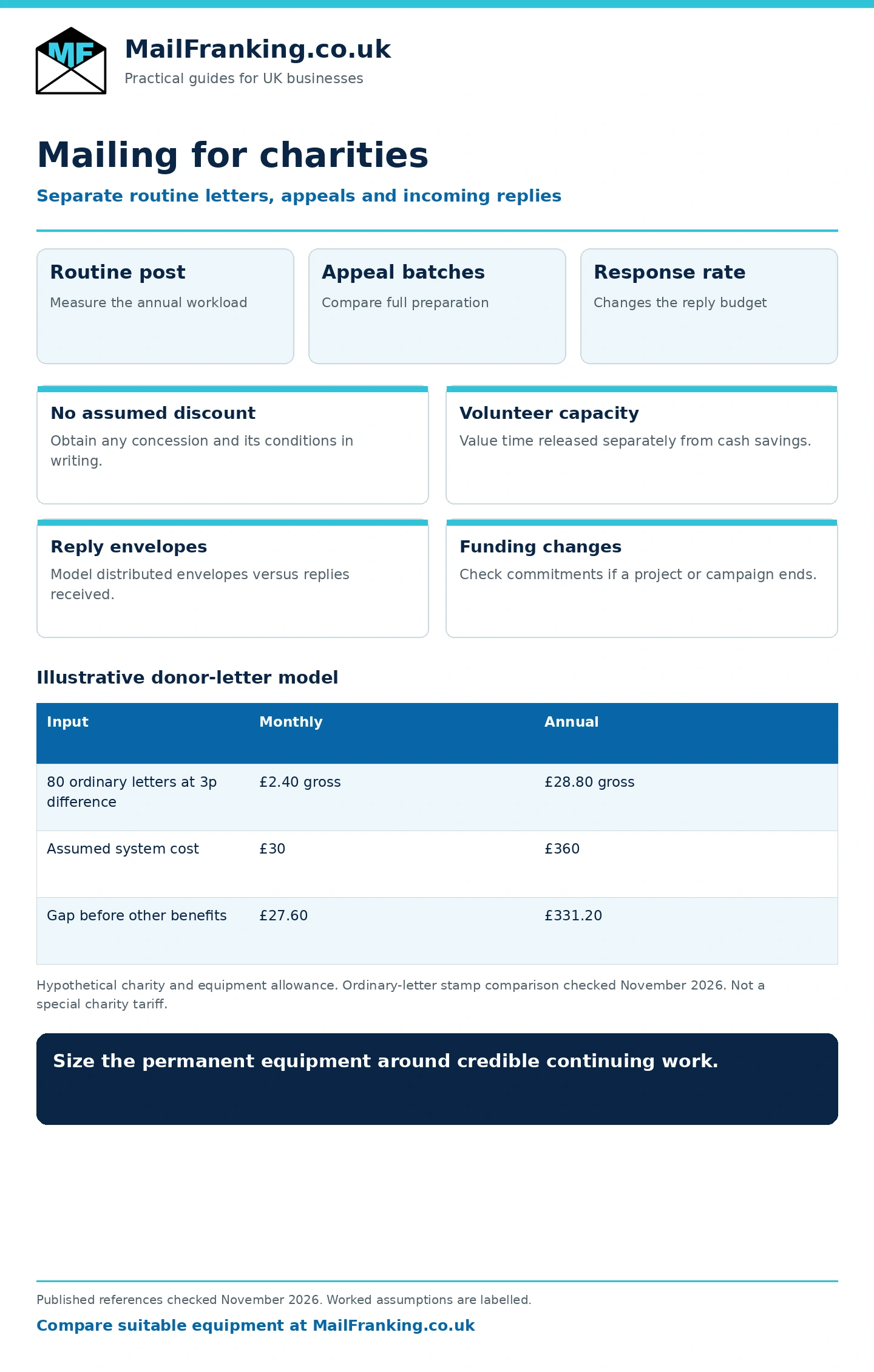
Assume a charity sends eighty ordinary letters monthly. Using a 3p gross saving against the corresponding stamp reference, the saving is £2.40 monthly or £28.80 annually. Against an assumed £360 annual system allowance, there is a £331.20 gap before considering any additional costs or operational benefit.
The letter comparison follows Royal Mail’s current published guides, checked in November 2026. It is not a charity-specific offer. A different format or an existing online baseline produces a different result, so build the calculation from your own postage receipts.
Convenience can still matter. If avoiding repeated postage administration releases twenty minutes each week for forty-eight weeks, that is sixteen hours annually. Assign an appropriate value only where the time can actually be used. Volunteer time is valuable capacity, but it should not automatically be reported as a cash payroll saving.
Appeals need a complete campaign calculation
For a hypothetical 5,000-item appeal, an apparent 5p unit improvement is £250. If artwork setup, stock handling and extra preparation add £180, the remaining difference is £70 before other charges. A campaign with complex personalisation may have a very different cost from a standard single-sheet letter.
Ask an external supplier to identify printing, envelopes, inserts, postage product, data work, proofs, delivery timing and exceptions. For in-house production, include staff or volunteer hours, consumables, spoiled items and equipment. Compare equivalent output, not an outsourced all-in price with an in-house postage-only total.
Do not assume that all appeal content qualifies for a particular advertising or account product. Obtain the exact eligibility conditions and service code from the provider. Our PPI comparison explains why a printed postage mark alone does not establish the price or discount.
Return envelopes can change the budget
A charity encouraging paper responses should compare the cost of paying for every enclosed return envelope with paying for responses actually received under an appropriate licensed service. The response rate matters as much as the unit postage amount, and setup, artwork and annual licence costs also belong in the calculation.
For example, distributing 4,000 response packs with a 10% reply assumption means 400 returns. A 25% assumption means 1,000. The same outward campaign can therefore produce very different inbound postage costs. Model more than one response rate before choosing the return method.
Royal Mail provides Business Reply and Freepost services, with product-specific requirements. Our prepaid replies comparison explains the payment models and published charges. Do not use an ordinary dated frank on a reply envelope without confirming that the proposed service permits the intended use.
Staff, volunteers and simple controls
Choose an interface and operating routine that suitable cover staff can repeat reliably. Keep authorised access, funding and account changes clear. Volunteers helping prepare a mailing may not need access to all reporting or postage-account functions, so match permissions to their role.
Use a short approved job guide for repeat mailings, including the physical format, service, account and dispatch preparation. Train people to check whether today’s contents differ from the usual pack. A saved job should reduce repetitive setup without encouraging staff to skip the checks that keep postage accurate.
Test an interruption during the demonstration. Establish how completed envelopes remain separate from those awaiting checks and how a second operator resumes the batch. The practical quality of the handover can matter more than a touchscreen’s appearance or a supplier’s maximum speed claim.
Donor and beneficiary information
Postage equipment does not validate the supporter address or match confidential contents to the correct envelope. Retain the charity’s established information-handling process for print files, insertion, returns and rejected material. Use invented records during equipment demonstrations rather than exposing real donor or beneficiary details.
The ICO’s information security advice is relevant background. If a third party prepares mail, assess the data arrangement and access controls separately from price. A professional-looking imprint does not establish that the complete communication process is appropriately controlled.
Keep direct marketing eligibility and supporter preferences within the charity’s own approved process. Buying a machine or a response service does not create permission to send a campaign. The equipment evaluation should concern how an authorised mailing is prepared and accounted for, rather than substituting for the charity’s compliance decisions.
Departments, projects and restricted budgets
Some charities need broad totals by department, while others need expenditure allocated to campaigns or funded projects. Define the reporting structure before paying for a large number of accounts. Ask finance whether a monthly export supports their actual records and how unallocated items are corrected.
Consider a hypothetical organisation with three programmes sharing one meter. If each programme uses a consistent code, finance can assess spending without a complicated account for every envelope. If campaign-level allocation is required, check that short-lived codes can be created and closed without leaving an unmanageable list.
Request a sample export and reconcile a small batch with the postage balance. Distinguish credit loaded, fees paid and postage used. A top-up made at the end of a month may fund later mailings, so the bank movement alone does not necessarily describe that month’s operational usage.
Supplies, downtime and campaign deadlines
Request the exact ink and label prices, delivery charges and usable yield assumptions. Intermittent use and additional envelope messages can affect consumption. Ask how much supply should be held before a planned campaign and who controls any automatic ordering arrangement.
Service terms should address the actual consequence of failure. For occasional routine post, a simple fallback may be enough. For a scheduled appeal with volunteers booked for one day, restoration or an alternative preparation route can be more valuable than a slightly lower annual service price.
Our maintenance guide explains the distinction between response and restoration. The supplies guide helps compare quantities and compatibility. Include backup costs in the campaign model where they are material, rather than relying on an unpriced promise that something will be arranged.
Contracts and changing funding
Compare the minimum commitment with the charity’s credible mailing forecast and approval process. A long rental can remain payable if a project ends or a grant changes. The fact that the machine is little used does not, by itself, alter the written agreement.
Ask for separate finance, service and software terms, including renewal, notice, return, damage and unused-postage recovery. If replacing equipment, obtain the existing position before accepting an upgrade contribution. Our cancellation guide sets out the obligations to check.
Recalculate at lower volumes and without the largest planned campaign. If the arrangement only works when one uncertain appeal goes ahead, compare a more flexible route. Keep convenience, capacity released and cash savings distinct in the approval note so decision-makers can assess the real trade-off.
How to make the final decision
Prepare a one-year mailing plan with routine volume, campaign dates, response assumptions and reporting requirements. Request comparable quotations from appropriate authorised suppliers, and give them representative filled envelopes. Ask normal staff or volunteers to run the demonstration under realistic conditions.
Compare the meter with keeping routine postage online and outsourcing only large runs. A mixed arrangement may match a charity’s uneven workload better than one machine sized for every possible task. Include transition, supplier administration and duplicate services in the comparison where applicable.
This guide uses published equipment capabilities and practical charity scenarios rather than a physical product ranking. The preferred option is the one that prepares authorised mail reliably, fits the charity’s resources and remains understandable over the full contract. A small monthly headline is only one part of that decision.
Frequently asked questions
Do not assume a universal charity equipment discount or special postal tariff. Ask for any concession and its conditions in writing, then compare the full package. Charitable status also does not settle every VAT question, so finance should assess the actual supplies and the organisation’s own position.
It may provide convenience, but small ordinary-letter volumes can produce limited postage savings. Compare the full annual equipment, service and supplies cost with the current alternative. Value staff or volunteer capacity separately and avoid presenting time released as a cash saving unless expenditure is actually reduced.
Compare complete campaign costs, including proofs, printing, data work, inserts, envelopes, postage, labour and exceptions. A machine only changes part of that process. An outsourced or mixed arrangement can suit infrequent large runs, while routine acknowledgements may remain in-house. Use equivalent output and confirmed postal-product eligibility.
The answer depends on the response rate, annual licence, applicable reply tariff, envelope production and alternative prepaid cost. Model several response levels rather than assuming every recipient replies. Confirm artwork and service requirements before printing, and compare the entire return-envelope arrangement separately from the outward mailing.
Suitable trained volunteers can follow an authorised operating process, but access and permissions should match their role. Test service selection, account allocation and interrupted-batch handovers. Keep funding changes and administrative access controlled, and retain a simple cover guide so the process does not depend on one experienced person.
Check the written agreements before committing. Equipment finance, service and software can have separate terms that continue even when a project or campaign stops. Model lower-volume scenarios and ask about notice, settlement, returns and unused credit. A flexible mailing arrangement may be preferable where future use is uncertain.