

Franking machines for housing associations need to suit tenant correspondence, service charge packs and the practical arrangements between offices. The number of homes managed is a useful starting point, but the buying decision should follow the letters actually posted, their formats and the work needed to prepare them.
A compact machine may handle the routine post of a small provider, while a larger association might combine central production, local meters and outsourced batches. This guide explains how to compare those arrangements, build a realistic cost model and specify equipment without paying for capacity that remains unused.
Start with correspondence, not property numbers
An association managing 5,000 homes does not necessarily post 5,000 letters every month. Online statements, household preferences, joint tenancies, empty properties and the timing of annual communications can all change the relationship between stock and postage. Count completed postal items rather than multiplying homes by an assumed monthly frequency.
Separate rent account correspondence, service charge information, repairs updates, consultation material, complaints and general administration. Record which team approves each communication and which service it requires. The equipment supplier can explain available postage products, but your organisation must decide how particular correspondence should be sent and recorded.
- Takes 2 minutes
- Receive quotes to compare
- Easy and no commitment
Use a full year of invoices and mailing records where available. A four-week sample taken between major billing runs can seriously understate capacity needs. Conversely, sizing permanent equipment around one exceptional annual mailing can create a long commitment for a problem that could be handled separately.
Build a useful housing mail profile
For each mailing, record the number of envelopes, finished weight, external dimensions, selected postal service, preparation time and dispatch location. Include returned items and reprints. A statement folded into a standard envelope and a multi-page service charge pack can have very different costs even when both concern the same tenancy.
| Workload | What to measure | Buying implication |
|---|---|---|
| Daily tenant letters | Normal items and dispatch cut-off | Simple repeat operation may matter most |
| Statement or rent batches | Largest recurring completed run | Compare feeding and preparation together |
| Service charge packs | Finished thickness and weight spread | Check scales, labels and format selection |
| Local office exceptions | Urgent items and internal transport | Retain a workable local dispatch route |
| Returned correspondence | Cause, reissue cost and ownership | Improve address records alongside equipment |
A mailing audit should also identify time spent printing, folding, inserting, checking and transporting post. Franking addresses the payment and marking stage. If preparation is the bottleneck, a faster meter may leave the total job almost unchanged. Our folder inserter guide examines that separate investment.
Current postage references and the limits of savings
The Royal Mail current price guides provide the baseline. Checked in November 2026, a standard letter up to 100g costs £0.88 with 2nd Class Mailmark franking against a £0.91 stamp. The equivalent 1st Class references are £1.77 and £1.80. Both differences are 3p per item before equipment costs.
- Give your requirements
- Receive quotes to compare
- Choose a provider or walk away - your choice!
The mix matters. A 1st Class large letter up to 100g has a £2.86 Mailmark reference against a £3.30 stamp: a 44p gross difference. For a 2nd Class large letter up to 100g, the corresponding £1.52 and £1.55 prices differ by only 3p. These are specific product comparisons, not a universal percentage saving on all association post.
Compare with the service you actually buy today. If you already use account mail or a print-and-post provider, a stamp comparison does not establish the saving from switching. Assess the exact alternative product, its preparation requirements and VAT treatment. The franking versus PPI guide explains why account mail has no single interchangeable tariff.
Worked monthly housing association example
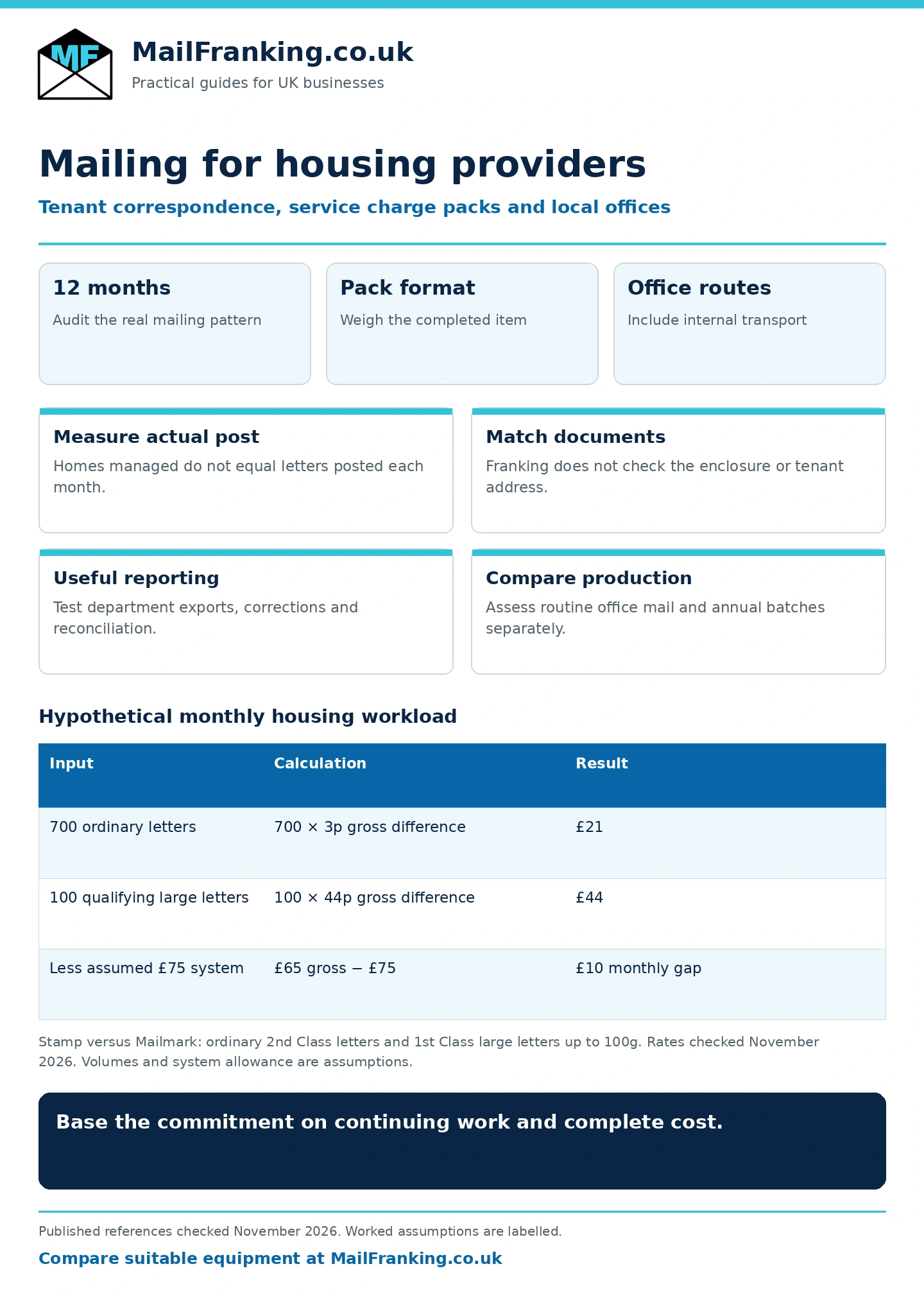
The following is a hypothetical workload, not a typical association or a supplier quotation. It assumes 700 ordinary 2nd Class letters and 100 qualifying 1st Class large letters up to 100g each month. The existing baseline is stamps for those same services, with no change in communication policy.
| Monthly item | Calculation | Amount |
|---|---|---|
| Ordinary-letter gross difference | 700 × £0.03 | £21 |
| Large-letter gross difference | 100 × £0.44 | £44 |
| Total gross postage difference | £21 + £44 | £65 |
| Assumed complete system allowance | Hypothetical monthly cost | £75 |
| Remaining monthly gap | £75 − £65 | £10 |
The stamp postage total is £967: £637 for ordinary letters and £330 for large letters. Mailmark postage is £902, rising to £977 with the assumed £75 system allowance. On these inputs the new arrangement costs £10 more each month before any additional preparation costs, operational benefits or charges omitted from that allowance.
An association could still value improved allocation or a reliable office process, but it should price those benefits separately. If all 800 items were ordinary letters with a 3p difference, the gross postage benefit would be £24. Changing the mix can matter more than negotiating a few pounds off the rental.
What should an equipment quotation include?
Pitney Bowes publishes broad UK guidance of roughly £500–£1,000 for entry-level purchase and £15–£100 or more per month for leasing, depending on features. These are general equipment references, not quotations for a housing association package. Obtain the VAT basis, maintenance arrangements and inclusions in writing.
Request separate figures for equipment or finance, meter arrangements, installation, training, service, ink, labels, connectivity and any reporting subscription. Ask about postage funding charges, minimum orders, delivery costs and annual increases. Our hidden-cost guide helps turn an attractive headline payment into a comparable commitment.
Show the total over the proposed term. An assumed £75 monthly package costs £4,500 over 60 months before increases and excluded costs. Keep postage usage separate from that fixed commitment. Loading £1,000 of postage credit is a funding movement; it does not establish that £1,000 was used on tenant correspondence during that accounting period.
Match the machine to the actual work
For small daily runs, compare compact manual-feed equipment such as the Quadient iX-1 and Pitney Bowes SendPro Mailstation. Check the currently available UK configuration, supplied scale, reporting and service support. A product name alone does not establish what is included in the quotation.
More substantial recurring runs may justify desktop batch equipment. Ask for a demonstration with your filled envelopes and count accepted, ready-to-dispatch output. The manual versus automatic feeding comparison is useful when repeated hand feeding is consuming measurable staff time.
For genuinely large central runs, compare automatic equipment with outsourced production. Include replenishment, misfeeds, labelling and inspection in the timing. Do not buy solely from an advertised letters-per-minute figure: that may describe continuous transport under particular conditions rather than the complete housing correspondence job.
Central mailroom or local offices?
Central production can reduce duplicated equipment and concentrate expertise, but it also introduces transport and cut-off questions. A neighbourhood office needs a defined route for a letter approved after the internal collection has left. Savings disappear quickly if staff routinely drive documents between sites or recreate them locally.
Compare three arrangements: local preparation and local franking; local preparation with central dispatch; and central print, preparation and dispatch. Record who controls address files, who reconciles batches and how exceptions return to the originating team. Department reporting does not itself solve physical document movement.
For example, avoiding two assumed £40 monthly packages releases £960 annually. If the central upgrade costs an additional £360 a year and internal handling adds £500, the remaining improvement is £100 before transition costs. These are hypothetical figures, but they show why counting removed machines is insufficient. The property team guide examines related branch decisions.
Keep tenant and document matching controls separate
A postage impression does not check that the correct statement reached the correct envelope. Before processing a batch, test address windows using the real folded document, check page counts and define how interrupted jobs restart. Use fictitious tenant details for supplier demonstrations and training material.
Decide how staff will distinguish two residents with similar names, multiple correspondence addresses and items requiring a different communication format. Those controls belong in the document and dispatch process. They should not depend on an operator remembering an exception while feeding hundreds of envelopes.
Where individualised packs contain different page counts, ask the production supplier to demonstrate its matching controls rather than assuming ordinary insertion is sufficient. Review relevant ICO information security guidance with your information governance team. Equipment features support a process; they do not replace ownership, training and checking.
Allocate postage without creating misleading tenancy charges
Housing services, repairs, finance and corporate administration may need separate cost centres. Ask the supplier to demonstrate the actual report, including dates, reversals, adjustments and exported data. Confirm whether accounting functions are included or require an upgraded licence, and how many usable codes the quoted configuration permits.
A department code is not automatically a tenancy-level record. Equally, the ability to allocate postage does not decide whether a cost should be recharged. Finance and housing teams should determine their own treatment. Test a small fictional batch across several cost centres and reconcile the report to the machine total before accepting the system.
Keep operational reporting proportionate. If the association only needs monthly totals for four departments, requiring operators to select hundreds of individual accounts may increase errors without producing useful information. Identify the decision each report will support before adding software and administration to obtain it.
Compare hybrid mail for predictable batches
Repeat statements and approved template letters are candidates for a separate print-and-post comparison. Our hybrid mail versus franking guide explains the difference between buying postage equipment and outsourcing production. Request prices for the same paper, pages, envelope, service and dispatch schedule.
Compare cost per completed accepted item, including setup, exceptions, reprints, file handling and unused minimum commitments. A central batch provider and a local meter can coexist. The relevant question is which work each handles economically, with clear accountability when a file fails or a late letter needs dispatch.
Test a sample before moving a recurring programme. Confirm the evidence returned for file acceptance, production and postal handover, and distinguish each from delivery evidence. Agree how undeliverable mail and address corrections enter the housing system. A low headline print price provides little value if returned correspondence remains unresolved.
A practical demonstration and contract brief
Give shortlisted suppliers the same anonymised sample: ordinary letters, mixed-weight packs, one interrupted batch and a month-end allocation exercise. Ask a normal office user and a cover colleague to run it. Record preparation minutes, operator interventions, rejected items and the final reconciliation, alongside the quoted cost.
Require written answers on installation, network approval, supplies, escalation, restoration arrangements and continuity. Agree how the association will dispatch essential correspondence during an outage and who can authorise postage funding. Include any local-office fallback in the annual budget rather than discovering its cost after a breakdown.
Before signing, compare purchase and rental options over the same period, including existing termination commitments. Test a lower-volume forecast as digital correspondence grows. Request itemised quotations using actual housing workloads, then select the arrangement whose complete cost and practical performance fit the association’s continuing needs.
Frequently asked questions
It depends on their actual postal workload. A machine can support routine tenant correspondence and cost allocation, but low volumes may not cover its fixed costs through postage savings alone. Compare a full year’s mail with stamps, existing account services and outsourced production before committing to equipment.
Not automatically. Measure posted items, finished formats and recurring batch sizes rather than housing stock alone. Digital communication, household preferences and annual billing schedules change demand. A larger machine is useful when it improves a demonstrated production problem and its complete annual cost remains justified.
Many systems offer accounting functions, but capacity, software and subscription requirements vary. Request a demonstration of the exact quoted configuration and a usable export. Check corrections and reconciliation as well as department totals. A department report does not automatically provide individual tenancy records or determine charging policy.
Do not assume one applies simply because you provide housing. Ask for written eligibility and terms for any proposed account product or concession. Compare the same service, format, weight and VAT basis. Ordinary Mailmark stamp comparisons should not be presented as a discount on every housing mailing.
Compare outsourcing when a predictable batch needs substantial printing, folding and insertion. Include file preparation, exceptions, reprints and postal handover in the quotation. A local machine can remain useful for routine correspondence. Trial the batch and confirm reporting and matching controls before moving the whole programme.
A postage impression and an equipment usage report do not by themselves prove receipt. The appropriate postal service and evidence depend on the communication. Your organisation should specify dispatch and record-keeping requirements separately, then confirm that the chosen equipment and handover process support those requirements.