

Franking machines for councils range from compact equipment used by a parish office to automatic systems in a shared corporate mailroom. The appropriate choice depends on actual correspondence, dispatch locations, departmental reporting and the full cost of operating the service throughout the contract.
This guide explains how to build a council-specific requirement, compare equipment with central or outsourced production, and evaluate published postage references. It also covers the distinction between buying a machine and procuring wider postal services, so an attractive equipment payment is considered in its proper context.
Start with the authority’s actual workload
A town council posting occasional meeting papers has a different requirement from a unitary authority coordinating revenues, housing and corporate correspondence. Do not translate population, employee numbers or annual postal expenditure directly into a machine size. Identify the work that will actually pass through the proposed equipment.
Gather twelve months of postage usage and production records where possible. Separate routine letters, large packs, predictable bulk runs, parcels and services bought through other accounts. The aggregate postal budget may include substantial work that a local meter will never handle, so it is an unreliable equipment forecast on its own.
- Takes 2 minutes
- Receive quotes to compare
- Easy and no commitment
Record which team chooses the postal service for each category. A franking machine pays and marks postage; it does not decide the appropriate method for a notice, validate its contents or establish that it was received. Keep service decisions and required evidence within the authority’s approved correspondence procedures.
A practical mailroom specification
The buying brief should describe normal days, recurring peaks and exceptions. Count completed envelopes, finished formats, operator time and the cut-off for handover. Include the number of locations and the work needed to move documents between them. Reporting across three offices is different from physically processing all three offices’ mail centrally.
| Requirement | Evidence to collect | What the quotation should identify |
|---|---|---|
| Daily letters | Normal and peak completed items | Feeding arrangement and usable capacity |
| Mixed document packs | Finished weights and thicknesses | Weighing, labels and manual exceptions |
| Department budgets | Codes and required export | Included reporting and licence costs |
| Multiple offices | Cut-offs and internal transport | Local equipment or central handling |
| Continuity | Essential work and recovery target | Support and an approved fallback |
Map printing, folding, insertion, checking, franking and handover separately. If the bottleneck is preparation, buying a higher advertised processing speed may have little effect on the whole job. Assess folder inserter equipment or production changes only against a demonstrated need and a separate complete cost.
Published postage prices for the business case
The Royal Mail current price guides, checked in November 2026, provide useful ordinary-service references. A 2nd Class letter up to 100g costs £0.88 with Mailmark franking against a £0.91 stamp. A 1st Class ordinary letter costs £1.77 against £1.80. Each comparison gives a 3p gross difference before equipment costs.
- Give your requirements
- Receive quotes to compare
- Choose a provider or walk away - your choice!
A 1st Class large letter up to 100g has a £2.86 Mailmark reference against a £3.30 stamp, a 44p difference. Other weights and services differ. Do not apply the large-letter saving to ordinary notices or assume every council item qualifies for the most favourable advertised comparison.
If the authority already has account rates, compare those specific services and preparation requirements. The franking versus PPI guide explains why an account impression is not a single tariff. Use the actual baseline, including VAT treatment, rather than presenting a stamp comparison as a saving against the current contract.
Worked example for a small council office
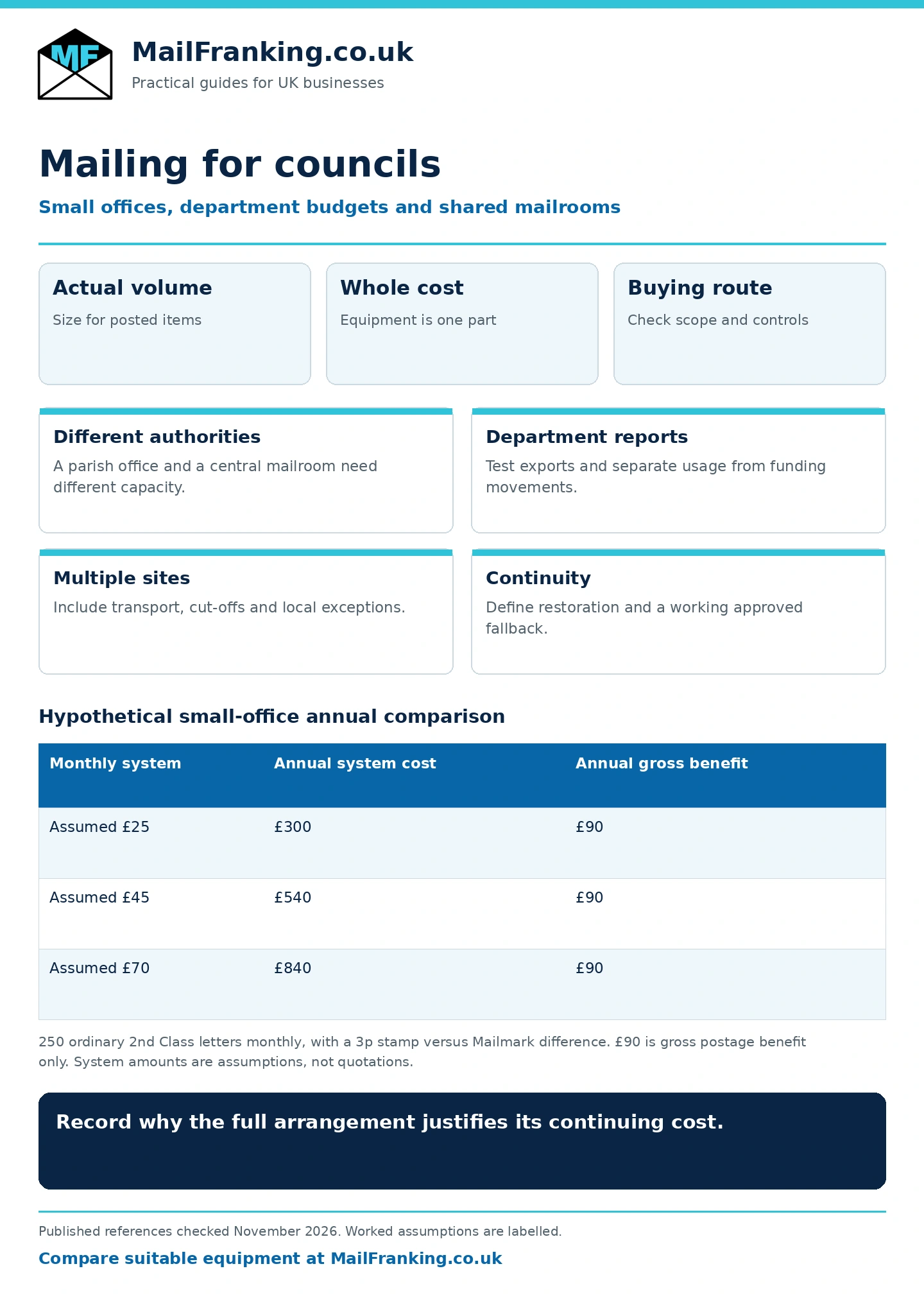
Consider a hypothetical office sending 250 ordinary 2nd Class letters monthly and currently buying stamps. Mailmark postage would be £220 against £227.50 in stamps, a £7.50 gross difference. The following equipment allowances are examples for calculation, not supplier offers or a claim about the minimum price available.
| Monthly system allowance | Annual system cost | Annual gross postage difference |
|---|---|---|
| Assumed £25 | £300 | £90 |
| Assumed £45 | £540 | £90 |
| Assumed £70 | £840 | £90 |
At the assumed £25 monthly cost, ordinary-letter savings leave an annual £210 gap before any additional costs or operational benefits. The authority may value more convenient dispatch or allocation, but it should make that reasoning explicit. The decision becomes less clear if expected postal volumes are declining during the term.
For larger offices, the same principle holds: more letters create more gross benefit, but automation and service packages also cost more. Our savings calculator guide explains how to include equipment and mail mix rather than treating the postage difference as net financial savings.
What equipment prices can tell you
Pitney Bowes publishes general UK guidance of around £500–£1,000 for entry-level purchase and £15–£100 or more monthly for leasing, depending on features. These are broad equipment references, not council framework prices or a complete quotation. Confirm the VAT basis and inclusions directly.
Request equipment, finance, meter arrangements, installation, training, maintenance, supplies and software as distinct lines. Identify fixed charges, usage charges, inflation provisions and postage funding fees. The rental guide helps compare term commitments, while the hidden-cost guide covers common omissions.
A hypothetical £120 monthly system costs £7,200 over 60 months before increases and excluded costs. Its quoted payment should not be compared with a purchase price that excludes service, or with a wider postal contract that includes usage. Compare equivalent services over the same evaluation period and use the authority’s appropriate VAT treatment.
Different equipment for different council offices
Compact manual-feed equipment can suit a small administrative office if its recurring workload is manageable. Compare the Quadient iX-1 and SendPro Mailstation by the supplied UK configuration, usability, reporting and support. Do not pay for a large machine solely because the customer is a public body.
A central mailroom with recurring batches should compare desktop and automatic-feed options using actual filled envelopes. The manual versus automatic guide explains feeding differences. For higher sustained output, use our high-volume guide to frame a trial that includes preparation, weighing and exceptions.
Ask suppliers to demonstrate normal mixed mail as well as a clean uniform stack. Record accepted output, operator interventions and recovery after a stoppage. Advertised maximum letters per minute is useful as a specification reference, but it is not a reliable forecast for the entire council dispatch process.
Centralisation needs a physical transport model
A useful real-world example is the Cheshire East contract register entry, which describes three leased and serviced machines supporting offices in Crewe, Sandbach and Macclesfield. It illustrates a multi-site arrangement, not a universal recommendation to replace local equipment with one central system.
The value recorded for a broader postal arrangement should not be interpreted as the purchase price of an individual meter. Check what each public contract includes before using it as a pricing benchmark. Postage usage, collection and associated services can make a headline contract value unsuitable for equipment comparison.
In your own model, include internal transport, secure holding space, collection frequency, local late items and staff time. If retaining one central machine removes local access, specify how essential exceptions are dispatched. An efficient central routine should not rely on unbudgeted journeys or staff buying postage personally when a cut-off is missed.
Report costs by department and reconcile funding
Ask finance which cost centres it actually needs, how often reports are required and what format its systems accept. Demonstrate the quoted accounting package using fictional departments. Include an incorrect allocation, a correction and a month-end export rather than accepting a screenshot of a report that may belong to an optional upgrade.
Reconcile usage with funding movements and supplier invoices. Adding £5,000 of postage credit does not establish that £5,000 was consumed during that month. Separately identify funding fees, equipment charges and remaining balances. Otherwise a timing change in top-ups can look like a departmental postage increase.
Determine who may change account codes, authorise funding and access reports. Keep the process proportionate: a small council may need only a simple operational record, whereas a shared service may need consistent department mapping across several devices. The number of available codes is less useful than a reliable export that supports an actual budget decision.
Procurement routes and the wider postal requirement
The Government Commercial Agency’s Postal Services & Solutions framework RM6280 covers public and third-sector postal requirements. Its published structure includes franking machines and mailroom equipment in Lot 1, with other lots addressing services such as collection and delivery, hybrid mail and managed processes.
Use the current buyer guidance and ask the authority’s procurement team to confirm eligibility, scope and the appropriate award route. A commercial comparison quotation is not automatically a framework quotation or a compliant call-off. Framework availability does not remove the need to follow the authority’s own controls and the applicable rules.
Define the requirement before selecting the route. A meter replacement, an outsourced production service and a corporate postal contract are different purchases. Procurement arrangements also depend on jurisdiction, contract history and scope; do not apply a single simplified threshold or procedure to every council across the UK.
Compare hybrid mail and recurring bulk production
Repeatable council correspondence may justify a comparison between in-house production and hybrid mail. Request a price for the same documents, sheets, envelope, service and dispatch schedule. Include file preparation, approval, reprints, exceptions and any minimum commitment, rather than comparing a print-and-post figure with postage alone.
Where a supplier proposes account or bulk-mail services, ask which product the actual batches qualify for and what preparation is required. A large monthly total assembled from many small unrelated runs does not establish eligibility for every batch offer. Keep the assumptions and any qualifying conditions visible in the business case.
Central equipment and outsourcing can serve different work. A regular corporate run may be produced externally while local offices retain an approved route for unusual packs and late correspondence. Assign ownership for rejected files, returned items and reconciliations so the handover between arrangements remains workable.
Demonstrate controls, continuity and a declining-volume case
Use fictional resident details and representative stationery for demonstrations. Check window alignment, document matching, access, secure trays and interrupted-batch recovery. A machine’s ability to print postage does not validate the contents or prove receipt. Relevant information governance controls should cover the full preparation and dispatch process.
Require written support arrangements, including escalation, supplies, response and restoration expectations. Confirm an approved fallback for essential correspondence during an outage. A promise of telephone response is different from a working replacement or restored production, so define the result the council needs and what the price covers.
Finally, evaluate a lower-volume scenario over the proposed term. Digital services, site changes and production outsourcing may reduce meter use while fixed payments continue. Request comparable itemised quotations, trial the equipment and retain the decision record showing why the selected arrangement serves the authority’s actual work at a justified whole cost.
Frequently asked questions
Some may find one useful, but low ordinary-letter volumes often produce limited gross savings. Count the actual annual workload and compare it with fixed equipment costs. Convenience and reporting can still matter, provided the council values them explicitly and follows its own purchasing and approval arrangements.
Many systems support department codes, but software, capacity and exports vary. Test the exact quoted configuration using fictional cost centres, corrections and a month-end reconciliation. Keep postage consumed separate from credit loaded. A useful finance export matters more than a large advertised number of available accounts.
Government Commercial Agency framework RM6280 includes postal services and franking equipment. Check current buyer guidance, eligibility, lot scope and award procedures with your procurement team. A quotation obtained commercially is not automatically a framework offer, and the authority still needs to follow its internal controls and applicable rules.
Compare the complete physical workflow first. Centralisation may reduce duplicated equipment but add internal transport, secure storage and late-item handling. Model those costs and dispatch cut-offs alongside reporting. Several local devices can be appropriate where their continuing cost is justified by the service each location needs.
An ordinary franking impression does not by itself establish receipt or satisfy every communication requirement. The authority should specify the appropriate service, dispatch procedure and records for the particular notice. Confirm that the equipment and postal handover support those requirements rather than treating meter reports as complete evidence.
Compare equivalent configurations over the same period, including service, supplies, software, funding charges, increases and exit arrangements. Separate equipment from postage usage and wider postal services. Use consistent VAT assumptions, a realistic annual workload and a declining-volume scenario, then demonstrate the proposed process with representative mail before committing.