

The best franking machine for a law firm is one that handles its document mix reliably, records spending at the right level and fits the dispatch controls used by the practice. A small conveyancing office, a litigation team and a shared legal mailroom can have very different requirements even when they spend the same amount on postage.
Start with three practical questions: how many prepared envelopes leave each office, how many need a client or matter reference, and which items require a particular postal service or posting record? This guide builds a shortlist around those needs and uses clearly labelled calculations to assess the financial case.
Match equipment to the legal work
A firm sending a modest number of mixed letters may value a compact meter more than an automatic feeder. A central team processing completed batches may benefit from reduced envelope presentation. Thick packs create a separate requirement: they may need labels rather than direct printing and a platform capable of supporting the packed item properly.
The Quadient iX-1 review covers a compact manual option. The iX-4 vs SendPro C comparison examines larger desktop packages, while the automatic-feed comparison suits firms with repeated batches. These are requirement-based candidates, not claims that one model is universally best for solicitors.
- Takes 2 minutes
- Receive quotes to compare
- Easy and no commitment
| Practice requirement | Equipment direction | Demonstration priority |
|---|---|---|
| Few varied letters each day | Compact manual meter or existing online route | Simple selection and reliable cover use |
| Many client-coded envelopes | Meter with suitable enabled accounts and exports | Correct allocation and reconciliation |
| Repeated prepared batches | Confirmed automatic-feed configuration | Successful output without rework |
| Bulky case or transaction packs | Suitable platform and compatible labels | Physical support and service workflow |
Client accounting is not always matter accounting
A product listing a number of accounts may support departments but still be awkward for thousands of live matters. Explain the identifier structure to the supplier before discussing software. Ask how accounts are created, searched, closed and exported, and whether the operator can accidentally charge a job to a default account.
Request a sample report containing the fields your finance team actually needs. A monthly total for conveyancing is different from a transaction-level file that can be matched to a matter ledger. Do not assume a general dashboard integrates with your practice-management system merely because both can export a spreadsheet.
For a controlled test, create ten fictitious matters and process a mixed batch. Close one identifier, correct an allocation and export the results. Measure the work needed to reconcile the file. If a more expensive package saves an hour monthly at an assumed £30 loaded administrative cost, the modelled value is £360 annually.
What should a law firm budget?
Equipment, reporting, service, supplies and postage should be separate lines. There is no verified universal solicitor-specific tariff. Obtain a quotation for the exact hardware, enabled accounts, software users and support package. Ask whether additional branches or report access create recurring charges.
- Give your requirements
- Receive quotes to compare
- Choose a provider or walk away - your choice!
The following figures are illustrative complete-system allowances, not supplier quotations. They exclude postage and assume no price increases. Their purpose is to show the commitment that a seemingly modest recurring payment creates, especially where the firm expects more correspondence to move online.
| Assumed monthly allowance | Annual amount | 36-month amount | 60-month amount |
|---|---|---|---|
| £45 | £540 | £1,620 | £2,700 |
| £80 | £960 | £2,880 | £4,800 |
| £140 | £1,680 | £5,040 | £8,400 |
Add any existing finance settlement only once and show overlapping service commitments separately. Buying new equipment does not automatically end the old agreement. Our rental guide explains the contract questions, and the hidden costs guide helps identify excluded charges.
Worked example: ordinary letters and document packs
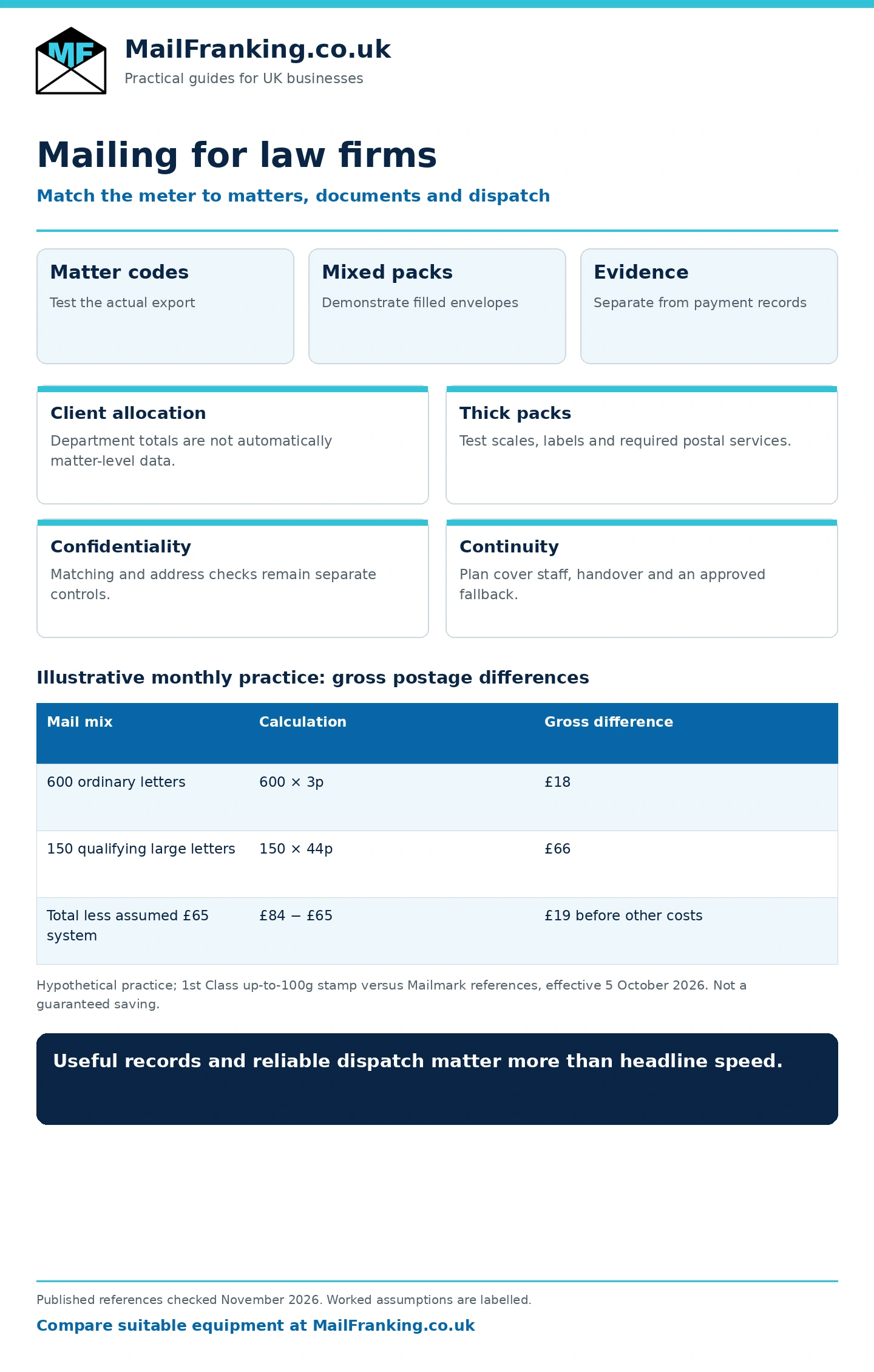
Assume a practice sends 600 ordinary 1st Class letters and 150 1st Class large letters up to 100g monthly. Using the November-checked Royal Mail references, ordinary letters cost £1.77 through Mailmark against £1.80 by stamp; those large letters cost £2.86 against £3.30. The gross saving is £18 plus £66, or £84 monthly.
The references are in the Mailmark wallchart and October 2026 retail price guide. Deduct an assumed £65 complete monthly system allowance and the example leaves £19 before other costs. This is a hypothetical practice, not an expected saving for every firm.
If the baseline is already online postage, use those actual prices instead of stamps. If the packs exceed the stated weight or format, recalculate them. Add labels, collection and administration where not included. A mail profile built from invoice evidence is more reliable than a savings percentage taken from an unrelated mailing example.
Choose services around the correspondence
Routine invoices, original documents and time-sensitive correspondence should not automatically follow one default service. Agree the decision process with the practice team and demonstrate each required postal product on the quoted setup. A familiar product name on a touchscreen does not establish that every barcode or supplementary step is included.
A franking impression records payment; it should not be treated as automatic evidence that the physical item was accepted, delivered or legally served. The firm’s responsible legal team should determine the service and evidence appropriate to each task. Keep the equipment selection separate from that professional decision.
Test the handover procedure for important items as carefully as the print process. Identify who checks the selected service, prepares the required paperwork, retains the acceptance evidence and records exceptions. A fast meter is of limited value if an urgent pack waits uncollected on a desk.
Confidentiality starts before the meter
The most consequential error may be a document in the wrong envelope rather than an incorrect postage amount. Check address sources, window alignment, insert matching and the handling of returns. Keep completed and uncompleted batches distinct so that interrupted work can be resumed safely.
The ICO’s information security advice provides the broader context for handling personal information. A franking machine does not certify a firm’s confidentiality arrangements. Assess who can access the workstation, reports and rejected envelopes, and use suitable fictitious data in demonstrations.
For outsourced mail, examine the data-processing arrangement and document controls separately from equipment economics. Ask how originals, sensitive packs and exceptions are handled. Our hybrid mail comparison helps compare preparation routes without assuming that every legal communication is suitable for outsourcing.
Thick envelopes and mixed formats
Test completed packs rather than empty stationery. A document wallet can be light but too thick for a chosen service or the transport. An automatic feeder may be appropriate for routine envelopes while a small number of larger packs still need manual labels and a separate handover process.
Record the proportion of work outside the machine’s direct-print limits. If 15% of items need special handling, include that time in the trial. Do not assign the full batch a production speed that only applies to thin standard envelopes. The usable platform size matters as much as its maximum stated capacity.
Compare the cost of changing stationery where an otherwise attractive machine requires different envelope stock. A small increase on thousands of envelopes can offset a lower rental. Ask for an approved stock specification and retain a sample batch used during acceptance so subsequent supply changes can be checked.
Branches, shared mailrooms and cost allocation
One central system may improve reporting but create transport and cut-off problems for branch offices. Measure how work reaches the central point and whether local staff still need an alternative for urgent post. Consolidation should include these costs, not only the number of meters removed.
Build branch and practice-area totals around a stable account structure. Decide who can amend identifiers and how unallocated usage is resolved. If client references contain personal information, minimise what is stored or exported according to the firm’s own policies and practical requirements.
Suppose centralisation removes two assumed £45 monthly packages but adds £60 of internal transport and handling each month. The remaining £30 improvement is £360 annually before setup and transition costs. The arrangement may still improve control, but its financial case is smaller than a simple £1,080 equipment saving suggests.
Consumables, service and continuity
Request ink and label prices for the exact unit, together with expected usable yield, delivery and permitted supplies. Additional envelope messages and test prints can affect consumption. For client charging, decide whether the accounting process records postage alone or also handles a separate agreed cost basis; the meter does not decide that policy.
Check service hours against the firm’s posting deadlines. Establish diagnosis, engineer attendance, parts and replacement arrangements, and whether software faults have the same support route as hardware faults. A response promise is not the same as having working equipment before the last collection.
Keep an approved fallback and train a cover operator. Test what happens if postage cannot be loaded or the network is unavailable. Use our maintenance guide and funding guide to compare the contractual detail without assuming every service-inclusive offer covers the same risks.
How we would select a shortlist
Score candidates against actual requirements: matter allocation, mixed-pack handling, service selection, posting evidence, continuity and whole-contract cost. Weight the items according to the practice. A small office may put simplicity first, whereas a shared mailroom may value exports and controlled account selection more highly.
Ask each supplier to process the same anonymised batch and provide the same cost schedule. Record elapsed time, exceptions and report quality. Check current support and licensing for the exact UK meter, particularly for refurbished offers, through an appropriate authorised supplier.
Choose the smallest package that demonstrably meets the requirement with acceptable support. Recalculate at lower volumes before signing a long commitment. A credible proposal should remain understandable when the impressive speed claim is removed and the decision is reduced to successful dispatch, useful records and a complete annual cost.
Keep an acceptance record for future changes
Retain the approved envelope samples, report specification, model identifier and enabled software with the supplier documents. When the practice changes stationery, its matter structure or its case-management process, check whether those assumptions still hold. A reliable original demonstration is less useful if later changes quietly move the workload outside the tested configuration.
Review account accuracy as well as total spending during the first month. Look for default allocations, repeated corrections and items requiring manual labels. Discuss the results with the operator and finance before expanding the system to other teams. This identifies whether the expected benefit is coming from actual work removed or simply from a more attractive report presentation.
Frequently asked questions
A compact supported meter may suit modest mixed correspondence, provided it handles the required accounts, envelopes and services. Compare a manual option with the firm’s current online route before buying. The best choice depends on actual workload and reporting needs, not simply the number of solicitors or the machine’s advertised speed.
Potentially, but account limits and reporting vary by configuration and software. Demonstrate your identifier structure, export format, corrections and closed matters. Department totals are not automatically detailed matter records. Ask finance to test the output before assuming a dashboard will integrate with the practice-management or billing system.
A printed payment impression should not be treated as automatic proof of acceptance, delivery or valid legal service. The responsible legal team should choose the appropriate method and evidence for the particular communication. Test how the equipment supports that process and retain the relevant handover records separately from meter usage.
It depends on their completed dimensions, thickness, weight and the machine’s material limits. Some packs need compatible labels or a different workflow. Demonstrate representative filled envelopes and confirm the correct postal format. A device’s physical thickness allowance does not change Royal Mail’s conditions for a letter or large letter.
Only if transport, cut-offs and urgent exceptions work in practice. Compare avoided equipment costs with internal handling, branch fallback arrangements and reporting administration. A central system can improve control while creating dispatch delays, so run a representative trial before removing local equipment or agreeing a larger replacement package.
The shortlist follows published product capabilities and practical law-firm requirements, including account allocation, mixed documents and continuity. It is not based on a hands-on comparative test. Final selection should use an anonymised batch, a finance-approved export and a complete quotation for the exact supported UK configuration.