
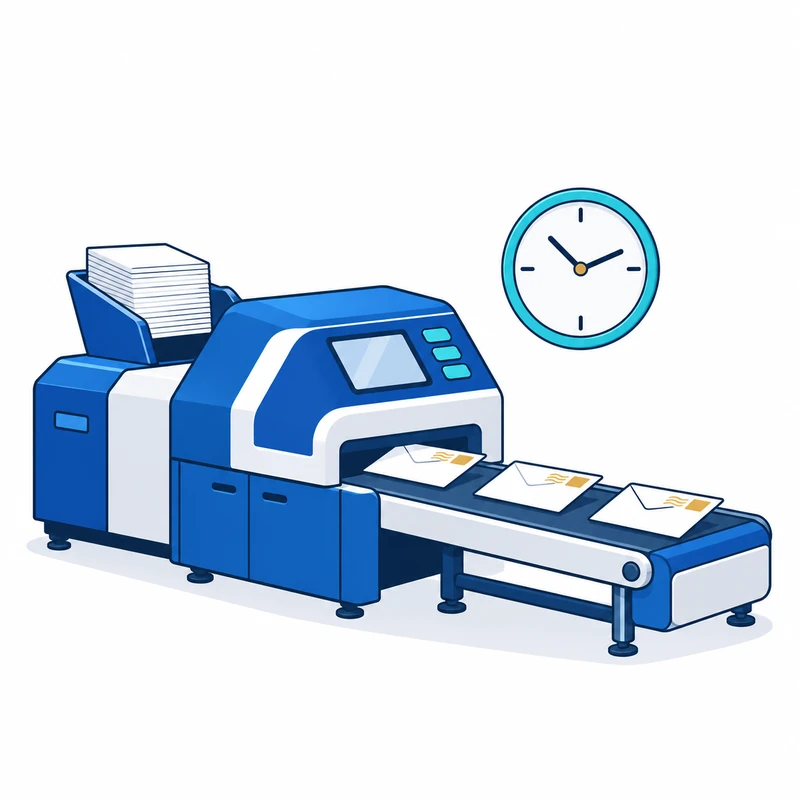
The best franking machine for a busy office is the one that clears its real daily workload reliably at a justified total cost. A high advertised speed helps only when the feeder, weighing method, sealing, operator and dispatch process can support it.
This guide compares medium and high-volume options for UK businesses, including current Quadient models, Pitney Bowes equipment and existing FP and Frama systems worth assessing. It also provides published equipment-price references, timed-batch calculations and a practical method for comparing complete proposals.
Our shortlist by mailing requirement
| Requirement | Machines or families to assess | Main reason to compare |
|---|---|---|
| Growing office with prepared batches | Quadient iX-6 HF / AF; supported FP PostBase configurations | Feeding, accounting and weighing features at office scale |
| Busy automatic-feed office | Pitney Bowes SendPro C Auto / Auto+; Quadient iX-8 | Reduced repeated hand-feeding and a more efficient batch process |
| Production mail centre | Quadient iX-9; Pitney Bowes SendPro P3000 | High throughput with the appropriate feeding and weighing configuration |
| Existing supported Frama installation | Matrix F62 or F82 | Compare remaining support, handling and total replacement cost |
| Used or refurbished proposal | Exact eligible UK model and meter | Condition, service life, supported products and complete price |
This is a task-based shortlist, not a claim that one manufacturer wins every category. Different configurations within a family can change throughput and functionality. Ask for a quotation and demonstration of the exact unit, including its weighing, feeding and software options.
Our small-business guide covers lower volumes. If the main issue is deciding whether equipment is worthwhile at all, start with the savings calculator. Buying a faster machine does not create a bigger standard Royal Mail discount for the same item.
- Takes 2 minutes
- Receive quotes to compare
- Easy and no commitment
Current Quadient options: keep the UK range clear
Quadient’s UK and Ireland catalogue distinguishes current UK-listed iX-1, iX-4, iX-6, iX-8 and iX-9 options from pages labelled Ireland-only. This matters when an older iX-3, iX-5, iX-7 or IS-6000c listing appears in a search result. A model available elsewhere is not automatically a current UK new-machine offer.
| Current listed model | Manufacturer’s maximum processing speed | Feed type in comparison table | Manufacturer’s daily selection guide, not a technical limit |
|---|---|---|---|
| iX-4 | Up to 45 letters/minute | Manual feeding in the UK brochure | 100 letters |
| iX-6 | Up to 110 letters/minute | HF assisted / AF automatic; confirm exact configuration | 350 letters |
| iX-8 | Up to 175 letters/minute | Automatic | 2,000 letters |
| iX-9 | Up to 300 letters/minute | Automatic | 5,000 letters |
The usage figures and maximum speeds are different specifications. A machine’s short-run maximum does not mean that multiplying its letters-per-minute figure by an eight-hour day gives a sensible daily workload. The operator, mail mix, handling and maintenance affect real output.
Treat the iX-6 as an office-scale comparison and test whether semi-automatic feeding meets the workload. For the iX-8 and iX-9, specify the feeding, weighing and output arrangement in the proposal. Do not infer that every optional system shown on a product page is included in a base price. The linked iX-4 review uses the UK brochure’s manual-feed specification; the iX-6 review separates HF from AF. Treat web-table daily guidance as a selection aid and time your own batches.
Pitney Bowes automatic-feed and production systems
The SendPro C Auto family is relevant when staff spend time hand-feeding repeat batches. Its published maximum is up to 120 letters per minute. Compare C Auto and Auto+ as configured offers, including software and service, rather than assuming the plus designation simply means a faster feeder.
- Give your requirements
- Receive quotes to compare
- Choose a provider or walk away - your choice!
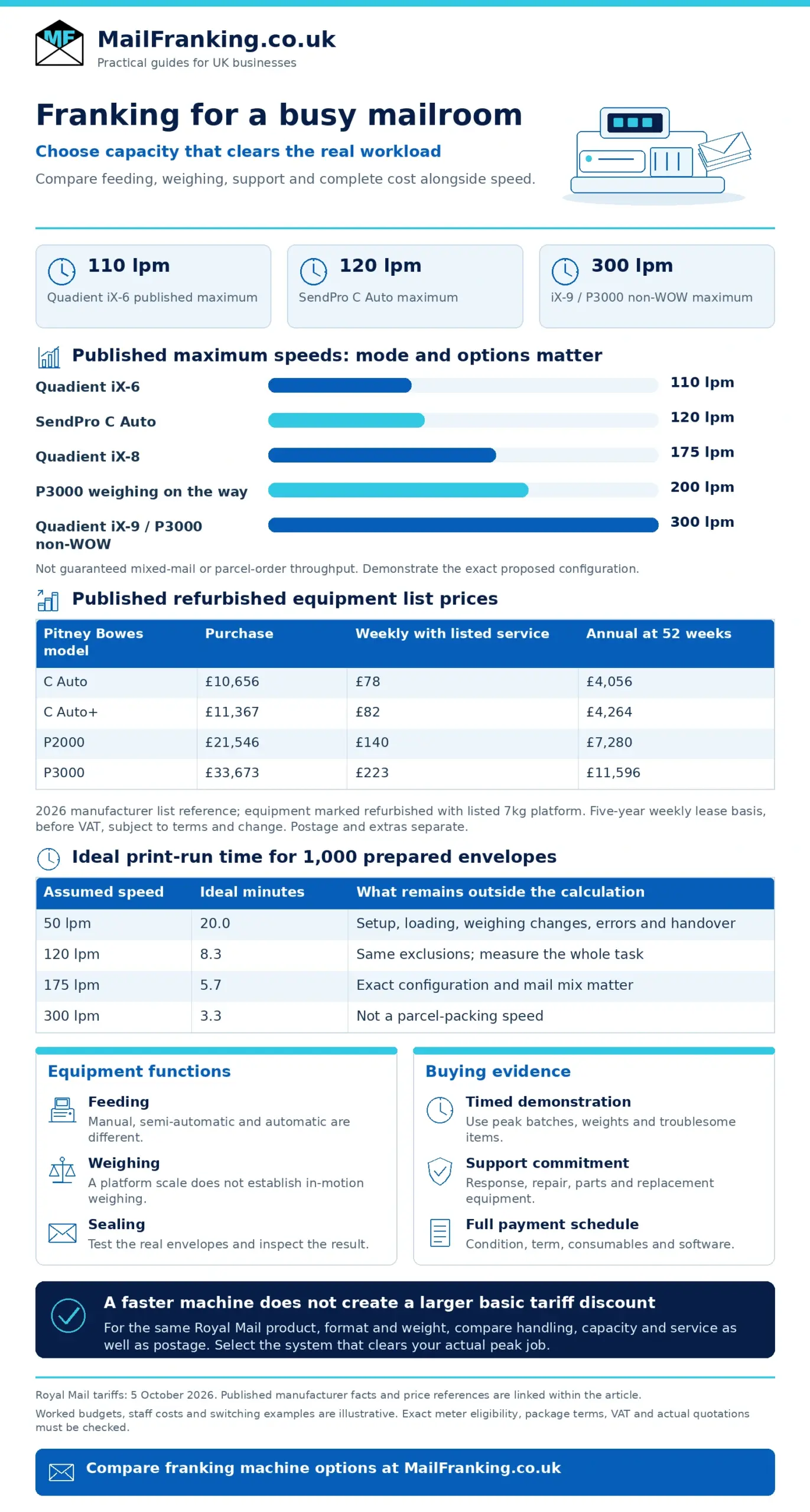
For production mailing, the SendPro P3000 specifications identify mode-dependent throughput: up to 300 letters per minute without weighing on the way and up to 200 in its weighing-on-the-way mode. Use the relevant mode when assessing a mixed-weight job.
A demonstration should show how the unit selects the actual format, weight and postal product you need. If parcels are part of the workload, assess the shipping-label process separately. A 300-letter-per-minute headline is not a claim that the machine can prepare 300 individually packed ecommerce orders each minute.
Read our detailed C Auto review and P3000 review for the model-specific buying checks. Ask who will provide service and which parts and accessories are covered for the whole proposed term.
Published prices: keep refurbished equipment identified
Pitney Bowes’ 2026 list-price document gives specific figures for equipment marked refurbished. The table below preserves that condition label and the stated five-year weekly lease basis. These are published list references, not an assurance of stock or a current tailored quotation. Prices exclude VAT and are subject to the document’s conditions and subsequent changes.
| Refurbished model with listed 7kg platform | Purchase list price | Weekly five-year lease | Weekly lease including listed inclusive service | Listed annual inclusive service |
|---|---|---|---|---|
| SendPro C Auto | £10,656 | £57 | £78 | £1,070 |
| SendPro C Auto+ | £11,367 | £61 | £82 | £1,070 |
| SendPro P2000 with shipping | £21,546 | £115 | £140 | £1,245 |
| SendPro P3000 with shipping | £33,673 | £180 | £223 | £2,169 |
For budgeting, £78 weekly is £4,056 over 52 weeks, equivalent to £338 per calendar month. At 260 assumed weekly payments, the amount is £20,280. The corresponding £223 weekly P3000 figure is £11,596 annually and £57,980 across 260 payments, before postage and any extras outside the package.
Do not add the separately listed annual service figure on top of a weekly price that already includes that service. Conversely, do not assume the equipment-only weekly column includes it. Confirm ink, labels, funding, software and the precise maintenance exclusions in the written offer.
For Quadient, FP and Frama comparisons where the exact UK configuration is quotation-led, request an itemised price rather than assigning a made-up market price to a specific model. A numerical budget can still be useful, but it must be labelled as a planning scenario rather than a manufacturer tariff.
Existing FP and Frama equipment
An existing supported machine may remain economical if it can handle the required services and its peak workload. Our FP PostBase Vision review compares the older configurations and the checks needed for an actual UK offer. Confirm the currently available replacement range with the supplier.
For Frama, the Matrix F62 and F82 are automatic-feed systems worth assessing where offered with appropriate support. Their published maximums are 5,500 and 8,500 items per hour respectively. Converted averages are about 91.7 and 141.7 items per minute, but an hourly maximum does not make every mixed-mail run perform at that rate.
Do not reject or retain equipment solely on age or the original badge. Establish the exact meter’s eligibility, service scope, parts availability and the written support commitment. Include the cost of disruption, installation and retraining when comparing retention with replacement.
How much faster is a faster machine?
Start with the size of a real batch and the available processing window. Dividing quantity by maximum letters per minute gives an ideal print-run time, useful for comparison but excluding setup, loading, errors, weighing changes, sealing adjustments and handover.
| Assumed maximum speed | Ideal time for 1,000 prepared envelopes | Ideal time for 3,000 prepared envelopes |
|---|---|---|
| 50 letters/minute | 20 minutes | 60 minutes |
| 110 letters/minute | 9.1 minutes | 27.3 minutes |
| 120 letters/minute | 8.3 minutes | 25 minutes |
| 175 letters/minute | 5.7 minutes | 17.1 minutes |
| 200 letters/minute | 5 minutes | 15 minutes |
| 300 letters/minute | 3.3 minutes | 10 minutes |
At an assumed loaded labour cost of £18 per hour, reducing the ideal 1,000-item run from 20 minutes to 8.3 minutes releases about £3.50 in staff time. Over 22 such runs it is about £77 monthly. That can support an equipment decision, but it is not automatically a reduction in wages.
The theoretical improvement from 120 to 300 letters per minute on that same batch is only five ideal minutes, worth £1.50 at the assumed hourly cost. Real advantages may lie in mixed-mail weighing, sealing, reliability and reporting rather than print speed alone. Test the complete operation before paying a large premium.
Feeding, weighing and sealing are separate decisions
Manual feeding requires the operator to present items individually. Semi-automatic designs reduce some handling but should be tested on your own envelopes. Automatic feeders can process a loaded batch, subject to the machine’s permitted sizes, thicknesses and preparation requirements.
Our manual vs automatic franking guide shows how to time the complete job and compare the extra equipment cost with useful staff capacity. For the iX-6 specifically, distinguish HF assisted feeding from AF automatic feeding; the family name and maximum speed do not identify which configuration a quote includes.
Static weighing means weighing an item on a platform. Differential weighing uses changes in a batch’s weight as items are removed. In-motion or weighing-on-the-way systems assess items as they travel through the system. These functions are not interchangeable, and a supplied scale does not prove that dynamic weighing is installed.
Sealing also needs a practical test with your envelopes and inserts. Ask staff to inspect a sample after processing. If they must manually reseal a substantial part of the batch, the advertised feeder speed may have little relationship to the useful end-to-end time saving.
Measure the space as well as the base unit. Feeder, scale, stacker, output clearance and operator access all count. Check the power and supported network connection, and make sure installation requirements are clear before delivery.
Build a whole-cost comparison
Use a common term and workload for every quote. Include equipment, service, supplies, funding fees, installation and expected return costs, with postage shown separately. Identify new versus refurbished equipment and make sure all proposals cover the same reporting and shipping functions.
| Illustrative monthly operating category | Office automatic-feed scenario | Production-system scenario |
|---|---|---|
| Equipment and service allowance | £350 | £1,000 |
| Ink and labels allowance | £100 | £250 |
| Funding and software allowance | £20 | £50 |
| Total before postage and VAT | £470 | £1,300 |
| Annual equivalent | £5,640 | £15,600 |
These are planning examples, not quotes for named models. At a 3p saving on ordinary letters, £470 requires 15,667 items monthly to cover those costs through postage alone. At a 44p saving on qualifying First Class large letters against stamps, it requires 1,069 items. Change the baseline to online postage and recalculate.
Higher-volume equipment is often justified by a combination of labour, reliable throughput, departmental controls and postage savings. It should not be sold on a uniform percentage that ignores your postal mix. The hidden-cost checklist helps turn a headline payment into a comparable total.
For suitable standard-letter batches, investigate Business Mail Advanced separately. Check the qualifying rules, final account adjustments and your VAT recovery before treating an advertised bulk-mail discount as a net saving. For standard digital correspondence, include hybrid print-and-post as a separate production route. Compare printing, inserting, postage and retained administration on the same basis rather than equating outsourced fulfilment with postage alone.
Our selection method and demonstration checklist
The shortlist uses manufacturer-published UK specifications, clear model and country identification, available price evidence and practical relevance to growing offices or production mailing. It is a desk-based buying comparison, not a hands-on laboratory test or a claim that we have measured each machine’s actual throughput.
Ask each provider to process a representative sample containing ordinary letters, large letters, different weights and the envelopes that cause problems today. Record total elapsed time from prepared batch to reconciled dispatch. Include loading, sealing, rate selection, reprints and the export your finance team needs.
Request written answers on support hours, response versus repair commitments, consumables, replacement equipment and software-data access. Check how the agreement handles a fall in volume and whether an upgrade restarts the term. Existing commitments should be assessed using our supplier-switching guide.
Finish with an itemised proposal from eligible suppliers for the configuration that passed the test. Choose the machine that clears the real job economically and reliably, with enough capacity for your known peaks. Maximum speed is evidence to examine, not the decision by itself.
Frequently asked questions
There is no single universal daily threshold. In this guide, the term describes systems designed for substantial office batches or production mail, typically with automatic feeding and additional weighing or reporting options. Compare your peak batch and deadline with the manufacturer’s recommended workload and a practical demonstration.
Current published comparisons include the Quadient iX-9 at up to 300 letters per minute and the Pitney Bowes P3000 at up to 300 without weighing on the way. Mode and configuration matter: the P3000’s published weighing-on-the-way maximum is lower. Actual end-to-end throughput needs testing with your mail.
Configured quotations vary. As a specific reference, Pitney Bowes’ 2026 list identifies a refurbished C Auto at £10,656 to purchase and a refurbished P3000 at £33,673, before VAT and subject to conditions and changes. Compare the full service, finance and consumables schedule rather than those purchase figures alone.
Not on the same standard Royal Mail item simply because it is faster. Postage depends on the product, format, weight and applicable tariff. Higher-capacity equipment may justify its extra cost through handling, weighing, sealing, reporting and reliable peak capacity, alongside the postage saving on the actual mail mix.
It can be worth comparing where the exact UK meter remains eligible and the provider offers suitable support. Confirm condition, included accessories, service scope, parts, postal functions and the support term. Preserve the refurbished label when comparing prices and assess installation and disruption as part of the total.
Use real envelopes, weights, inserts and reports. Time the complete process, including loading, weighing, sealing, reprints, sorting and reconciliation. Test the actual proposed configuration and ask the supplier to explain any differences from the advertised maximum speed. Keep the results with the quotation for comparison.